NDSU professor recognized as a worldwide microbiology leader
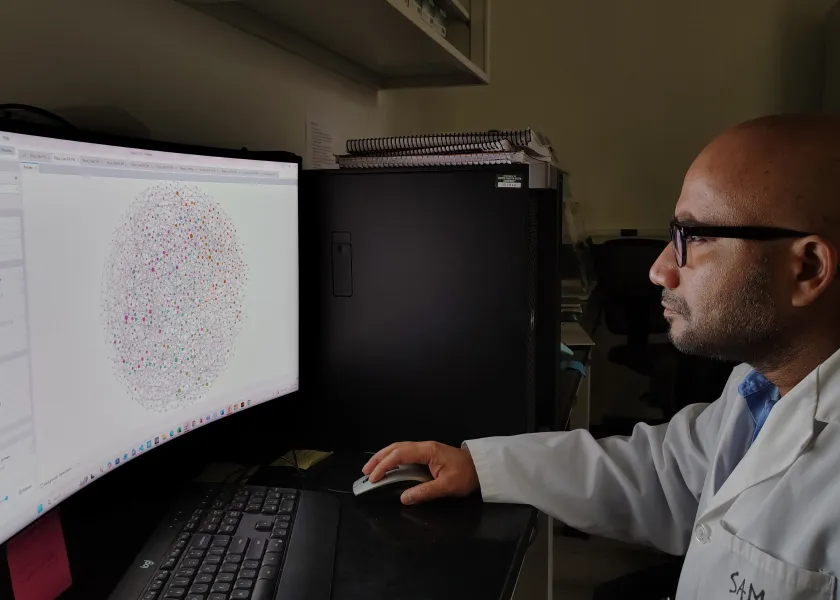
Samiran Banerjee, NDSU assistant professor of microbial ecology, has been named to the 2025 Clarivate Highly Cited Researchers list. As one of only 6,868 researchers worldwide to be recognized, Banerjee is also among only 168 microbiological scientists and is the lone NDSU researcher selected for this year’s list.
Researchers included on Clarivate’s list are recognized for their substantial and wide-ranging impact within their respective fields. Each researcher selected has authored multiple Highly Cited Papers, publications that rank among the top 1% by citations for their field and publication year in the Web of Science Core Collection throughout the past 11 years. However, while citation performance is a key factor, it is not the only criterion for evaluation. The list is further refined using additional quantitative measures, qualitative evaluation and expert judgment to ensure a comprehensive assessment of influence.
Banerjee joined NDSU in 2019. His group works on fundamental microbiomics, with a particular focus on understanding the associations between microbes.
“Much of our work explores how soil health, nutrient cycling, and microbiome dynamics influence crop productivity, environmental quality and broader One Health outcomes,” he said.
Over the past six years, Banerjee’s team has led several large-scale projects across the state, working with more than 150 producers, extension specialists and researchers to collect in excess of 5,000 soil and plant samples. A cornerstone initiative, the North Dakota Agricultural Microbiomes Project, sampled 201 farmer fields across 51 counties and generated one of the most extensive datasets of agricultural microbiomes in the United States.
“Our collaborations with NDSU’s Research and Extension Centers have established a statewide network that links research innovations directly to producer needs and priorities,” Banerjee said.
“We are thrilled to recognize Dr. Banerjee for his extraordinary early-career accomplishments,” said NDSU interim vice president for research and creative activity Heidi Grunwald. “To achieve such a high citation impact in the competitive field of microbiology so rapidly is a testament to the rigor, originality and immediate relevance of his work. Dr. Banerjee’s use-inspired research has direct implications for the soil health of North Dakota, crop yields, animal health, and human health.”
Banerjee’s most frequently cited research involves his work on keystone taxa and microbe-microbe associations. His 2018 article in Nature Reviews Microbiology presented a framework for identifying keystone taxa. It highlighted how these microbes — often low in abundance but highly interconnected — shape community structure, stability and ecosystem functioning.
“This concept has since been widely adopted in microbiome research across various fields, including soil, plant, environmental and human microbiomes,” Banerjee said.
“Being recognized as a Clarivate Highly Cited Researcher is a meaningful honor,” Banerjee said. “It reflects the global reach of our work on keystone taxa, microbial ecology [the study of microbial communities and their interactions with each other and their environment], and microbe–microbe associations, as well as the dedication of my students and collaborators. This recognition would not have been possible without the supportive environment at NDSU, which has allowed me to pursue ambitious ideas and build a research program that integrates fundamental science with practical applications. This distinction also highlights NDSU’s growing national and international presence in agricultural, environmental, and microbiome sciences.”
“I’m proud that we are home to one of the world’s most influential microbiologists,” said John McEvoy, NDSU professor and department head of microbiological sciences. “What makes Dr. Banerjee’s impact especially meaningful for our land-grant university is how directly his science serves grower needs. His statewide agricultural microbiomes project integrates microbiome, weather, soil, management, yield and crop-variety data to deliver practical soil-health and microbiome models for North Dakota agriculture. It’s world-class science delivering real-world value.”
Beyond citations, Banerjee’s lab is committed to producing innovative, societally relevant research outcomes. This includes integrating ecological theories, network science and microbiome data to gain predictive understanding of microbial communities. This predictive capacity is essential for developing sustainable practices and enhancing long-term resilience in food and environmental systems.
Specifically, the lab’s goals include:
• Studying the ecological principles that govern microbe-microbe interactions in soils and roots.
• Developing AI-assisted predictive tools that use network dynamics, microbial traits and soil health indicators to predict crop performance and environmental outcomes.
• Identifying keystone taxa that stabilize soil ecosystems and enhance nutrient cycling.
• Designing management practices that reduce microbial homogenization and restore the ecological functions provided by beneficial groups.
• Building a statewide open-access microbiome database to support research, agricultural management and policy decisions.
Banjeree’s lab consists of six doctoral students, one master’s student and two undergraduate students.
“As a graduate student in his group, I am fueled by his mentorship, which drives me to be an autonomous thinker and an independent scientist, said Debarshi Dasgupta, NDSU graduate research assistant. “He encourages critical thinking and pushes me to pursue complex questions in soil microbial ecology that can advance soil health and agroecosystem productivity. His input and support have been instrumental in my development as a doctoral student. Above all, Dr. Banerjee prioritizes the professional and personal growth of his students. I am happy to be a part of his vibrant and dynamic research group here at NDSU. "
“This work has strengthened my skills in both laboratory and computational methods, and it has given me a clearer vision of how microbiome research can drive innovation in agriculture, environmental stewardship and human health,” said Isha Pokhrel, NDSU graduate research assistant. “Being part of this research group has had a significant impact on my development as a scientist and has inspired me to pursue deeper, more rigorous questions in microbial ecology.”
For Banerjee, the rewards of research go beyond the essential data compiled and analyzed.
“I am inspired by the hidden microbial world beneath our feet, especially microbial community dynamics that orchestrate ecosystem functioning,” Banerjee said. “Research allows me to merge fieldwork, molecular biology, network ecology and computational modeling to uncover how these dynamics shape soil health, crop performance, biodiversity and resilience. Mentoring students is the most rewarding aspect of my work. I am fortunate to have an outstanding group of students in my lab. Their creativity and curiosity drive our lab’s innovations.”