NDSU researchers discover simple method to combat global ‘forever chemicals’
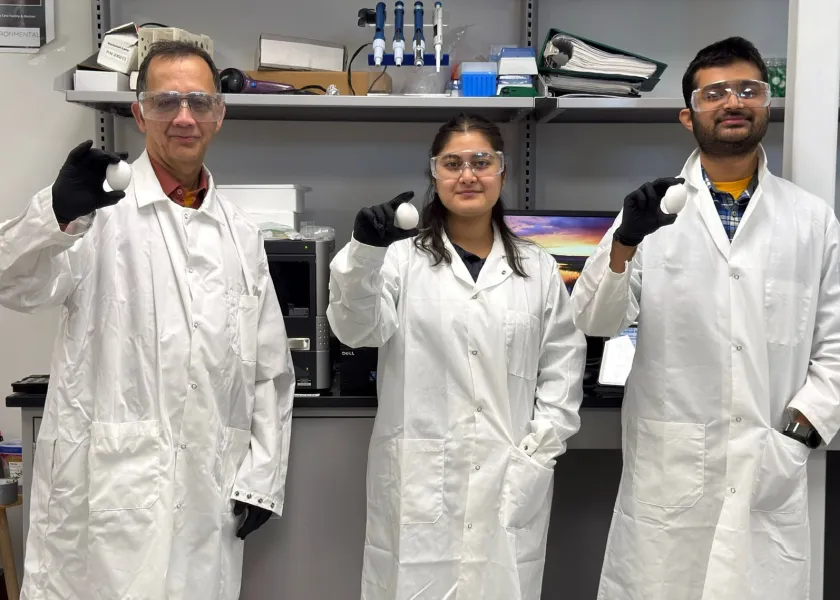
A collaborative research team led by North Dakota State University has discovered that ovalbumin, the primary protein found in egg whites, effectively binds and removes per- and polyfluoroalkyl substances (PFAS) from contaminated water.
PFAS are widely used in products such as nonstick cookware, waterproof fabrics, and firefighting foams and are often called “forever chemicals” because of their extreme persistence in the environment and in the human body. Exposure to certain PFAS has been linked to serious health risks, including cancer, liver damage and immune system disruption.
Led by NDSU professor Achintya Bezbaruah and Iowa State University associate professor Wenjie Xia, the team discovered that ovalbumin acts as a natural carrier protein that binds to and wraps around PFAS molecules, trapping them in a stable complex. The researchers hope that this property can be harnessed to develop scalable, bio-based materials for PFAS capture in water treatment systems and natural waters. Their research is reported in Cell Reports Physical Science.
The multidisciplinary team includes University of Central Florida associate professor Mohi Quadir, who examined the molecular architecture of ovalbumin and its binding with PFAS, and U.S. Environmental Protection Agency scientist Mallikarjuna Nadagouda, who focused on the practical needs of environmental engineers and water treatment facilities.
The researchers found that ovalbumin binds PFAS spontaneously and rapidly and shows particularly high affinity for PFOA (perfluorooctanoic acid) and PFOS (perfluorooctane sulfonate), two of the most scrutinized PFAS compounds due to their toxicity and persistence. Using molecular modeling and computational techniques, the team visualized ovalbumin/PFAS interactions at the atomic level and identified key amino acids, including arginine and lysine, as primary docking sites for the contaminants.
“Traditional PFAS cleanup methods, such as activated carbon or membrane filtration, can be expensive,” Xia said. “The potential use of egg-derived proteins represents a paradigm shift towards less expensive and green chemistry. Leveraging abundant natural proteins as bio-adsorbents offers an environmentally benign approach," he said.
"This breakthrough using egg white proteins to help mitigate PFAS contamination in the environment exemplifies how university research delivers practical solutions to pressing real-world problems,” said NDSU interim Vice President of Research Heidi Grunwald. “The translational science of turning a common household ingredient into a powerful tool against 'forever chemicals,' exemplifies our land grant mission and our researchers’ dedication to protect public health and ecosystems, showing once again how innovation from the lab directly enhances lives in our communities and beyond."
The project combined experimental precision with advanced computational modeling, providing valuable research experience for NDSU doctoral students Shirsa Mazumdar, Jimli Goswami and Amara Arshad. Mazumdar and Goswami demonstrated that ovalbumin could trap seven types of PFAS under diverse conditions.
“It’s remarkable that a simple egg white can offer such sophisticated environmental utility,” Mazumdar said. Goswami added that the discovery shows “the next great solution to a global crisis might be waiting right in our refrigerator.”
Arshad led the computational effort, visualizing interactions at the atomic level and pinpointing the amino acids critical for PFAS binding. “It was deeply rewarding to uncover how a simple protein can serve as a sophisticated tool against persistent contaminants,” she said.
“This work has laid the foundation for developing a bio-based adsorbent that is both easily available and highly effective,” Bezbaruah said. “By establishing a high-tech, industrial use for eggs as a starting material for bio-adsorbents, we also see potential new revenue streams for the poultry industry.”
"This breakthrough exemplifies the innovative spirit we cultivate within the College of Engineering at NDSU,” said NDSU Dean of Engineering Alan Kallmeyer. “By finding a sophisticated solution to a complex global challenge in something as common as an egg protein, our researchers are proving that sustainable, bio-based engineering is the future. This work doesn't just advance science; it offers a practical, scalable path toward cleaner water and healthier communities."
Read the full study online.