NDSU researchers working to improve highway work-zone safety
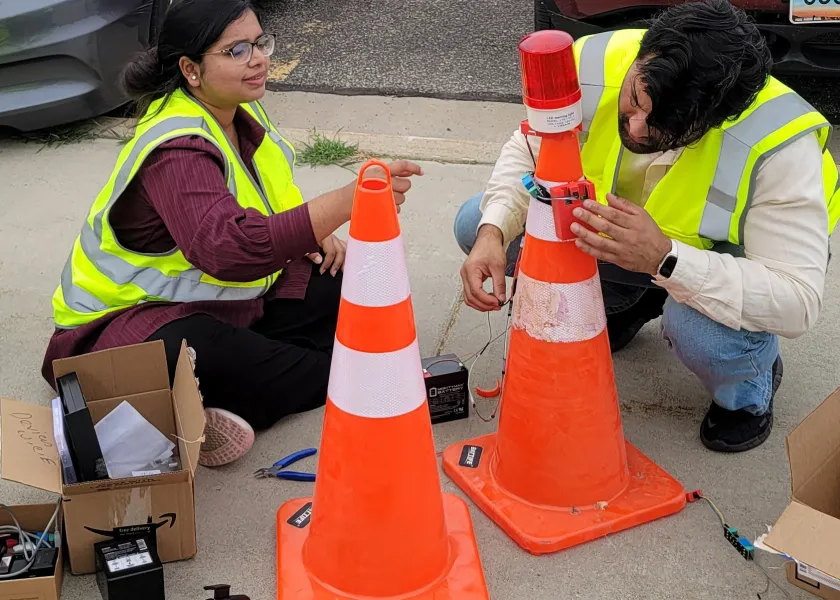
Improving safety in highway work zones is a priority for researchers at North Dakota State University.
According to the National Safety Council, 898 people were killed, and more than 40,000 people were injured in work zone crashes in 2023. One thing that grabbed the interest of NDSU researchers is that several current solutions to improve safety are expensive and impractical.
A team led by Youjin Jang, an NDSU assistant professor of civil, construction, and environmental engineering, has developed a wearable, modular hazard-detection and alerting system to help reduce deaths and injuries in work zones. Jang is the principal investigator, while Inbae Jeong, an NDSU assistant professor of mechanical engineering, and Danling Wang, an NDSU associate professor of electrical and computer engineering, are co-PIs on the project, which is funded by the Minnesota Department of Transportation.
“Every highway work zone represents an opportunity to ensure that the people improving our roads will return home safely. Investing in translational research isn’t optional; it’s how we turn that opportunity into reality,” said NDSU interim vice president for research Heidi Grunwald. “We applaud the Minnesota DOT for investing in and our scientists for creating the prototype sensor-based alert system that detects oncoming hazards in real time, which will transform cutting-edge technology into practical protection for the workers who need it most.”
The prototype was developed using a set of small smart devices. Workers wear them, equipment can carry them, and some can be positioned at a work-zone boundary. Devices communicate with each other to track the positions of workers and equipment. If a worker gets too close to moving equipment, they receive an immediate warning via sound and vibration. The equipment operator also receives a clear visual warning. The system also records events, allowing supervisors to monitor conditions and review what happened later to improve safety.
“We pursued this work because ‘struck-by’ and ‘intrusion’ risks remain among the most persistent dangers in highway work zones, and many existing solutions are either costly, difficult to deploy in changing site conditions, prone to nuisance alarms or focused on only one hazard type,” Jang said. “We saw a need for a practical, scalable approach that can address both near-miss accidents between workers and equipment and vehicle intrusion, while producing consistent, trustworthy data that supports proactive safety management.”
“Our goal is to shift from reactive to proactive safety,” said Moein Younesi Heravi, an NDSU doctoral student working on the project. “By connecting workers and equipment through a real-time sensor network, we can identify hazards and prevent accidents before they occur.”
A practical work-zone safety monitoring system has been designed and tested in the field. The system supports the detection of near-miss events between workers and equipment, as well as vehicle intrusions at the work-zone boundary. Controlled tests and live field trials were used to assess reliability, response time, and usability. The system consistently detected safety-critical situations and issued timely alerts. Field users found the system easy to understand and suggested stronger alerts for noisy environments. These results guide the next phase of pilot testing and system improvement.
“The system demonstrated consistent performance in detecting safety-critical situations and issuing alerts in time to be useful in the field,” Jang said. “Field users reported that the concept and workflow were easy to understand and recommended stronger alert intensity in noisy environments. These findings directly inform the next pilot phase and system refinement.”
“Using compact wearable sensors for work zone hazard detection and alerting, without heavy infrastructure or complicated setup, is useful in a lot of ways,” said Ayenew Demeke, an NDSU doctoral student who worked on the project. “It adds a constant layer of protection for workers and creates a clear record of hazards and near-miss events that teams can review later for training, planning, and improving procedures. The data also lays the groundwork for future work in predictive safety and AI integration.”
The next step is a larger pilot in several active work zones to test the system under different traffic, equipment and weather conditions, and to improve alert settings and device durability. At the same time, the system will be standardized to make installation and maintenance easier and integrated with existing safety programs so the data can be used in daily operations. After that, small production runs can support pilot use at selected MnDOT sites, along with training and user feedback, before wider deployment.
“The broader objective is a deployable platform that can be adopted, operated, and maintained at scale, rather than a one-off prototype,” Jang said.
The essence of the research is creating an affordable, wearable alert system that provides earlier warnings of near-miss accidents. This will not only benefit North Dakotans and their work zones but also other such areas across the nation.
“The system’s automatic, time-stamped incident records can support better safety planning and training,” Jang said. “These benefits translate well to North Dakota work zones and to agencies seeking practical, scalable tools rather than expensive, infrastructure-heavy solutions.”
This technology has a patent pending and is available for licensing/partnering opportunities. Contact the NDSU Research Foundation for more information.