Presidential candidate Alan Smith visits NDSU
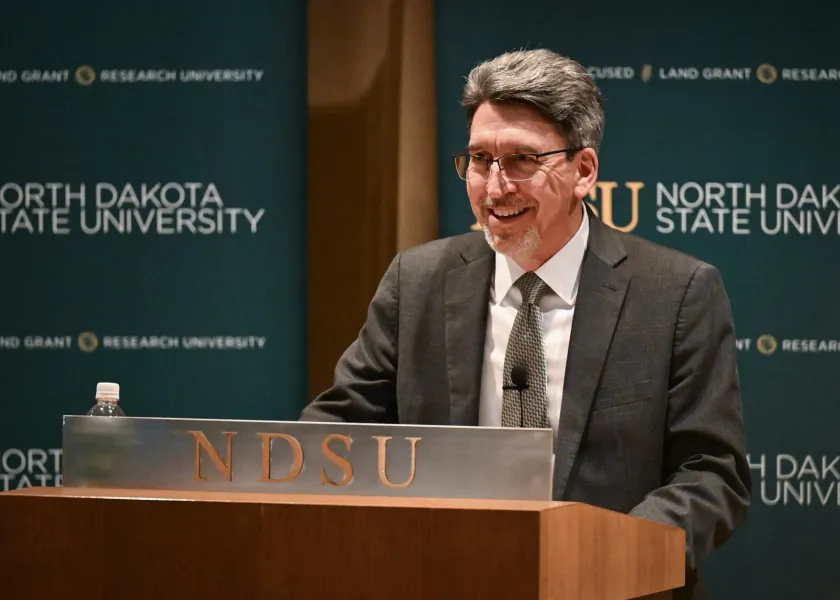
North Dakota State University presidential candidate Alan Smith outlined his top priorities to distinguish the university nationally among public research institutions.
Smith, the Emma Eccles Jones endowed dean and tenured professor of kinesiology and health science, and former interim president at Utah State University, presented his ideas at an open forum in the Memorial Union on March 25. He is the last of three candidates to visit campus for interviews and meetings.
“I believe North Dakota State University is exceptionally well positioned, not just to respond to the challenges facing higher education, but to lead. Over the next decade, I see an opportunity for NDSU to distinguish itself as a high-impact land-grant research university that is deeply connected to the region and nationally recognized for focused excellence across disciplines,” Smith told the audience made up of students, faculty, staff and community members.
Among his top priorities is improving outcomes related to student success through data.
“I truly believe the next frontier in this space is what we might call precision student success. So I know there are folks in the room that are precision engineering or agriculture, and there are others who are in precision medicine. Why not think of student success in the same way? We have the expertise to use data effectively in identifying when students need support, intervening early for them and tailoring that support in meaningful ways.”
The second area Smith wants to focus on is artificial intelligence, including how AI can be used to operate the university and enhance learning in the classroom.
Smith also wants to maintain NDSU’s strong research identity, while identifying opportunities to bring expertise across disciplines together to address present and future challenges.
“For us to fully thrive and tackle the most challenging scientific and societal problems, we must bring together expertise from business, economics and data sciences, health and human sciences, natural resources, the arts, humanities and social sciences, while leveraging our extension and experiment station infrastructure. The opportunity is to build problem-based, interdisciplinary initiatives that connect these strengths so that NDSU is known not just for excellence in fields, but for impact on complex, real-world challenges.”
Another priority Smith identified is strengthening NDSU’s land-grant mission. His ideas include aligning programs with workforce needs, expanding experiential learning, deepening partnerships with industry and communities, and building on the New Horizon investment.
“That's core to our identity and core to the needs of the state and the region. With strong legislative trust in us, alignment of state and university goals, and continued growth in scholarship, research and technological innovation, North Dakota is in a position that many states would envy.”
Within his first year, Smith would implement four priorities, including having structured listening and engagement sessions across campus and the state, refining institutional priorities within the strategic planning process, overseeing early progress on student success, particularly through data-informed approaches and system improvements, and advancing key strategic initiatives, such as AI integration.
“I would focus on communication, respect and alignment,” he said. “With students, I would be visible, accessible and responsive. With alumni, the goal is connection and pride in their institution. With industry leaders, it's partnership and collaborative problem-solving. With the legislature, it's trust, transparency and most importantly, accountability.”
Smith said he wants to focus on what matters most, which is to deliver on the promise of a land-grant institution within a modern context.
“A promise that, when fulfilled, enables individuals, families and communities to thrive,” Smith said.
At Utah State University, Smith’s work as dean focuses on supporting the development of future professionals and leaders in education, health and other disciplines that support individual, family and community well-being in Utah and beyond.
In 2025, Smith served as Interim President of USU, overseeing the implementation of significant budget cuts and reallocations while addressing campus morale, bringing state and other stakeholder needs into alignment, completing late stages of USU’s reaccreditation and navigating an athletic conference transition. Located in Logan, Utah, USU is the state’s only land-grant and space-grant university that enrolls nearly 30,000 students.
Smith’s scholarly work focuses on how sport and physical activity involvement relate to young people's psychological and social functioning. He is among the top 2 percent of cited scientists in the world.
Smith earned his bachelor’s degree from the University of Rochester, New York, a master’s degree from the University of North Carolina at Greensboro and his doctorate from the University of Oregon.
Two other finalists, Marshall Stewart, the executive vice president for external engagement and chief of staff at Kansas State University, and Bernie Savarese, the vice president for academic affairs, research and student success at the University of Tennessee, held their open forums on March 23 and 24, respectively.
Following the on-campus visits, the NDSU Presidential Search Committee will officially recommend candidates to the State Board of Higher Education during a final committee meeting on Friday, March 27. The board will conduct final interviews on the NDSU campus on Monday, March 30, with the selection of the next NDSU president expected to be announced that same day. The new NDSU president is anticipated to assume office by early June.
For more information or to watch video of any of the candidate presentations, visit the Presidential Search web page.