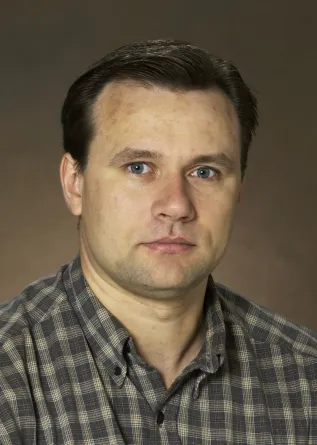
Andrei Kryjevski
Associate Professor
Faculty
Physics
- andrei.kryjevski@ndsu.edu
- (701) 231-8974
-
Office: South Engineering, 318D
Areas of Study & Research
Dynamics of Photoexcited Nanomaterials
Dr. Kryjevski group's research focuses on theoretical description of electronic properties of nanomaterials. The goal is to develop a comprehensive high-precision computational technique for modeling the dynamics of a photo-excited nanoparticle starting from photon absorption and until recombination into ground state. This requires a comprehensive description of electrons, photons, and atomic vibrations (phonons), all of which are interacting quantum mechanical particles. The group, therefore, employs powerful methods of quantum field theory, which have been mostly used in theoretical nuclear and particle physics, and combine them with the results of density-functional theory (DFT) simulations using advanced computational capabilities.
The systems of interest include semiconductor nanomaterials composed of quantum dots (QDs), nanowires (NWs), nanofilms, carbon nanotubes (CNTs), 2D flakes, etc.
Education
- Ph. D., Physics, University of Washington (2004)
Publications
[1] H. Griffin, A. Kryjevski, ``Phonon-mediated relaxation in nanomaterials using Boltzmann transport equation by combining density functional theory based non-adiabatic molecular dynamics with many-body perturbation theory", J. Chem. Phys. 163, 134110 (2025)
[2] A. Kryjevski, T. Luu, V. Karasiev, ``Electronic structure of semiconductor nanoparticles from stochastic evaluation of imaginary-time path integral", Phys. Rev. Research 3, 023173 (2021)
[3] A. Kryjevski, D. Mihaylov, and D. Kilin, "Dynamics of charge transfer and multiple exciton generation in the doped silicon quantum dot–carbon nanotube system: Density functional theory-based computation", J. Phys. Chem. Lett. 9, 5759 (2018).