Mila Kryjevskaia
Professor, Graduate Coordinator
Faculty
Physics
- mila.kryjevskaia@ndsu.edu
- (701) 231-8974
-
Office: South Engineering, 212C
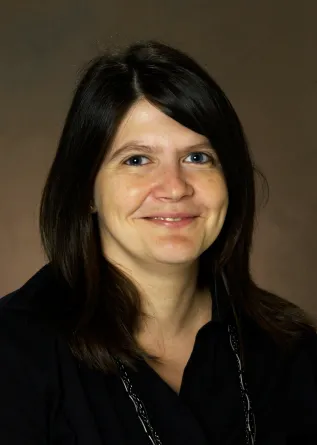
Mila Kryjevskaia is a Professor of Physics at North Dakota State University and a member of the Discipline-Based Education Research group. She received her Ph.D. in Physics from the University of Washington in 2008 and joined NDSU the same year. Her research in physics education focuses on student reasoning and decision-making, particularly the interplay between intuition and formal reasoning in learning physics. Supported by the National Science Foundation, she collaborates in a large multi-institutional research group and mentors both undergraduate and graduate students.
Areas of Study & Research
Prof. Kryjevskaia studies how students develop reasoning in physics, with a particular focus on why students often abandon correct knowledge learned in class in favor of intuitively appealing ideas that often lead to erroneous conclusions. Drawing on dual-process theories of reasoning from cognitive psychology, she designs and implements instructional strategies that help students decouple intuition from formal reasoning, strengthen their formal physics knowledge (i.e., “mindware”), and reason consistently across contexts.
Courses Taught
Mila Kryjevskaia teaches physics courses from the introductory level through upper-division, as well as graduate courses in STEM education.
Awards & Honors
- 64th Faculty Lectureship Award, NDSU, 2025
- James A. Meier Junior Professor for the College of Science and Mathematics, NDSU, 2020-2023
- Peltier Award for Teaching Innovation, NDSU, 2019
- Outstanding Teaching Assistant Award, American Association of Physics Teachers, 2003
- Best Student Talk, APS Northwest meeting, Portland, Oregon, June 2003
Publications
Most significant only.
A. McInerny,* A. Boudreaux, and M. Kryjevskaia, " Incorporating explicit discussions on the duality of reasoning into physics instruction," Phys. Rev. Phys. Educ. Res. 21, 010135 (2025).https://doi.org/10.1103/PhysRevPhysEducRes.21.010135
S. Ismael* and M. Kryjevskaia, “Students reasoning with multi-variable expressions in the context of potential difference,” Proceedings of the Physics Education Research Conference 2024, 4 pages, Boston, MA (2024).
B. A. Lindsey, A. Boudreaux, D. Rosen, M. R. Stetzer, and M. Kryjevskaia, "Reinforcing mindware or supporting cognitive reflection: Testing two strategies for addressing a persistent learning challenge in the context of air resistance," Phys. Rev. Phys. Educ. Res. 20, 020116 (2024), 16 pages. https://doi.org/10.1103/PhysRevPhysEducRes.20.020116
B. Santangelo* and M. Kryjevskaia, “Intuition and reasoning: What can we learn from cognitive psychology,” The Physics Teacher 61, 564–567 (2023).
M. Kryjevskaia, P. Heron, and A. Heckler, “Intuitive or rational? Students and Experts need to be both,” Physics Today, 74, 8, 28 (2021); https://doi.org/10.1063/PT.3.4813
A. McInerny,* M. Kryjevskaia, and A. Leontyev, Examining the efficacy of a professional development assessment tool,” Proceedings of the Physics Education Research Conference 2021, 2021 (4 pages).
J. C. Speirs, M. R. Stetzer, B. A. Lindsey, and M. Kryjevskaia, "Exploring and supporting student reasoning in physics by leveraging dual-process theories of reasoning and decision making," Phys. Rev. Phys. Educ. Res. 17, 020137 (2021). https://doi.org/10.1103/PhysRevPhysEducRes.17.020137
A. McInerny* and M. Kryjevskaia, “Investigating a collaborative group exam as an instructional tool to address student reasoning difficulties that remain even after instruction,” Conference Proceedings, Physics Education Research Conference, Virtual Conference, 2020.
M. Kryjevskaia, M. R. Stetzer, B. A. Lindsey, A. McInerny*, P. R. L. Heron, and A. Boudreaux, “Designing research-based instructional materials that leverage dual-process theories of reasoning: Insight into the testing of specific, theory-driven interventions,” Phys. Rev. Phys. Educ. Res., 2020.
C. Gette* and M. Kryjevskaia, "Establishing a relationship between student cognitive reflection skills and performance on physics questions that elicit strong intuitive responses," Phys. Rev. Phys. Educ. Res. 15, 010118, pp. 1-13 (2019).
C. Gette*, M. Kryjevskaia, M. Stetzer, and P. Heron, “Probing student reasoning approaches through the lens of dual-process theories: A case study in buoyancy,” Phys. Rev. Phys. Educ. Res. 14, 010113, pp. 1-16 (2018).
M. Kryjevskaia, M. R. Stetzer, and T. K. Le, "Failure to engage: Examining the impact of metacognitive interventions on persistent intuitive reasoning approaches," 2014 Physics Education Research Conference Proceedings, pp. 143-146 (2014).
M. Kryjevskaia, M. R. Stetzer, N. Grosz*, "Answer first: Applying the heuristic-analytic theory of reasoning to examine student intuitive thinking in the context of physics," Physical Review Special Topics - Physics Education Research 10, 020109, 1-12 (2014).
M. Kryjevskaia, A. Boudreaux, and D. Heins, "Assessing the flexibility of research-based instructional strategies: Implementing Tutorials in Introductory Physics in the lecture environment," American Journal of Physics, 82 (3), 238-250 (2014).
M. Kryjevskaia, M. R. Stetzer, and P. R. L. Heron, “Student difficulties measuring distance in terms of wavelength: Lack of basic skills or failure to transfer?” Phys. Rev. ST Phys. Educ. Res. 9, 010106 (2013).
J. Momsen, E. Offerdahl, M. Kryjevskaia, L. Montplaisir, E. Anderson, and N. Grosz, "Using assessments to investigate and compare the nature of learning in undergraduate science courses," CBE - Life Sciences Education, 12 (1), 30-38, (2013).
M. Kryjevskaia, M. R. Stetzer, and P. R. L. Heron, “Student understanding of wave behavior at a boundary: The relationships among wavelength, propagation speed, and frequency,” Am. J. Phys. 80, 339-347 (2012).
M. Kryjevskaia, M. R. Stetzer, and P. R. L. Heron, “Student understanding of wave behavior at a boundary: The limiting case of reflection at fixed and free ends,” Am. J. Phys. 79, 508-516 (2011).
* - Students in Kryjevskaia’s lab
Presentations
Link to a video of the lecture given as part of the 64th Lectureship award.