Collaborative BisonGuard project, developed by NDSU and Tribal partners, aims to protect bison herds
BisonGuard is the result of a partnership between NDSU and Wozu, a 501 (c) non-profit organization based on the Standing Rock Reservation in Cannon Ball, N.D.
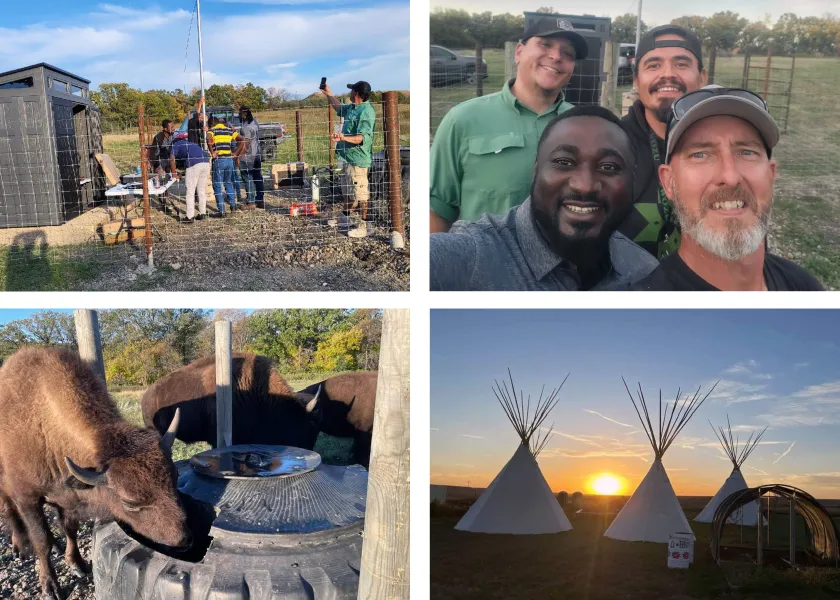
A shepherding system to monitor and protect bison herds in the state utilizing artificial intelligence has been developed in a collaboration between North Dakota State University and Tribal partners.
The system, called BisonGuard, is an example of how AI’s usage across agriculture is expanding daily. It’s a hands-off, intelligent tool designed to safeguard bison herds while tracking their movements in real time.
BisonGuard is the result of a partnership between NDSU and Wozu, a 501 (c) non-profit organization based on the Standing Rock Reservation in Cannon Ball, N.D. Wozu, which means “to plant”, has a vision to create a lifeline to the land connecting past and future generations. It has worked to bring bison herds back to the Standing Rock Reservation given the animal’s role as an integral part of the tribe's spiritual, cultural, and economic history.
Wozu is a large community-based organization that focuses on culture, tradition, and food sovereignty through initiatives such as regenerative agriculture, bison rematriation, and traditional food preservation.
According to NDSU assistant professor of civil, construction and electrical engineering Armstrong Aboah, the creator of BisonGuard, working with individuals from WOZU played a key role in shaping the new system. Initially, the research took a broad approach to intelligent livestock monitoring, however, after discussions with Wozu, Aboah’s team learned about the specific challenges involved in managing free-ranging bison herds—both technical and cultural. Their insights helped steer the project toward creating a system that aligns with Tribal stewardship values and emphasizes noninvasive herd management.
“Wozu’s partnership provided critical field access, local knowledge, and guidance on ensuring that the system’s design respected traditional land practices,” Aboah said. “Their insights helped us refine the objectives, particularly in designing the virtual fencing component and ensuring autonomous operation that supports conservation and sovereignty goals.”
“BisonGuard is more than just a technology; it's a model for research and partnership that respects Tribal sovereignty and indigenous culture,” said Heidi Grunwald, NDSU interim vice president for research and creative activity. “The project directly supports the community's food sovereignty efforts by ensuring the health of the herds and the land. By engaging with the community in the use of AI, robotics, and data analytics, the local and NDSU team are supporting future Agtech workforce opportunities for the Standing Rock Reservation.”
The concept of BisonGuard started at NDSU’s Sustainable Mobility and Advancing Research in Transportation (SMART) Lab, initially aiming to monitor cattle using AI and computer vision. “BisonGuard addresses critical challenges in livestock management that directly affect the agricultural and tribal economies of North Dakota,” said Aboah. The new technology arrives at a time when ranchers and herd managers are struggling to maintain continuous oversight of large, free-ranging herds due to labor shortages, vast grazing areas, and challenging environmental conditions.
“These challenges often delay the detection of illness, nutritional deficiencies, or straying animals, leading to financial loss and reduced productivity,” Aboah said.
The benefits of the system include improving bison welfare, maximizing the utilization of available resources, decreasing environmental impact and empowering Indigenous communities and conservationists through advanced, actionable insights. When harvested, healthy bison herds produce meat with a higher nutritional value and safer products.
The NSF AgTech Engine in North Dakota team initially facilitated conversations between NDSU researchers and Wozu to discuss the challenges of managing free-ranging bison herds when conventional livestock methods proved ineffective and culturally misaligned. This dialogue sparked ideas about how to transition from standard livestock monitoring to an autonomous solution specifically designed to respect bison behavior and align with tribal stewardship values. The NSF AgTech Engine in North Dakota provided funding of $121,095 for years 1 and 2 of the project.
Standing Rock community members have been heavily involved in the design, planning, and research for the BisonGuard project. Rather than acting as an outside entity, the Engine works alongside the community to improve bison herd management and health. The Engine funds university-based research and supports Wozu’s participation, enabling research that advances Wozu’s food sovereignty goals.
“No collars, no fences, no round-ups, rather we use drones to support buffalo being buffalo, safely,” said Cetan Wanbli Williams, innovation director for the AgTech Engine.
BisonGuard’s intent is to revolutionize conventional bison herd management by utilizing cutting-edge technologies, including Unmanned Aerial Vehicles (UAVs), autonomous ground robotics, and artificial intelligence (AI), to help ensure the health and well-being of bison herds by tracking and monitoring bison behavior, health and nutritional issues, and straying. Tested with Wozu herds, it combines advanced technology with Indigenous knowledge for sustainable and ethical herd management.
“BisonGuard represents the next generation of livestock intelligence, bridging autonomous systems research with Indigenous knowledge to advance sustainable and ethical herd management,” Aboah said.
The first phase of developing BisonGuard focused on designing and implementing virtual fencing and virtual tagging. To achieve this, the system utilizes computer vision, spatial mapping, and AI-based recognition to determine movement within invisible digital boundaries and identify individual bison based on their unique characteristics, thus eliminating the need for traditional physical barriers and tags.
“This phase has been completed and validated in collaboration with the Wozu herds, demonstrating the feasibility of automated containment and individual tracking in open-range environments,” Aboah said.
Aboah said the next step will include expanding the system’s capabilities to include health assessments, behavioral modeling and autonomous coordination between drones and ground robots.
Using technology, BisonGuard mimics the natural behavior of bison herds to keep them safe and together. Ground robots guide the herd, much like wolves, while drones monitor the area from above, similar to crows. Cameras and AI virtually tag each bison, spotting early signs of illness, poor nutrition, or straying. Data is analyzed instantly and shared with herders via a digital dashboard, allowing for quick action.
Two of Aboah’s students were key contributors to the project.
“As a co-project lead on BisonGuard, I built the AI system that tracks individual bison across multiple cameras, creates behavior heatmaps, and maintains real-time zone-level counts across the 300-acre range,” said Joshua Kofi Asamoah, NDSU SMART Lab doctoral student. “These analytics send phone alerts when an animal strays or goes missing and give caretakers a clear picture of where the herd spends time, all without tags or collars. This non-invasive approach enhances herd welfare, saves staff time, supports community safety and planning, while advancing AI research at NDSU.”
As the lead on the BisonGuard project, fellow NDSU SMART Lab graduate student Andrew Danyo developed a tracking system using facial recognition technology to identify and monitor bison movements across more than 300 acres of farmland, providing real-time location updates.
“The facial recognition capability is crucial because it allows farmers to track specific animals' health patterns, detect unusual behaviors early, and maintain detailed records for each bison in their herd, hence enabling personalized care for each animal,” Danyo said.
Danyo also commented about working with the Standing Rock community. “It’s been incredibly rewarding. Their enthusiasm and warmth have shown me the real human impact of this technology, and it's a powerful reminder that AI innovation can make a meaningful difference in people's daily lives and livelihoods."
“This research is particularly significant for North Dakota because it strengthens the intersection between agricultural innovation, rural resilience, and cultural stewardship,” Aboah said. “By merging Indigenous knowledge with advanced technologies developed at NDSU, BisonGuard promotes sustainable herd management practices, reduces operational costs, and reinforces the state’s leadership in precision agriculture and ag tech innovation. BisonGuard continues to position North Dakota as a leader in AI enabled, ethical, and sustainable herd management innovation.”