Stories
Anthropology Students Bring History to Life at Regional Archaeology Conference
Dr. Kristen Fellows, Associate Professor of Anthropology at North Dakota State University, recently took 13 students to the annual Midwest Archaeological Conference in Mankato, Minnesota, held October 8–10. The conference gave students an opportunity to connect with archaeologists from across the region, share their research, and showcase how anthropology helps us understand the people, objects, and communities that shape our history.
Two NDSU students presented their work at the conference, with one earning top honors in the student poster competition.
Uncovering History Through a Family Heirloom
Merlin Schilling presented a paper titled “An Analysis of Material Culture: A Sheepskin Coat from the Germans From Russia,” developed through their Writing in History course. Their research began with a seemingly simple object: a sheepskin coat accompanied by a single index card containing a few clues about its past.
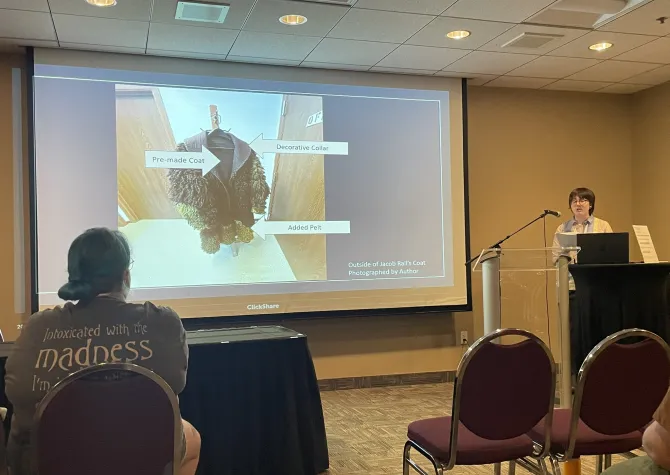
The card identified the coat’s owner as Jacob Rall, an immigrant who arrived in America in 1882 and was part of the Germans from Russia ethnic community. Using this limited information as a starting point, Schilling explored what the coat could reveal about Rall’s life, the history of Germans from Russia, and the cultural heritage carried by immigrant communities.
Their work demonstrates how an everyday object can become a window into the past—and how researchers can use material culture to uncover stories that might otherwise remain untold.
Student Research Earns Top Honors
Eliot Palmer received the Midwest Archaeological Conference Student Poster Competition Award for “From Census To Database: The Work Behind a Community Based Deep Map.” Palmer’s research contributes to Dr. Fellows’ ongoing project, “The Glacier, Prairie, Farm: Deep Mapping the Red River Valley,” which brings together historical records, photographs, oral histories, and other sources to explore the region’s history and communities.
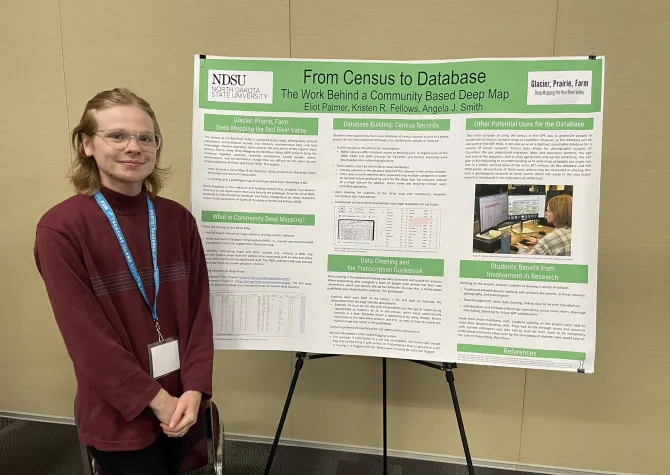
While historical documents and photographs offer valuable insights, making these materials accessible and useful to the public takes considerable work behind the scenes. Palmer’s poster highlighted the process of organizing historical information into databases that can eventually be integrated into a digital map. This work involves much more than transcribing records: students must clean and organize data, determine how information should be categorized, and develop consistent methods for managing materials collected by multiple researchers.
By helping build the digital infrastructure behind the project, students are playing an essential role in creating new ways for communities to explore and connect with the history of the Red River Valley.
Hands-On Learning, Lasting Impact
Both presentations highlight the value of experiential learning in anthropology. Whether examining a historic garment or building digital tools to preserve and share regional history, NDSU students are gaining practical research skills while contributing to a deeper understanding of the past.
Their work also demonstrates how student research can extend beyond the classroom—helping preserve cultural heritage, make historical resources more accessible, and bring the stories of people and communities to a wider audience.