

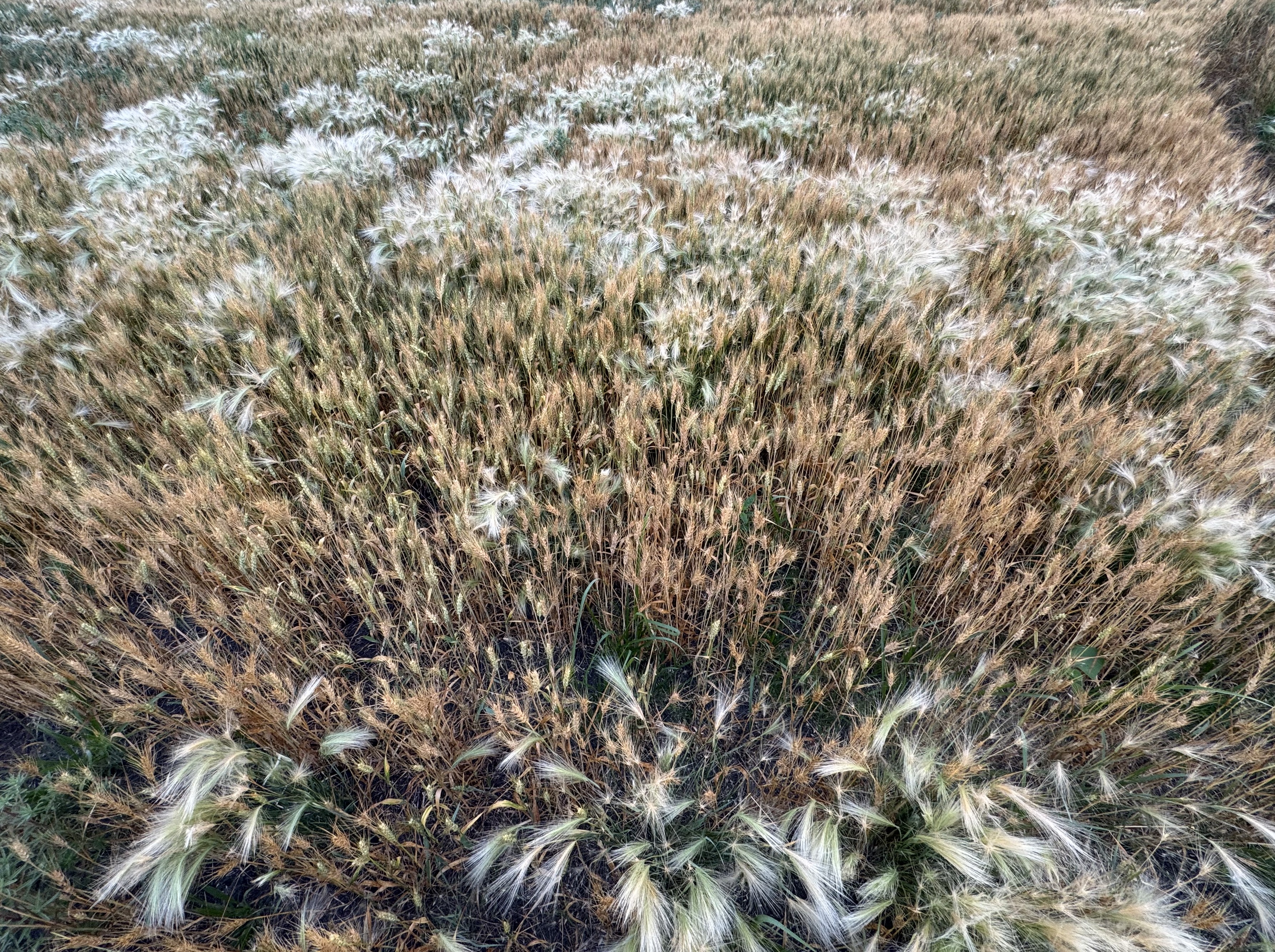
Why apply herbicides to crop fields in the fall?
Fall-applied herbicides are a great way to control cool-season perennial, winter annual, and biennial weed species and get a head start on controlling next year’s early-season summer annual weed species.
- Cool-season perennial weeds such as foxtail barley, Canada thistle, perennial sowthistle, dandelion, absinth wormwood, and other perennial weed species capable of surviving freezing temperatures are best controlled with fall-applied herbicides.
- Winter annual weeds such as field pennycress, shepherd’s-purse, horseweed (marestail), Japanese brome, and several other species are also best controlled in the fall.
To control foxtail barley:
- Apply glyphosate at 1.5 pounds acid equivalent per acre (lbs ae/A) plus ammonium sulfate (AMS) at 17 pounds per 100 gallons (lbs/100 gal) of spray mixture.
- Apply after the first freeze or later, but several days before the soil freezes. Applying herbicides prior to the first freeze may cause a reduction in perennial plant species control because nutrient flow within plants is not taking herbicides to the perennial plant parts. However, regardless of freezing air temperatures, herbicide applications should begin by mid-October if we stay warm later than normal.
- Try to apply glyphosate when daytime temperatures are above 45 degrees Fahrenheit and above freezing in the morning, and on a sunny day.
- The warmer the temperatures, the quicker and more complete the foxtail barley control.
- If temperatures turn really warm and significant rainfall occurs a new flush of foxtail barley could emerge after the application.
- It is usually better to wait as long as possible, yet look ahead at the forecast to be certain there are enough days to apply herbicides before the ground freezes.
To improve control of horseweed (resistant to glyphosate) and dandelion:
- Add 2,4-D ester at 0.75 to 1.0 lb ae/A to glyphosate for improved control of dandelion and horseweed. However, the addition of 2,4-D ester will antagonize glyphosate activity on all grass species, especially foxtail barley, reducing its control.
- When adding 2,4-D, dicamba, or any contact herbicide with glyphosate in the presence of foxtail barley and quackgrass, increase the glyphosate rate to 2.0 lbs ae/A.
- Always include AMS at 17 lbs/100 gal of spray mixture when applying glyphosate and other herbicides to glyphosate.
- To improve the activity of 2,4-D ester and contact herbicides mixed with glyphosate and reduce antagonism of glyphosate, add a high surfactant methylated seed oil adjuvant at 1.5 pints/A.
- It’s always better to apply glyphosate to control cool-season perennial or winter annual weed species in the fall under less-than-ideal temperatures rather than waiting until the spring.
To improve control of wild oat and kochia:
- Fall applications of pyroxasulfone (Zidua) products of at least 0.13 lb active ingredient (ai)/A will significantly improve wild oat and kochia control in the spring. Do not apply any residual herbicides in the fall until soil temperatures stay below 50 degrees Fahrenheit.
- Pyroxasulfone can potentially improve control of early emerging waterhemp plants and few other weeds.
- Pyroxasufone can suppress any very early season emerging Japanese brome, downy brome, and horseweed.
- Pyroxasulfone can be applied in the fall at 0.13 lb ai/A ahead of chickpea, corn, field pea, lentil, potato, safflower, soybean, sunflower, and wheat.
- Pyroxasulfone products can be broadcast-applied to undisturbed soil or incorporated with a field cultivator to a 2-inch depth in the fall. Research on the control of wild oat shows that very shallow spring tillage will not disturb the herbicide barrier enough to reduce wild oat control, however the very shallow spring tillage may reduce control of some summer annual weed species.
A note about flumioxazin:
- Historically, flumioxazin (Valor) products have been applied in the fall to control spring emerging horseweed and kochia, however the drastic increase in kochia resistant to flumioxazin and other PPO-inhibiting herbicides applied in the fall has decreased its utility in the fall.
Any field infested with foxtail barley now that’s destined for small grains in the spring needs fall-applied glyphosate because there are no POST herbicides for small grains that completely control foxtail barley. A fall herbicide application is a useful but often under-utilized tool to improve next season’s weed control.
Jeff Stachler, Ph. D., CCA
Jeff.Stachler@ndsu.edu
Extension Cropping Systems Specialist
