

Banner
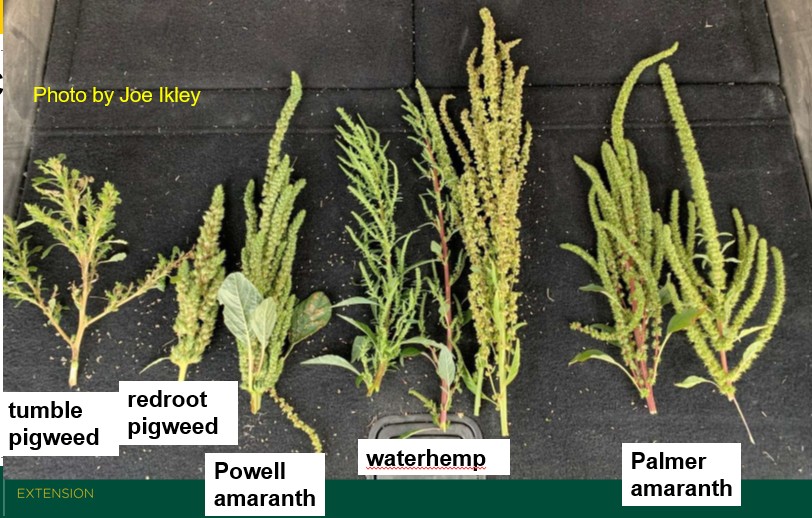
Photo Credit:
Joe Ikley
Pigweed seed spikes
Title
How to identify ND pigweed species
Authored on
Body
Pigweed species, especially waterhemp, are becoming more prevalent in many North Dakota crops. Proper identification of pigweed species is critical to properly manage pigweed species. Following proper identification, learn about pigweed species biology, the current types of herbicide-resistant pigweed species in your area, and make a good plan to get them under control.
These six pigweed species are in order by seed size with tips to help differentiate and identify them:
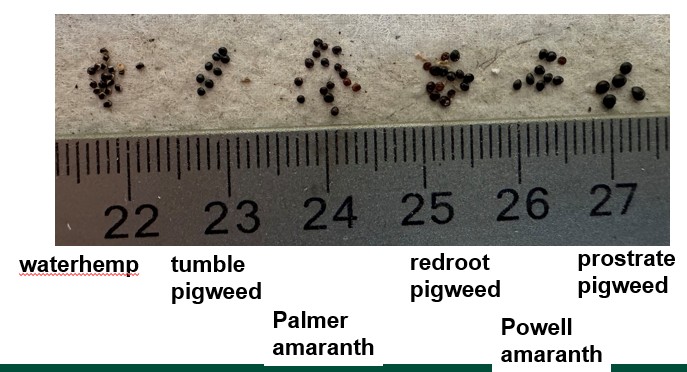
Photo Credit:
Joe Ikley
Pigweed seed size
- Waterhemp
- smallest seed of the ND pigweed species
- smallest and egg-shaped cotyledons
- all nodes have alternating leaves, although some plants may (rarely) have opposite leaves at the first node
- true leaves are longer and narrower than any other pigweed species
- none or almost no hair present on plants
- stems may be red, pink, green, or any combination of these colors
- flowers found on long and thin spikes
- dioecious flowers (separate female and male plants)
- Tumble pigweed
- narrow and slightly longer cotyledons than waterhemp, with a pointed tip
- all nodes have alternating leaves
- small rounded- to spoon-shaped true leaves usually have a wavy leaf margin in the field and always a small spine at the tip of the leaf blade
- no hair on the plant
- flowers found in very short thin spikes at end of a branch and at the nodes
- many branches at lower nodes making it look similar to kochia, and stem the breaks off at the soil line and tumbles
- stems mostly green in color, but can be red
- monoecious flowers (male and female flower parts separate, but very close to each other on the same plant)
- Palmer amaranth
- mid-sized seed
- cotyledons are linear, narrow, and asymmetrical (one cotyledon is much longer than the other) but the longest cotyledon is still shorter than redroot pigweed and Powell amaranth
- alternating true leaves with a somewhat flat first true leaf tip
- most true leaves are ovate-shaped with the petiole usually being longer than the leaf blade
- may have a white mark on upper leaf surface
- no hair on plant
- stems may be red, pink, green, or any combination of these colors
- flowers in very long and wide spikes having very sharp seed bracts that hurt when touched
- dioecious flowers (separate female and male plants)
- Redroot pigweed
- cotyledons long and narrow and usually symmetrical (both same length)
- alternating true leaves at all nodes
- true leaves ovate-shaped
- redroot stems have the longest and most dense hairs
- hair also present on the petiole (structure attaching leaf blade to the stem)
- base of stems usually have a dull red color, but not as high up on stem or as bright as Powell
- flowers in short, thick, compact spikes
- monoecious flowers (third sharpest seed bracts)
- Powell amaranth
- cotyledons linear/narrow and somewhat asymmetrical like Palmer, but not as noticeable and larger than redroot
- alternating true leaves at all nodes
- most true leaves are ovate-shaped with no hairs on petiole
- Powell stems have shorter and fewer hairs than redroot stems and are most easily seen near the growing point
- stem is darker red in color and the color goes highest up on most stems compared to redroot
- flowers in long, wide spikes with seed bracts being the second most sharp (painful to touch), but shorter and less painful than Palmer
- monoecious flowers
Prostrate pigweed
- largest seed of all pigweed species
- widest, longest, and shiniest cotyledons of the pigweed species
- first node may have opposite true leaves or are at least close together with remaining true leaves alternate
- leaves smaller and spoon-shaped compared to tumble and stacked on top of each other at first
- no hair on plant
- flowers found almost only at the nodes
- numerous stems usually flat (horizontal) on the ground
- stems usually having a dark red color
- monoecious flowers
More information about Palmer amaranth, waterhemp, and other pigweeds is available online. For more information, contact Jeff Stachler.
Jeff Stachler, Ph. D., C.C.A.
Jeff.Stachler@ndsu.edu
Extension Cropping Systems Specialist
Widgets

Photo Credit:
Joe Ikley
Pigweed seed size

Photo Credit:
Joe Ikley
Pigweed seedlings

Photo Credit:
Joe Ikley
Pigweed seed spikes
