

Kochia
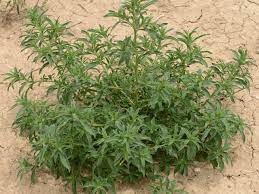
Kochia - Weed of the Year in 2016
Kochia Emergence:
- Seed dormancy: None (usually)
- GDD required: <50
- Days to 95% emergence: 2 weeds
- Temperature range: 40 to 100 F
- Maximum emergence depth: 3.25 inches
- Calendar time span: April through July
- Soil Conditions: Fertile/saline/drought
- Seedling frost tolerance: Lower teens
- Rooting depth: Up to 16 ft in drought
Implications: Wide genetic diversity in kochia is expressed in highly variable phenotypes: green, red, and purple colored plants, tall and narrow plants, short and round plants, and plants with wide leaves, and narrow leaves. Wide genetic diversity caused ALS (Group 2) resistance kochia biotypes to develop in the late 1980s, a short time after ALS herbicides were developed. Most kochia emerges in a 2 to 3 week time span very early in the spring. However, early spring tillage and herbicide burndown practices have selected for later emerging kochia biotypes. As a result, multiple flushes of kochia now occur from April through July. Kochia is adapted to drought conditions and saline soil and grows mostly uninhibited as it lacks competition from other plant species.
Kochia biomass production:
Ratio of seed mass per unit plant mass: Foxtail = 75, Lambsquarters = 150, Kochia = 500.
Implications: Kochia has one of the highest seed to plant mass ratios. This allows plants to disseminate numerous seeds that are weakly attached to light, buoyant plants that roll (tumble weed) uninhibited across fields with the wind.
Kochia carbon assimilation pathway (C3 or C4):
C4 (fixes 4 carbons vs. 3 during photosynthesis)
Implications: C4 carbon assimilation physiology allows rapid kochia growth in hot temperatures and in low moisture conditions.
Herbicide resistant kochia biotypes in North Dakota:
Group 2 (ALS) = Express, Raptor, Python, etc.
Group 4 (Growth regulators) = 2,4-D, dicamba, Starane.
Group 5 (Photosynthetic inhibitors) = atrazine.
Group 9 (EPSPS inhibitors) = glyphosate.
The mechanism of glyphosate resistance in kochia is gene amplification (i.e. plants make multiple copies of the EPSPS gene). Gene amplification can produce kochia that cannot be controlled by practical rates of glyphosate
multiple herbicide resistant kochia in North Dakota:
Group 2 + 4, Group 2 + 9, Group 2 + 4 + 9.
Implications: Wide genetic diversity in kochia allows resistant biotypes to develop from high herbicide selection pressure (frequent use of herbicides from one site of action). 2,4-D was registered in the mid 1940s. Use of 2,4-D over 70 years has gradually depleted susceptible biotypes leaving tolerant/resistant kochia biotypes that survive the relatively low 2,4-D rates of 1 pt/A used in wheat. Fluroxypyr (Starane) resistant kochia is from over-dependence on fluroxypyr in small grains and corn. A contrasting difference between 2,4-D and glyphosate resistance in kochia is the maximum 2,4-D rate of 1 pt/A in wheat compared to the high rates of glyphosate used in tolerant RUR crops (2.25 lbs ae/A). The 1 pt/A rate of glyphosate used in the 90s now requires 2 to 4 qt/A to achieve the same level of weed control. Resistance increases in each successive kochia generation compared to the previous generation.
Pollen: Type of pollination: Cross but able to self. Length of pollen viability: Up to 12 days.
Implications: Pollen from herbicide resistant kochia plants can pollinate flowers on susceptible plants to make seed resistant to herbicides.
The chink in the armor: SHORT seed viability. % seeds viable after 1 year = 5%, 2 years = 1%.
Implications: Seed from most weeds remain viable in the soil for many years. Most kochia seed is non-viable after 1 or 2 years - see next section below.
"Humans have brains, weeds don't - why are weeds winning?" (Ford Baldwin - U of AR). Consider effective non-chemical control strategies . . . build a biological fence.
Implications: Most fences around fields have been removed and recently shelterbelts are also being removed. These structures inhibit/prevent kochia from rolling across fields. Since kochia seed dies after 1 or 2 years, why not prevent tumbling plants and deplete the soil seed bank by building a biological fence? Do this by planting 6 or 8 rows of corn or sunflower around field borders. Tall crops trap and prevent kochia plants from rolling across fields.
Crop Rotation: A crop rotation that includes a grass crop where many effective herbicides are registered can effectively control kochia and deplete the soil seed bank. Corn and small grains have the largest portfolio of herbicides to control kochia.
Chemical Control in Crops:
The most effective chemical control strategy for kochia includes PRE followed by POST herbicides. Many PRE corn and soybean herbicides can effectively control kochia if activated by rain. Except for corn and small grains, all other crops have very few POST herbicides to effectively control kochia and timely POST applications to small plants are required for maximum activity. **See pages 112, 114, and 116 in the ND Weed Control Guide for effective herbicides for kochia control.
Herbicides for Kochia Control
Corn: atrazine, dicamba, flumioxazin, fluroxypyr, isoxaflutole, mesotrione/tembotrione/topramezone + atrazine, pyroxasulfone, saflufenacil, and Liberty in Liberty Link corn. See pages 21-23 for additional herbicide information in corn.
Soybean: bentazon + MSO adjuvant (split applications- see paragraphs E3-E4 on page 81 and F5-F6 on page 83), flumioxazin, fomesafen, metribuzin, sulfentrazone, saflufenacil and Liberty (LL corn). See pages 30-31 for additional herbicide information in soy.
Dry bean: bentazon + MSO adjuvant (split applications- see paragraphs E3-E4 on page 81 and F5-F6 on page 83), fomesafen, sulfentrazone. See pages 32-33 for additional herbicide information in dry beans.
**Warning**
Most remaining herbicides that control herbicide-resistant kochia in soybean and dry beans are Group 14 (PPO Inhibitors). Over-use of PPO herbicides will quickly increase the development of PPO resistance and result in kochia biotypes with multiple resistance: glyphosate + ALS + PPO. This multiple-resistant kochia will require some creativity to control - as Albert Einstein said, “We cannot solve (this) problem with the same level of thinking that was used to create it.”
