
Title

Perennial Salt-tolerant Plant Species for Non-productive Cropland

(R2299, July 2026)
Summary

Soil salinity and sodicity often cause little to no germination of major annual cash crops and may transform productive cropland into non-productive cropland. This publication will help land managers better assess soil salinity and sodicity, and select a recommended plant species mixture that grows on these non-productive croplands. The recommended plant species include wheatgrass species, Russian wildrye, winter-hardy alfalfa and strawberry clover.

Lead Author
Lead Author:
Naeem Kalwar, NDSU Extension Soil Health Specialist
Other Authors

Jeff Stachler, NDSU Extension Cropping Systems Specialist
Kevin Sedivec, NDSU Extension Rangeland Management Specialist
Ezra Aberle, NDSU Research Specialist
Carlos Pires, NDSU Extension Soil Health Specialist

Availability
Availability:
Available in print from the NDSU Distribution Center.

Contact your county NDSU Extension office to request a printed copy.
NDSU staff can order copies online (login required).

Publication Sections

Soil salinity and sodicity often cause little to no germination of major annual cash crops and may transform productive cropland into non-productive cropland. Assessing soil salinity and sodicity requires proper sampling and analytical approaches that differ from those used in standard soil fertility evaluations. For detailed information about soil salinity and sodicity, refer to North Dakota State University Extension publications SF1087 (“Managing Saline Soils in North Dakota”) and SF1941 (“Sodicity and Remediation of Sodic Soils in North Dakota”). To properly sample and analyze areas affected by salinity and sodicity, refer to NDSU Extension publication SF1809 (“Soil Testing Unproductive Areas”). Collect soil prior to planting as described and have it analyzed to determine the severity of the salinity and sodicity.
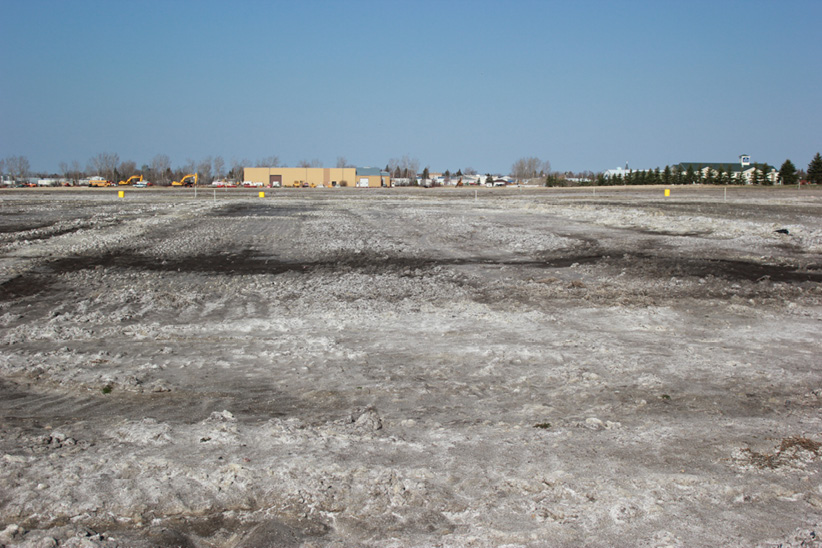
Figure 1
Photo Credit:
NDSU Photo
picture shows barren, nonproductive farmland impacted by salinity and sodicity due to improper groundwater management on April 24, 2015.

Non-productive cropland areas generally exist along headlands, roadside ditches and wetlands. Soil salinity and sodicity in these areas are usually caused by poor water drainage management of the natural landscape, leading to excess water in the ditches or wetlands. This excess water moves upward from the groundwater into more productive areas of the field through capillary action, transporting dissolved salts and sodium. This process leads to increased salinity and sodicity levels in the topsoil and plant root zone with saline and sodic areas increasing in area over time.
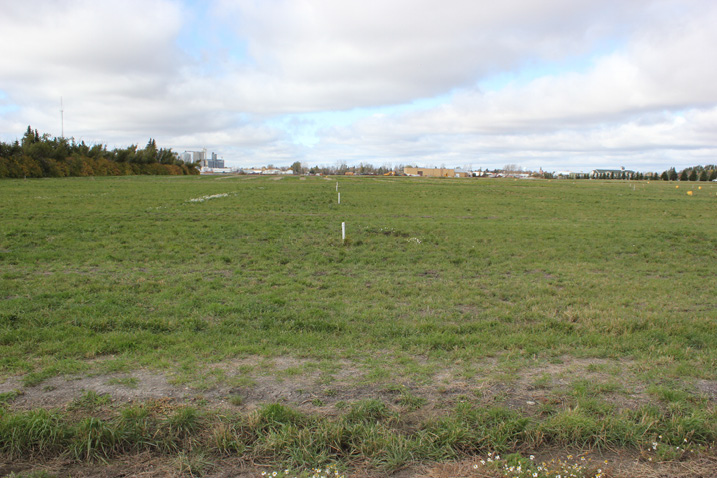
Figure 2
Photo Credit:
NDSU Photo
This site picture is the same site 13 months later on Oct. 6, 2026 after an established perennial salt-tolerant grass mix

Every year, farmers dedicate time and input costs to these non-productive cropland acres when they plant their cash crops, resulting in 100% loss. Investing in perennial, saline and/or sodic-tolerant plant mixtures could save $70-$277 per acre annually in expenditures, depending on cash crop and region (North Dakota State University 2026 crop budgets). Considering both direct and indirect costs, farmers can save $183-$676 per acre by not planting annual crops on non-productive cropland.

Soil Salinity and Sodicity Thresholds for Planting Options

Soil salinity levels are determined by collecting soil samples for electrical conductivity (EC), whereas sodicity is determined by assessing the sodium adsorption ratio (SAR) — preferably by using the “saturated paste extract method.” The most important soil depth for assessing soil salinity and sodicity in determining salt-tolerant perennial plant species is the top 12 inches of soil. These zones are where the seed is planted and where salinity and sodicity can severely affect seed germination, plant growth and yields. Soil sampling results will help assess the severity of soil salinity and sodicity. Based on NDSU research trial data, soil surface (6- or 12-inch depth) saturated paste extract EC values of ≥10.0 mmhos/cm and SAR values of ≥12 can be considered threshold levels beyond which planting — even for the most salt-tolerant annual crops such as sugarbeet, sunflower, oat and barley — becomes difficult to establish these species and even harvest a crop. At or above these salinity and sodicity levels, establishing perennial salt-tolerant plant species is a more reliable option for maintaining plant growth and reducing economic losses in these areas.
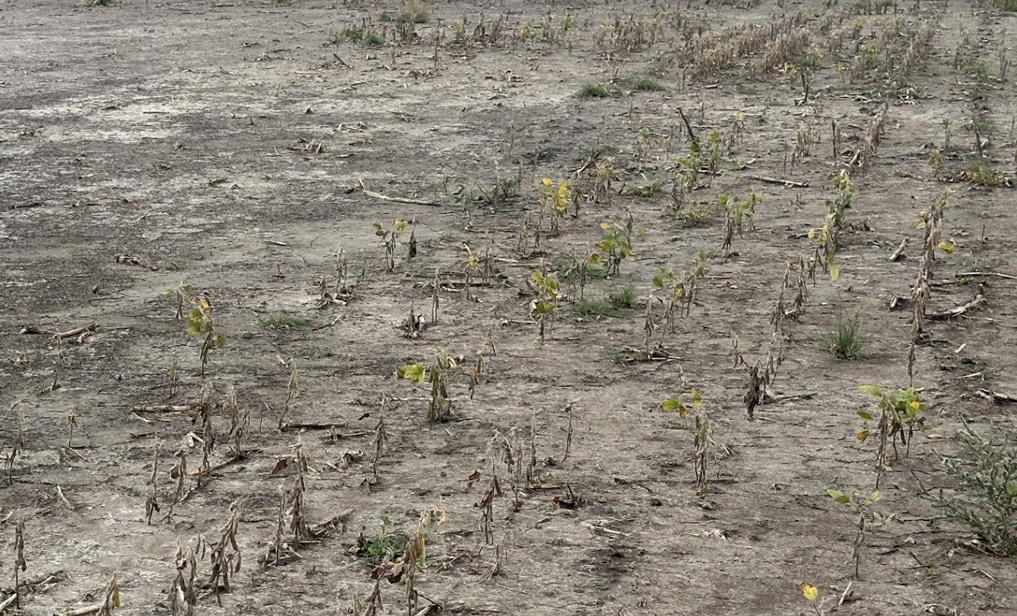
Figure 3
Photo Credit:
NDSU Photo
Soybean field impacted by soil salinity in early October in central North Dakota.

Recommended Plant Species for Saline and Sodic Soils

Soil salinity levels are determined by collecting soil samples for electrical conductivity (EC), whereas sodicity is determined by assessing the sodium adsorption ratio (SAR) — preferably by using the “saturated paste extract method.” The most important soil depth for assessing soil salinity and sodicity in determining salt-tolerant perennial plant species is the top 12 inches of soil. These zones are where the seed is planted and where salinity and sodicity can severely affect seed germination, plant growth and yields. Soil sampling results will help assess the severity of soil salinity and sodicity. Based on NDSU research trial data, soil surface (6- or 12-inch depth) saturated paste extract EC values of ≥10.0 mmhos/cm and SAR values of ≥12 can be considered threshold levels beyond which planting — even for the most salt-tolerant annual crops such as sugarbeet, sunflower, oat and barley — becomes difficult to establish these species and even harvest a crop. At or above these salinity and sodicity levels, establishing perennial salt-tolerant plant species is a more reliable option for maintaining plant growth and reducing economic losses in these areas.

Recommended Plant Species for Saline and Sodic Soils

Plant species growing in saline or sodic soils include mainly wheatgrass species, Russian wildrye, winter-hardy alfalfa and strawberry clover. Alfalfa is typically not recommended when EC levels exceed 4.0 mmhos/cm. However, salt-tolerant alfalfa varieties are available and have shown some success at EC levels of 6.0 mmhos/cm. Consistent data on the successful establishment of salt-tolerant alfalfa compared to traditional alfalfa varieties is limited for soils with EC levels greater than 4.0 mmhos/cm. Some studies have shown that seeding alfalfa at the same time as a salt-tolerant grass species mixture may cause the alfalfa to eventually establish in the plant community two to three years after planting.

Below is a list and description of preferred wheatgrass species, as well as Russian wildrye, strawberry clover and alfalfa, recommended for seeding these non-productive saline and/or sodic cropland areas.

Tall Wheatgrass: This cool-season perennial grass is a tall-statured, coarse, late-maturing bunchgrass with large seed and an upright plant architecture. Although a poor-quality feed for livestock, tall wheatgrass provides excellent habitat for wildlife. It has a medium water use and high salinity tolerance: 13-26 mmhos/cm.
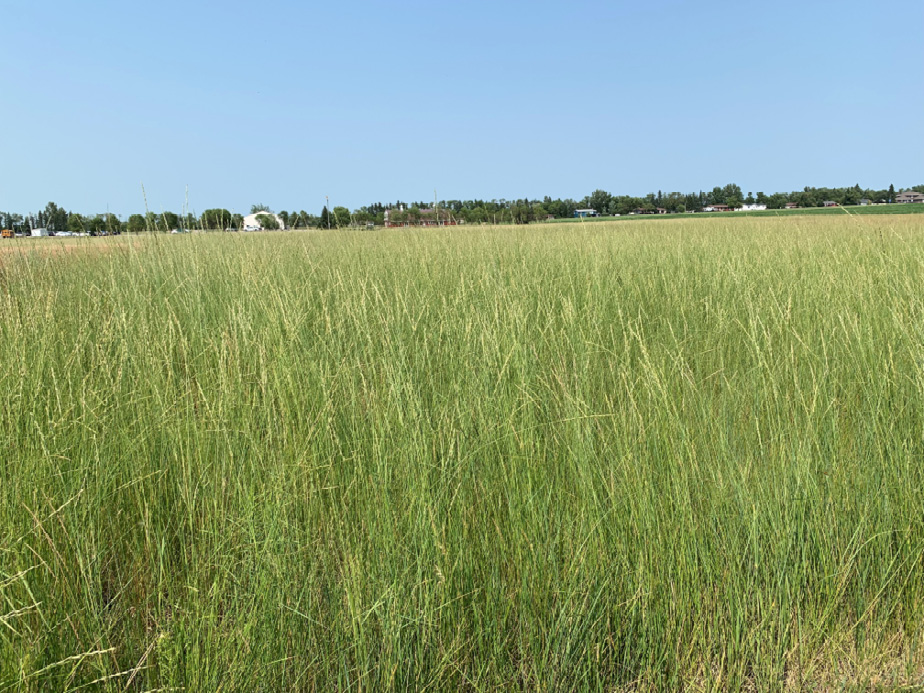
Figure 4
Photo Credit:
NDSU Photo
Tall wheatgrass growing at the Langdon REC on July 30, 2024.

Slender Wheatgrass: This cool-season, short-lived, perennial bunchgrass has an upright plant architecture. It is easy to establish, providing good vigor in the first year; however, it loses vigor and declines in population density within three to five years. It has low water use and high salinity tolerance: 10-22 mmhos/cm.
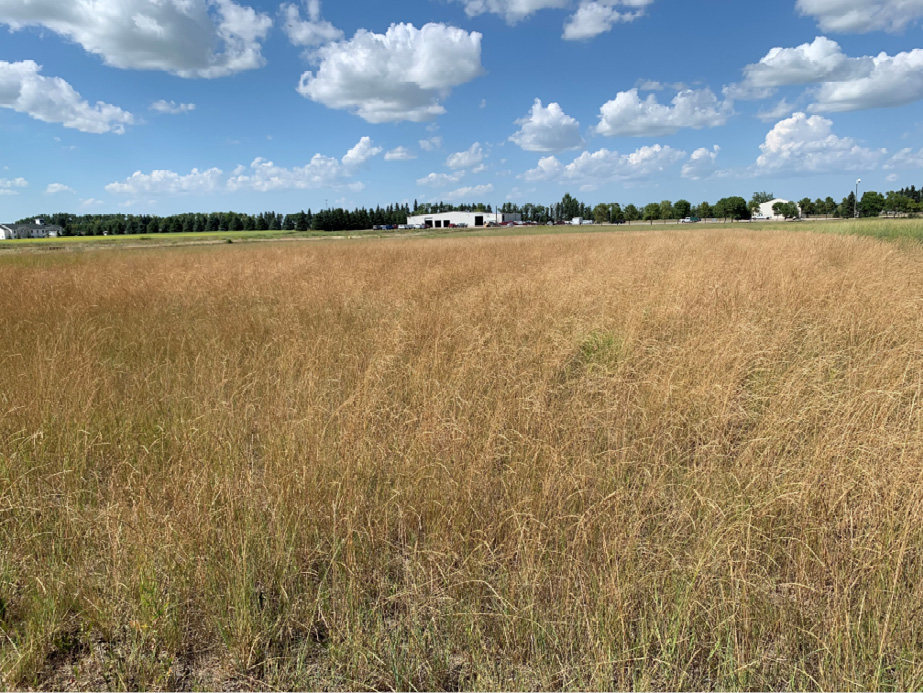
Figure 5
Photo Credit:
NDSU Photo
Slender wheatgrass growing at the Langdon REC on Aug. 2, 2023.

Green Wheatgrass (AC Saltlander): This cool-season, long-lived, perennial bunchgrass has an upright plant architecture and is a low-water-use species. It grows in moderate- to high-salinity soils and is a hybrid between quackgrass (Elymus repens) and bluebunch wheatgrass (Pseudoroegneria spicata). Although it has a bunch-type appearance, it can spread through rhizomes, providing quicker soil cover compared to most bunchgrasses. This species can handle wet soil conditions. It is, however, the most expensive of the grass seeds in this mixture. The most common variety used for saline/sodic soils is AC Saltlander. It has a high salinity tolerance: 15-25 mmhos/cm.

Western Wheatgrass: This cool-season perennial grass grows upright and is a long-lived, drought-resistant and sod-forming grass with a deep rhizomatous root system. This species can withstand periodic flooding, has moderate water use, and has moderate to high salinity tolerance: 6-16 mmhos/cm.
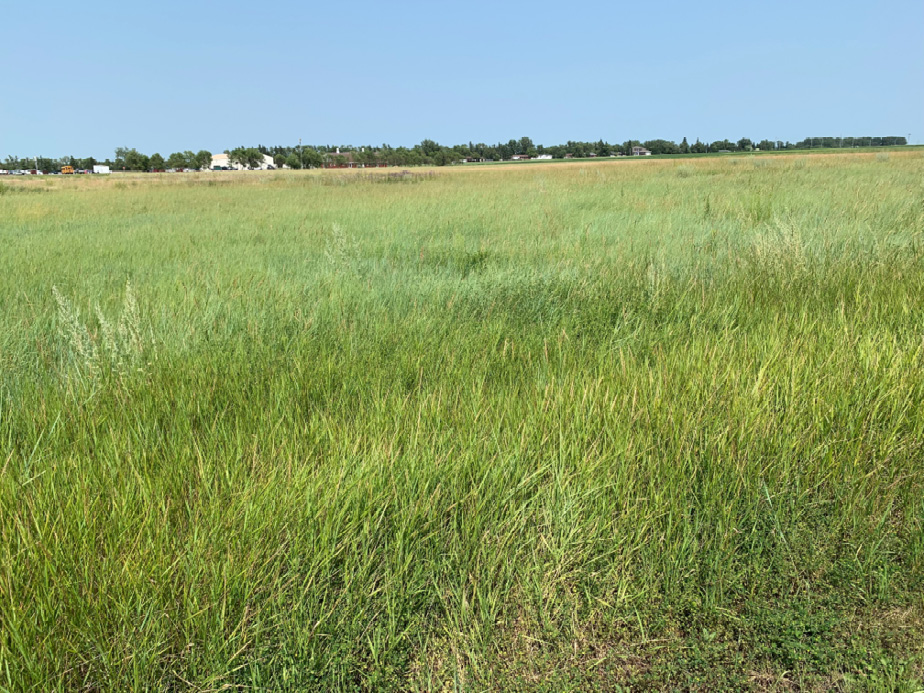
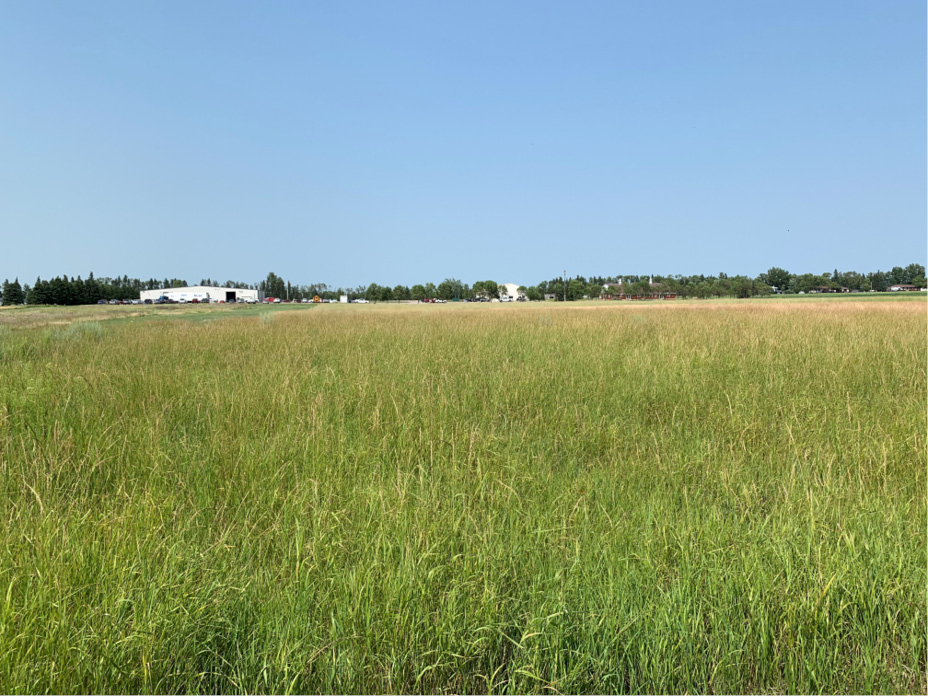
Figure 6
Photo Credit:
NDSU Photo
Western wheatgrass growing at the Langdon REC on July 30, 2024.
Figure 6
Photo Credit:
NDSU Photo
Green wheatgrass growing at the Langdon REC on July 30, 2024.

Russian Wildrye: This cool-season perennial grass is an early-maturing, long-lived bunchgrass with fine basal leaves and a deep fibrous root system. It grows upright and doesn’t handle excessive water well, causing it to disappear in long-term saturated soils. This grass is exceptionally drought-tolerant and has high salinity tolerance: 13-24 mmhos/cm.
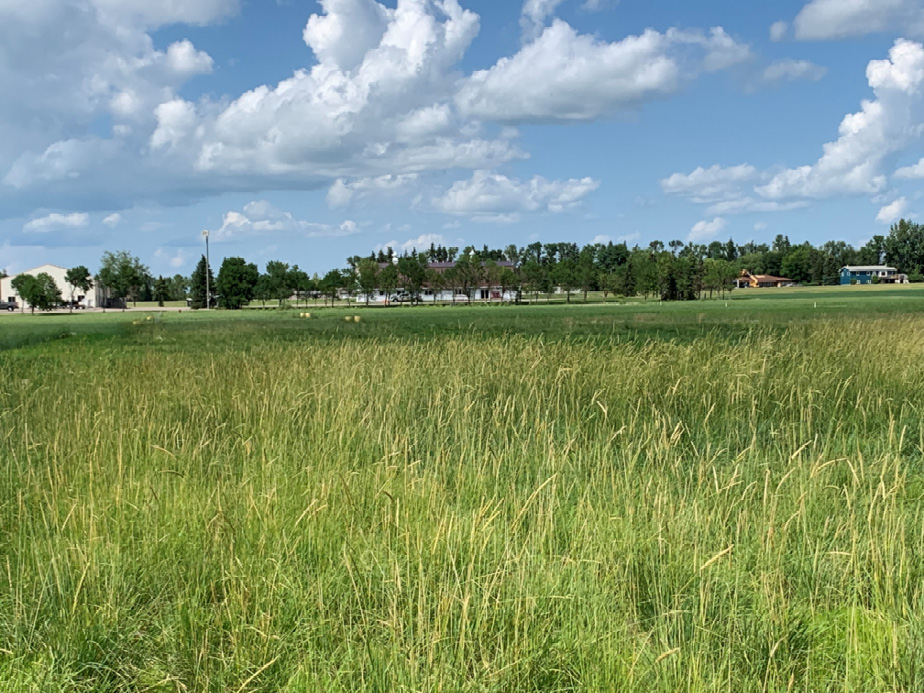
Figure 7
Photo Credit:
NDSU Photo
Russian wildrye growing at the Langdon REC on July 22, 2022.

Strawberry Clover: This low-growing perennial clover is notoriously tolerant of wet, waterlogged conditions, and it produces nitrogen to feed the grass species. This plant is deep-rooted and spreads. Strawberry clover does not tolerate excess shading and performs best when grasses within the plant community are hayed or grazed. Salinity tolerance is high: 15-25 mmhos/cm.

Alfalfa: Generally, this species needs to be a winter-hardy, inexpensive alfalfa variety in a mixture of perennial salt-tolerant grasses. Alfalfa may not establish in the first two to three years but can lie dormant as salinity levels decline to allow germination. Once the alfalfa is established, it can handle moderate salinity levels. Alfalfa has a slightly lower salinity tolerance in the seedling stage: 2-4 mmhos/cm. Salt-tolerant alfalfa varieties have shown success in establishment at levels up to 6 mmhos/cm. Alfalfa may not establish or be maintained in the plant community if soils stay saturated for long periods of the year.

Note: The EC tolerance values mentioned above were measured at a 1:1 soil-to-water ratio, which generally yields lower values than the saturated paste extract method.

Establishing Perennial Salt-tolerant Plant Species

Prior to planting:

  • Determine what herbicides have been applied to the planned planted areas for the last two years to ensure herbicide residues in the soil will not interfere with plant establishment. Consult pages 102-106 in the North Dakota Weed Control Guide for information in sections Y15 and Y16 regarding crop rotation restrictions and herbicide residues for cover crop establishment (For more information, see the North Dakota Weed Control Guide).
  • Make sure seeded areas are free of weeds prior to planting. This can be accomplished by applying herbicides or conducting tillage prior to planting, since most of these sites have previously been planted to annual cash crops. Two concerns with weed management practices for these sites include herbicide-resistant weed biotypes, particularly kochia, and tillage, which can cause the soil seedbed to dry out and reduce perennial plant species germination and emergence. If foxtail barley is present in these areas, apply glyphosate (1.5 pounds acid equivalent/acre [lbs ae/A]) plus non-ionic surfactant (0.25% volume per volume [%v/v]) and a spray grade ammonium sulfate [AMS] (17 pounds per 100 gallons of spray mixture) late in the fall after a frost and before dormant or spring seeding. Applying glyphosate in the fall provides the best foxtail barley control. To control kochia before spring seeding, apply paraquat (0.75 pounds active ingredient per acre [lbs ai/A]) plus non-ionic surfactant (0.25% volume per volume) applied at 20 gallons per acre spray volume with medium to coarse spray droplets. Paraquat is a restricted-use herbicide, so users must hold a North Dakota Private Pesticide Certificate and complete a special paraquat training every three years. If seeding in the spring with foxtail barley present and no intent to till the soil, apply glyphosate (2.0 lb ae/A) plus non-ionic surfactant (0.25% volume per volume [%v/v]) and AMS (17 pounds per 100 gallons of spray mixture), but understand complete control is not possible. If foxtail barley and kochia are present and there will be no tillage, apply the glyphosate at least one day prior to the paraquat. Don’t mix glyphosate and paraquat together. Conducting tillage in a moderate to dense foxtail barley population is unlikely to provide a quality seedbed.

Stand establishment:

  • Make sure the planted area goes at least 20 feet beyond the current salinity/sodicity impacted area, where no cash crops grow, and into any low areas where water may collect. This will ensure salts do not creep further into the cash cropping areas of the field.
  • Recommended seed mixture and rates to successfully cover the soil and establish plant cover include the following:
    • Green wheatgrass (AC Saltlander) at 2.0 lbs/A of pure live seeds (PLS)
    • Slender wheatgrass at 1.5 lbs/A of PLS
    • Tall wheatgrass at 2.8 lbs/A of PLS
    • Western wheatgrass at 2.7 lbs/A of PLS
    • Russian wildrye at 1.5 lbs/A of PLS
    • Strawberry clover at 0.33 lbs/A of PLS (optional depending on forage goals and possibility for soil saturation)
    • Alfalfa at 1.0 lbs/A of PLS (optional depending on EC levels and future land use goals)
    • Or the NRCS Saline Soils seed mixture
  • With all grass species being cool-season, there are two optimum planting periods: early to mid-May (unless areas are wet, then grass species could be successfully planted up to mid-June) and dormant planting in mid-October to early November (before soil freezes). Seeding methods for planting of seeds can be applied by 1) the use of a spreader (broadcast) and incorporation of seed with a harrow or field cultivator pass to lightly incorporate the seeds, or 2) direct seeding with a drill. If a field needs to be prepared for weed control purposes and a proper seedbed, mixing a salt-tolerant annual cash crop seed, such as oat or barley, at the rate of 20-40 pounds/acre at the time of planting can provide a good nurse crop (cover) in the first year while perennial grasses and legumes are establishing. That can also better prepare the field for dormant seeding, as long as short-residual herbicides are applied to not cause poor establishment.
  • Grass species may be broadcast-seeded and harrowed-in in the spring; however, using a drill followed by a packer usually provides improved seed germination.
  • All of these perennial salt-tolerant species should be planted at a depth of ½ to ¾ inch and firmly packed after seeding. Barley or oat seed should be added at about 20-40 lbs/a as a nurse crop and mixed with the salt-tolerant perennial seed mixture, especially when using a drill to achieve a more uniform seed distribution. The nurse crop will protect the soil from erosion while the seeded mixture establishes, reducing evaporation and weed competition (especially in the first year), thereby reducing the movement of salts to the soil surface.

Weed management:

Clip or mow weed-infested areas (such as kochia and foxtail barley) to 6 inches when weeds become dense. This method is the safest option for the planted grasses within the first year of establishment. Clipping or mowing weeds between when the first plant begins flowering and when the first plant has mature seeds should sufficiently reduce weed seed production and the spread of weed species while still allowing grass growth. It is very important to monitor the growth and establishment of perennial grass plants within the first year before clipping or mowing weeds, as the first priority is to protect perennial (next season’s) growth. Once perennial growth is at least 6 inches, clipping weeds and leaving 6 inches of growth should be fine.

Medium- to long-term maintenance:

  • Depending upon early rainfall and soil moisture levels during the first or even second year, mowing may still be required to allow for establishment and weed suppression.
  • Scout planted areas seasonally for weeds to determine the need for annual clipping of weed patches, particularly noxious weeds such as Canada thistle. The presence of annual weeds may not be a major threat, as the soil is still covered and salt levels are reduced. The problem with kochia and foxtail barley is that they can easily move to other parts of the field by wind, where successful crop production may be negatively affected.
  • If perennial grass stands start too thin, don’t mow or clip for a year or two to rejuvenate the stands, since the grass plants will produce seed that falls on the soil surface and germinates in the next or future seasons. Eventually, these stands will need to be properly grazed or hayed to enhance tiller development, thicken weakening stands and reduce salinity levels.
  • Haying and grazing these salt-tolerant plant species on an annual basis once the plant stand is established is best for reducing salinity levels because haying and grazing these species will cause roots to become denser and grow deeper in the soil. Not cutting these salt-tolerant species will not improve soil health; it will only improve soil cover for wildlife.

Grazing and Haying Value of Perennial Salt-Tolerant Plant Species

The forage value of the perennial salt-tolerant plant mixtures varies by species. All four wheatgrass species are palatable to grazing livestock when in the immature phase; however, tall wheatgrass becomes low in palatability once it reaches the boot stage. Green, slender and western wheatgrass provide good quality and palatable forage for hay, while tall wheatgrass is not recommended due to high lignin content. Tall wheatgrass is best known for its conservation value, providing tall structure for nesting birds and mammals.

Legumes seeded in the perennial salt-tolerant plant mixtures provide excellent forage for all classes of livestock. Both alfalfa and strawberry clover can cause bloat to grazing ruminant animals, but at the recommended seeding rates provided in this publication, bloat is highly unlikely. Alfalfa is traditionally used for hay production, whereas strawberry clover is used primarily in pasture mixtures. Both provide pollinator habitat for bees and butterfly species, as well as seeds and cover for birds.