Recent Events
Physics Students Attend PHYSCON 2025
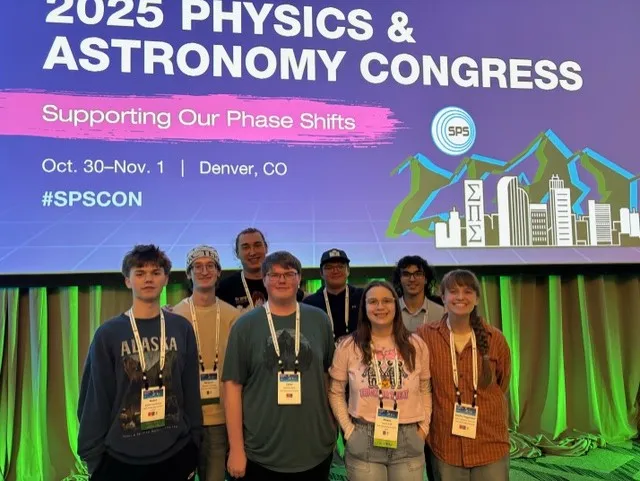
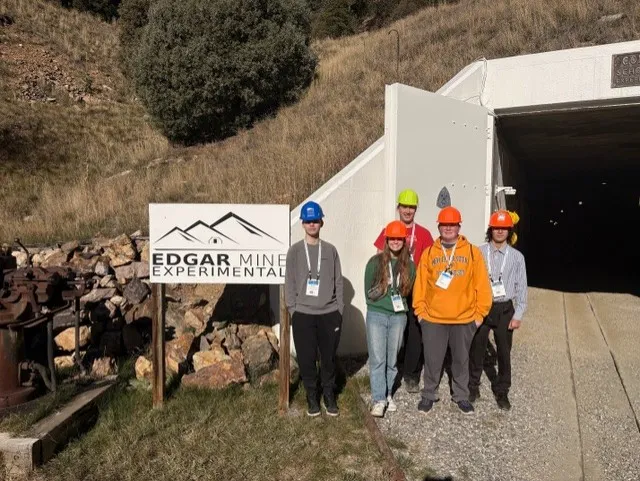
Eight undergraduate students from the Department of Physics attended this year's Physics and Astronomy Congress (PhysCon), held in Denver from October 30 — November 1. This triennial conference, the largest gathering of undergraduate physics and astronomy students in the world, brings together students, alumni and faculty members from around the country for a three-day bash featuring frontier physics, workshops, networking and fun. The event is supported by the American Institute of Physics and hosted by Sigma Pi Sigma, the physics and astronomy honor society. This year’s gathering was highlighted by inspiring plenary speakers, including Dr. Jocelyn Bell Burnell, discoverer of pulsars, and Nobel Prize winner Dr. Eric Cornell. The packed agenda also included Poster and Art sessions, a Career Expo and Grad Fair, networking opportunities and a dance party. To kick off their visit, students joined a tour of the Edgar Experimental Mine, part of which is dedicated to neutrino studies and the impact of high energy radiation on quantum information devices. Funding for the trip was made possible by a generous donation from NDSU alum Dr. Darrell Strobel.
Warren Christensen Secures NSF Funds
Warren Christensen has been honored with an NSF grant to support his research in the Physics Education Sphere. The grant, "Collaborative Research: Scaffolding the Calculus in Calculus Based Physics" will support this cutting edge work into how students understand both mathematics and physics! The award, totalling $230,111, will help support graduate students to work on this interesting problem with Warren! A great sight for the strength of education research at NDSU!
Erik Hobbie Secures NSF Grant
Professor Erik Hobbie has secured an NSF grant worth $427,935 to study Silicon Carbide nanocrystals. The work is part of the NDSU drive towards more sustainably developed materials. In this case, the Hobbie group is focusing on silicon and carbon to create fluorescent particles because they are both very abundant source materials. This provides a much better route to semiconductor devices than traditional materials which typically involve rare-earth metals. See more in the press release!
Croll Group Work on Journal Cover
The Croll group has recently published a paper entitled "Kuttsukigami: Sticky Sheet Design" in the journal Soft Matter. The project was a collaboration between graduate student Tim Twohig, faculty member Andrew Croll here at NDSU and Post-Doctoral Researcher Ravi Tutika, Ph.D. student Wuzhou Zu and faculty member Michael Bartlett at Virginia Tech. The work outlines a new method for creating structure with thin sheets, akin to origami, but with advantages such as the inclusion of a broader range of materials and reusability. The authors also point out how adhesion can be used to measure the mechanical energy stored in complex thin structures, such as the mobius strip. The editors liked the images throughout the work so much they featured the groups work on the journal cover.
