Advancing bone science and inspiring future researchers
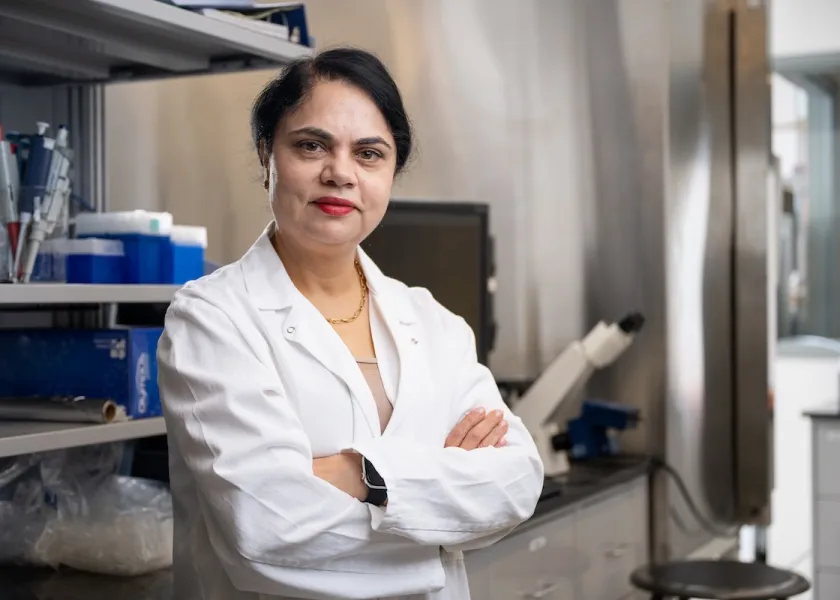
Kalpana Katti, NDSU University Distinguished Professor of Civil and Environmental Engineering, has for more than two decades redefined the limits of materials science while mentoring the next generation of researchers with the same mix of patience and curiosity that drives her own discoveries.
A pioneer in biomaterials and tissue engineering, Katti is internationally known for inventing bone test beds, synthetic models that simulate bone growth and cancer metastasis. Her research has opened new frontiers in bone regeneration and cancer studies, providing scientists with a way to examine how tumors spread to bone tissue and test treatments that could one day save lives.
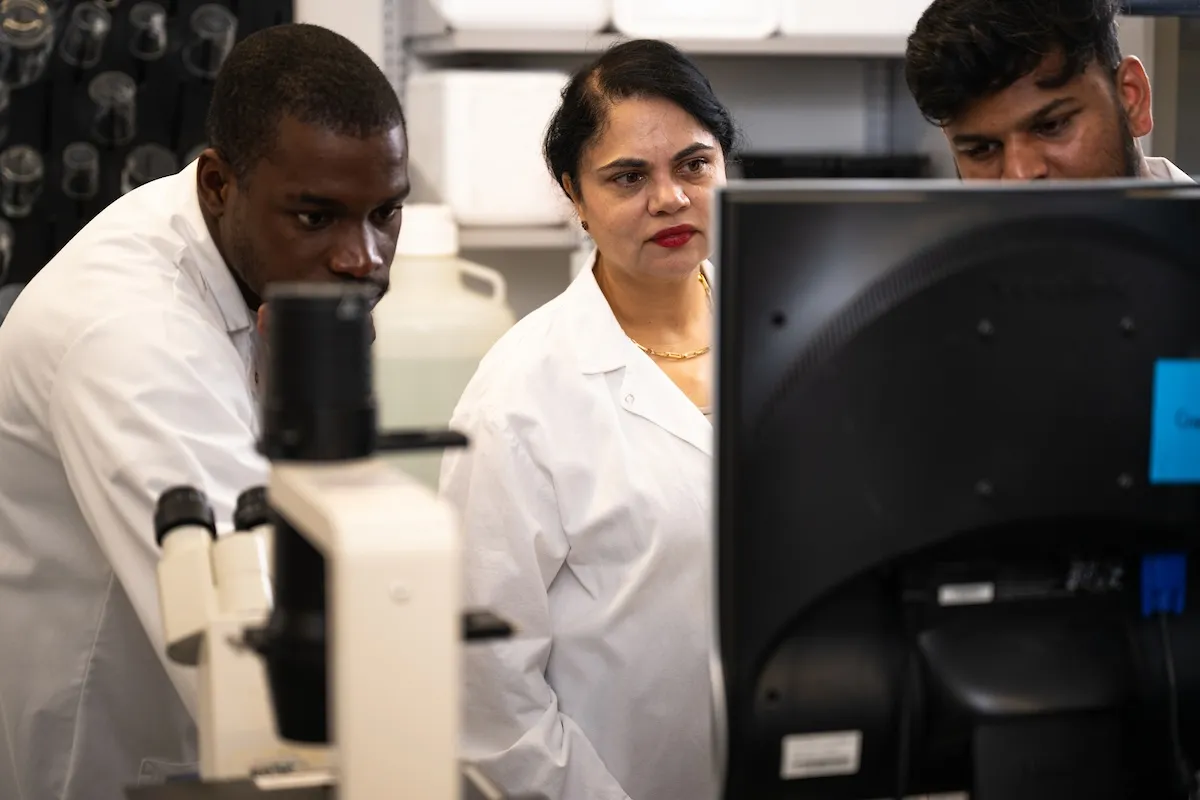
“We make mesh-like scaffolds seeded with human cells,” Katti said. “The cells are fooled into thinking they’re in the body and they start making bone. The scaffold degrades and you’re left with bone made from your own cells.”
That discovery alone would mark a career, but Katti’s work goes much deeper. Using these bone structures, her team can now model the metastasis of breast and prostate cancers, diseases that frequently spread to bone and are nearly always fatal at that stage. The lab-grown tumors allow researchers to test therapies in ways not possible with patients or animal models.
“We can observe the cancer in real time, study how it grows and even send samples to partner labs in Boston for imaging,” Katti said. “It’s the kind of work that can change how medicine approaches cancer treatment.”
For Katti, science is both creative and methodical.
“Discovery happens occasionally,” she said. “But creativity is every day. Every day you must think of new ways to approach a problem.”
Her philosophy extends to her mentoring style. In her lab, students are encouraged to question, experiment and think across disciplines.
“I never tell a student, ‘That can’t be done,’” she said. “You need to let ideas grow. Sometimes they lead nowhere, but sometimes they lead to breakthroughs.”
That open exchange of ideas has become a hallmark of her mentoring approach. Her lab includes students from engineering, chemistry, biology and pharmaceutical sciences who collaborate freely, guided by Katti’s belief that “the human mind has infinite capabilities.”
She sees her role not as the sole mentor, but as part of a community of learners.
“Senior students mentor junior students. Everyone learns from each other,” she said. “That’s how creativity thrives.”
Katti, who has been recognized as a Fellow of the American Association for the Advancement of Science, Engineering mechanics Institute and the American Institute for Medical and Biological Engineering, views these honors as reflections not only of her own work but of NDSU’s growing research reputation.
“Professionally, it’s very important for the institution,” she said. “It puts you in a group of elite scientists with national-level recognition and that enhances the standing of NDSU.”
For students, working alongside a globally recognized researcher like Katti means getting a firsthand look at how world-changing science happens through persistence, patience and a willingness to learn from failure. She often reminds her students that most of research isn’t about daily discoveries, but about the groundwork that makes those discoveries possible.
“The first six months can be hard,” she said. “Science isn’t fun every day. But if you keep trying, those wow moments come.”
Katti’s commitment to mentoring goes beyond the lab. She encourages her students, especially women in STEM, to keep moving forward despite challenges.
“Don’t slow down at the various stages in life when there are social expectations to slow down,” she tells them. “Find your support system and keep going.”
After 28 years at NDSU, Katti says the university’s collaborative spirit continues to inspire her.
“NDSU is a wonderful place,” she said. “We have a strong work ethic and a tradition of integrating research and education. Students here have opportunities to work with some of the best people in the world and to become leaders themselves.”
Looking ahead, Katti hopes to move more of her discoveries toward practical applications, developing products that can improve lives.
“It’s time to take what we’ve found and make it useful,” she said. “That’s what drives me now.”
For her students, that drive is contagious. In Katti’s lab, science is not just about discovery, it’s about persistence, imagination and the shared belief that every question is worth asking.