Bison Strides still connecting community with equine assisted services
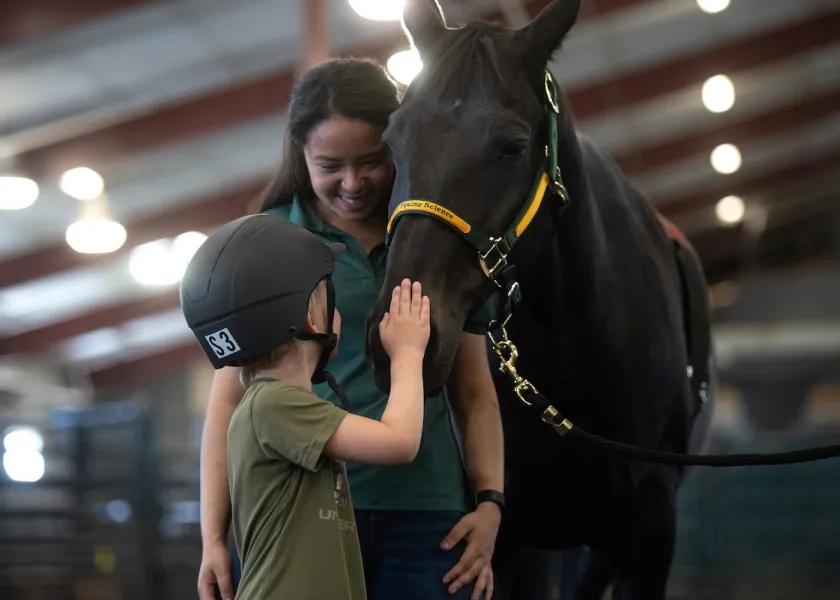
The first lesson at Bison Strides is not about horse riding. It is about connection. A participant learns how to calmly approach the horse, how to breathe and how to communicate in a way the animal understands. For many, that routine becomes a steady place to practice confidence, focus and calm.
Bison Strides operates at the NDSU Equine Center and serves people with a wide range of physical, cognitive, emotional, behavioral and mental health needs. The program serves participants with Down syndrome, autism, cerebral palsy, traumatic brain injury, ADHD, stroke, spina bifida, spinal cord injuries, PTSD, anxiety and depression, as well as other diagnoses. The organization frames its work as an expression of NDSU’s land-grant mission through education, research and outreach.
“Through the Department of Animal Sciences, undergraduates can earn a minor in equine assisted services. In addition, Bison Strides serves as a practicum site for graduate students who are in the Masters in Counseling program at NDSU. Research opportunities on the impact of horse-human interactions are also available for students,” said Erika Berg, Bison Strides program director.
The core service, adapted therapeutic horsemanship, teaches riding and horse-handling skills to participants ages 4 through adulthood. Bison Strides says documented outcomes include improved balance and posture, better social skills and growth in self-confidence and self-awareness. The program sets clear eligibility requirements for mounted sessions, including that riders must be able to sit independently on a moving horse for 45 minutes, weigh under 170 pounds and have no conditions that prohibit horseback riding.
The program also offers equine assisted learning for youth ages 6 to 17 who may benefit from social, emotional or behavioral development. Bison Strides describes these sessions as activity-based learning with horses that builds life skills, with an emphasis on self-awareness and problem solving. The program says the horse-centered work reinforces traits and behaviors such as honesty, respect, empathy and communication.
“Working with horses requires people to be in control of their emotions and that is really hard for some of our participants. This gives us the opportunity to talk about what the horse needs from us to feel safe,” Berg said. “These moments are often very motivating and result in young people who are emotionally regulated, better able to communicate, and able to build a relationship with their horse with skills that transfer to the world outside the arena.”
For veterans and active-duty service members, Bison Strides provides a military and veterans horsemanship program that is ground-based. The focus is on developing a relationship with the horse built on trust, clear expectations and mutual respect, with the program describing opportunities for self-reflection, emotional awareness and improved stress tolerance. Donors and grants cover the program so service members do not pay a fee.
“Bison Strides is incredibly grateful for the donors who support our military members, enabling them to participate free of charge,” Berg said. “We also have a Financial Assistance Program that provides support to participants and families who otherwise would be unable to receive services.”
Physical and occupational therapy using equine movement also is available through a partnership with Beyond Boundaries Therapy Services. This option is for participants at least 2 years old who can safely participate in mounted movement, with Beyond Boundaries therapists using clinical reasoning and evidence-based practice to target functional outcomes.
The impact of Bison Strides depends on a large network of people behind the scenes. Volunteers support sessions in the arena as side walkers and horse handlers, and the program also lists roles in fundraising, photography, tack and equipment cleaning and events. Volunteers must be at least 16, complete a two-hour training, and those working alongside participants are asked to commit one hour per week during a six-week session.
The horses are the foundation of the program and Bison Strides is direct about what it takes to care for them. It costs an average of $7,079 per horse annually to provide daily care, veterinary, dental and hoof care, as well as supplemental medications for our incredible program horses, Berg said.
The horses come from several sources, including animals owned by Bison Strides, community owners and NDSU students, and the program lists criteria for donated or purchased horses, such as soundness, a steady temperament and suitability for inexperienced or unbalanced riders.
Bison Strides also has quality standards that are uncommon in the region. The organization is accredited by the Professional Association of Therapeutic Horsemanship International and is the only PATH Intl. Premier Accredited Center in North Dakota, a status held by only a few centers worldwide.
Students in animal sciences, including equine science, consistently help out with the program throughout the year. Check out NDSU's animal sciences website to learn more.