Engineering students advance global energy research
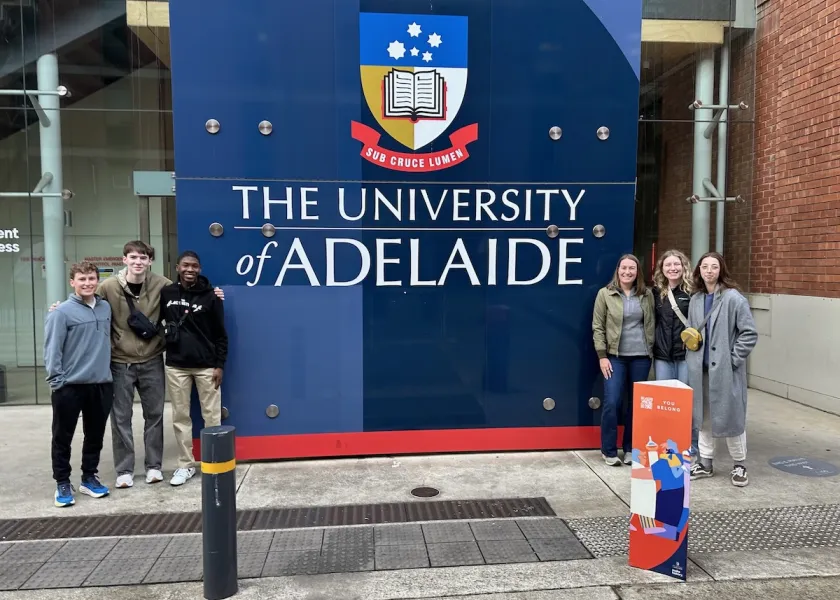
A pair of NDSU mechanical engineering students recently took their education across the globe and came back transformed.
Brenner Spaeth and Travis Reighard spent their summer conducting research at the University of Adelaide in Australia through a grant funded by the National Science Foundation’s International Research Experience for Students program. An experience that became a defining moment in their education.
“The IRES program was a life-changing project for me as a person, researcher and student,” Reighard said.
“Because of this experience, I have made memories, built friendships, and gained knowledge that will last a lifetime,” Spaeth added.

The IRES grant is a collaboration between NDSU, the University of North Dakota and Kansas State University that provides engineering students with global research opportunities. Through the year-long program, participants plan and design their research during the spring semester, spend eight weeks abroad conducting experiments in the summer, and return in the fall to analyze data and present their findings.
Under the guidance of mentors from both NDSU and the University of Adelaide, Spaeth and Reighard worked on projects focused on new and novel energy solutions, a field that will play a critical role in the world’s energy future.
Spaeth’s research investigated new ways to convert waste biomass into higher-quality fuel sources and soil amendment products.
“It taught me a lot about renewable energy and engineering,” Spaeth said. “My favorite part of the research experience was getting to work hands-on in the lab. I really enjoyed being able to apply my own experimental plans that I worked hard on and see the results come to fruition.”
Reighard’s project centered on assessing the feasibility of locations for dual land use. His goal was to identify and model areas in South Australia and North Dakota where solar energy generation and pollinator habitat creation could coexist.
“I also learned the techniques and importance of presenting technical information to a wide range of audiences,” Reighard said. “This project has improved my interdisciplinary communication skills, which will be extremely beneficial for the rest of my career.”

Beyond the lab, both students said the experience broadened their professional and cultural horizons. They explored Australia’s renewable energy initiatives, connected with researchers and policymakers and experienced the country’s rich diversity and focus on sustainability.
“It was very motivating to work on a project that focused on renewable energy in a region that puts so much attention on reducing its carbon footprint,” Spaeth said.
One of Reighard’s most meaningful experiences came through meeting with a representative from a local Indigenous community.
“It helped me conclude that their community has a high suitability for a pollinator-friendly solar system,” he said. “This was extremely rewarding to see how my work can help others.”
Both students returned from Australia with new skills, global awareness and inspiration to continue their research and studies.
“Having the opportunity to interact with engineers, researchers, policy makers, and communities in a foreign country allowed me to consider new perspectives on challenges that I would not have considered otherwise,” Reighard said.
“My experience abroad in Australia was an incredible opportunity to learn about research and the culture in the country,” Spaeth added.
By encouraging experiential learning opportunities like this one, the NDSU College of Engineering and Department of Mechanical Engineering equip students with the skills, perspective and confidence to lead in a rapidly changing world.