NDSU graduate making her mark in agriculture
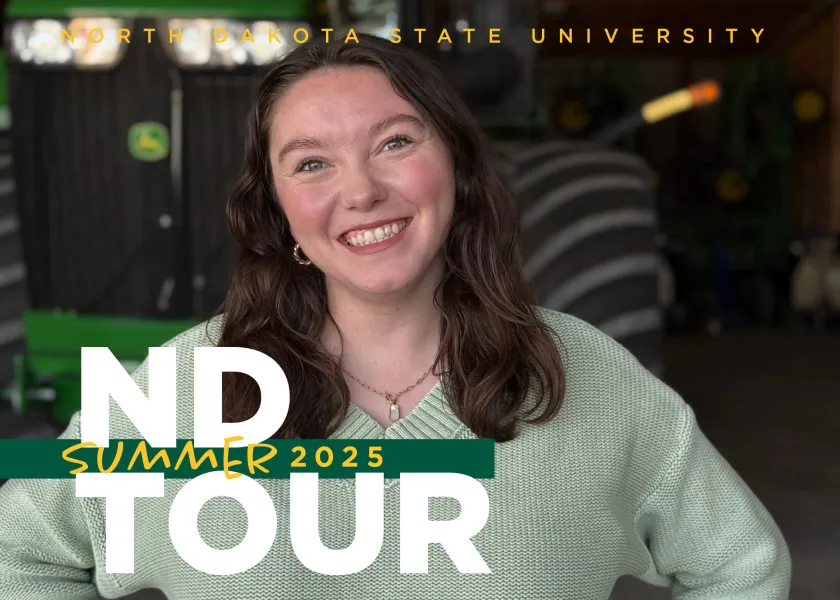
As a fifth-generation farmer in Rolla, North Dakota, Billie Lentz, a 2022 NDSU agriculture economics graduate, enjoys sharing her passion for agriculture with producers and consumers.
Lentz documents her life as a first-year farmer on Instagram, where her followers can watch as she grows soybeans, canola, barley and wheat.
“From showing farm life, to educating others on the crops we grow and the technology and other practices that go into it, I want all people to feel that there is a corner of the agriculture industry they can belong in and that they are free to safely ask questions or simply learn,” Lentz said. “I am trying to show how women like me are quickly becoming the new face of farming.”
Her work in agriculture doesn’t end on the farm, Lentz also works full-time as a marketing, communications and recruitment manager at Legacy Cooperative, a $350 million dollar grain, agronomy and energy cooperative, located in Bisbee, North Dakota. Legacy Cooperative strives to support the farmers and growers in rural North Dakota to help communities thrive.
“My work is most rewarding when I see that we are able to provide vital services that farmers need in our areas, and how that, in turn, improves our communities as a whole,” she said.
Lentz’s passion for agriculture also is evident in her involvement on various boards and organizations. She serves on the board of directors for the North Dakota Soybean Growers Association and was one of North Dakota’s delegates last year for the American Soybean Association Young Leader Program. She’s also a member of the Global Farmer Network, a group of farmers from around the globe that use their voices to promote farming and the agriculture industry throughout the world.
For Lentz, her role in the agricultural industry feels like a full circle moment, all leading back to her time at NDSU. As a student, Lentz was awarded the North Dakota Soybean Growers Association Scholarship, and she became interested in global agriculture, leading her to her current role on the Global Farmer Network.
“NDSU opened my eyes to agriculture on a local, state, national and global level – and I have been able to pursue a deeper understanding of each of those levels ever since,” she said.
The importance of NDSU’s role in agriculture takes center stage during NDSU’s annual North Dakota Tour from July 14 through Aug. 7. NDSU President David Cook, university administrators, deans and others will meet alumni, local leaders, legislators, members of the State Board of Higher Education, Extension employees, agriculture producers and NDSU supporters during stops throughout North Dakota. The tour coincides with NDSU’s annual field days, which highlights groundbreaking NDSU agriculture research at Research Extension Centers across the state.
NDSU felt like home long before Lentz was a student. She attended camps and conventions at NDSU for 4-H and FFA, where she gained in-depth insight into the agriculture industry and the career she wanted to pursue.
Lentz’s love for marketing and communications, and her desire to manage her family’s farm, led her to pursue a degree in agriculture economics. The degree not only allowed Lentz to chase her interests, but it also provided a comprehensive curriculum covering several areas of agribusiness and farm management classes that helped set her up for success.
Lentz said NDSU’s faculty and staff, who happily share their industry knowledge with students, are among the many things that make NDSU special.
“Our faculty and staff are truly experts in their work, while also being personable and approachable,” she said. “I have never had a professor that intimidated me or left me feeling inferior. They all are energized by helping their students succeed, both in and out of the classroom. They help you build your network, seek out opportunities for internships and jobs, they give career advice, they’re the advisors to our organizations. You truly feel cared for as a student at NDSU.”
Cheryl Wachenheim, a professor of agribusiness and agriculture economics, taught Lentz’s agriculture finance course during the COVID-19 pandemic. A memorable lesson Lentz received in Wachenheim’s course was when the professor coordinated a guest speaker to discuss the importance of succession planning for family farm businesses. The topic can be emotional and difficult for farmers and their families, Lentz said. Wachenheim invited students to attend the virtual course with their parents, allowing them to have those discussions in real time.
“My parents joined me for zoom class that day and it prompted extremely crucial conversations for my family that we had been tiptoeing around before,” she said. “Dr. Wachenheim recognized that this is a topic that several of her student’s struggle to work through, and she found the perfect opportunity to pull back the curtain on it and remove some of the fear around the topic too.”
Lentz’s success inside the classroom and now post-graduation have been noticed by Wachenheim and others in the Department of Agribusiness and Applied Economics.
“There are a growing number of women who operate farms along-side their families. Billie stands out as a young woman making both operational and financial decisions with a long-term vision of managing the family farm operation and of doing so with an eye towards also ensuring she helps grow her community,” Wachenheim said.
After graduating Lentz didn’t return home right away. She initially worked with an agriculture equipment business, living in three states over the span of two years before deciding to return to North Dakota where there are ample opportunities in ag.
“Living in North Dakota always makes you feel cared for,” Lentz said. “Your neighbors and fellow community members watch out for you, you feel that there is room to grow – not a ladder to climb. You can chase down as many passions and interests that you want and build them the way you want them to be. If you can take initiative, you are able to do anything you put your mind to in North Dakota – for both living and working.”
As she continues uplifting the new faces representing the ag industry in the state, Lentz is excited for the future of agriculture.
“From incubators like the Grand Farm outside of Fargo that support the research and development for agriculture specific technology, to ongoing research taking place at NDSU’s state-of-the-art Peltier Complex, which houses the Northern Crops Institute, all these efforts keep North Dakota relevant on a global scale,” Lentz said.
“North Dakota is a state that is proactive about the future of agriculture and serving farmers solutions that are future focused.”