NDSU students contribute to groundbreaking research
Researchers at NDSU explore the frontiers of new knowledge as they shape the future of North Dakota and the region.
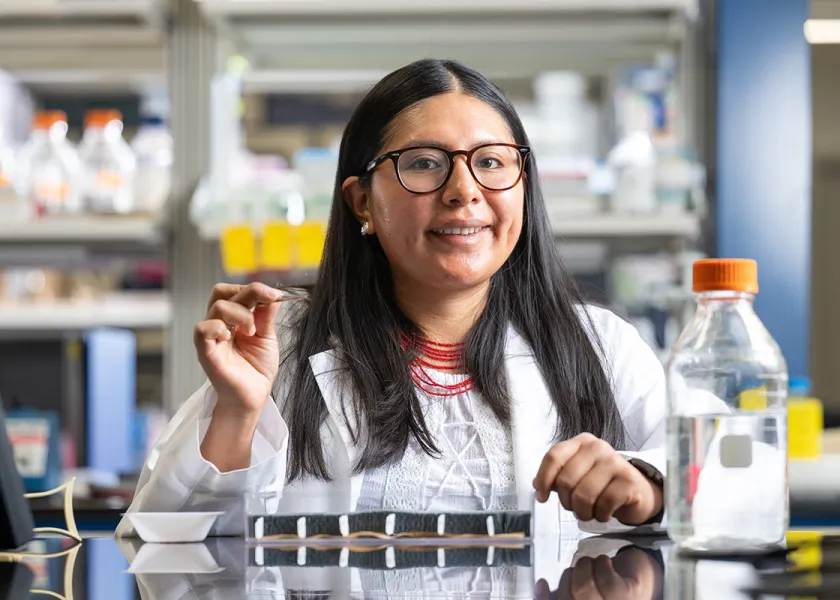
Marisol Morocho Lema, a graduate research assistant in the Department of Plant Sciences, is one of those researchers striving for a future filled with possibilities and solutions related to agricultural sustainability.
For the past year, Morocho Lema has been involved in research seeking to identify camelina varieties that have the potential to perform well under saline-sodic conditions. Morocho Lema’s research looks specifically at salinity effects on the germination and vigor of spring and winter camelina biotypes, which is an oilseed crop and feedstock for production of sustainable aviation fuels.
“This research has the potential to make a meaningful difference in agriculture across North Dakota and northern Great Plains,” Morocho Lema said. “Saline and sodic soils are major limitations to crop production in this region. Therefore, selecting salt-tolerant camelina varieties can offer viable cropping options”.


In addition to camelina being a promising biofuel crop, increased production of camelina in this region could support economic growth, as well as environmental sustainability.
So far, research results have shown that spring camelina types perform better than the winter types under saline condition, with the findings suggesting a genetic basis for salt tolerance.
Morocho Lema will continue to work in the lab of Marisol Berti, NDSU professor in the Department of Plant Sciences, to study salt tolerance by phenotyping a population of 254 Recombinant Inbred Lines (RILS) with the goal of identifying the QTLs and potential genes associated with salinity stress tolerance, which will benefit breeding programs and the future development of salt-tolerant camelina lines.
Along with Berti, Morocho Lema also works closely with James V. Anderson, a research biochemist at the USDA-ARS, and his research team at the Edward T. Schafer Agricultural Research Center located on campus. Her collaboration with researchers and fellow graduate students has allowed Morocho Lema to gain insights from various perspectives and has provided her with technical support.
Morocho Lema, who is from an Indigenous community called Puruhá, located in the Chimborazo province in Ecuador, first came to NDSU in 2018 for an internship in the plant sciences department. During this time, she learned about camelina, cover crops, forages and became interested in the crop’s potential to address agricultural challenges in the region.
Morocho Lema said she has enjoyed every minute in the lab since she returned to NDSU for her master’s degree in 2024 and becoming part of Berti’s research team.
Morocho Lema said her research involvement has been key to helping her personal growth.
“Being involved in this research has made me feel like I am contributing to real-world solutions and improving agricultural sustainability. It is rewarding to know that the work we are doing in the lab could help farmers grow crops in harsh conditions,” she said.
“Beyond academics, this experience has taught me resilience, confidence and how to effectively communicate scientific ideas to others,” she said. “I’ve had the chance to present my research findings at conferences, connect with students, and professionals across disciplines. This journey has affirmed my passion for plant sciences and shown me that I can make meaningful contributions to the field. I’m very grateful for this opportunity.”
This past spring Morocho Lema won first place for her research poster presentation at Gamma Sigma Delta’s symposium as part of Student Research Day. The opportunity gave her the chance to talk about her camelina research with NDSU faculty, staff, students and the community.
Morocho Lema said she is proud to be at a land-grant university where there is a strong emphasis on the benefits research provides to the community, state, and region. From the support she has received in the Plant Sciences department to the collaboration she has been involved in across disciplines, Morocho Lema said she has had endless opportunities to learn.
“Overall, NDSU creates a space where students can grow as researchers and develop the skills they need to make meaningful contributions to agriculture,” she said.
Her advice for fellow student researchers is to always stay curious and not be afraid to ask questions.
“NDSU offers an incredibly welcoming and dynamic research environment where innovation and collaboration thrive. Whether you are interested in plant science, engineering or any other field, there are so many opportunities to get involved,” Morocho Lema said. “NDSU provides access to modern labs, greenhouse facilities and field trials. The university also promotes interdisciplinary collaboration and has strong ties with industry and government research institutions.”
As she looks toward the horizon, Morocho Lema said she feels ready to take on any problem that comes her way and is excited to achieve new things.
“I now feel confident taking on new challenges and contributing to meaningful work, no matter where I go,” she said. “NDSU has truly prepared me for long-term success in science and agriculture.”
Find your frontier by applying today or scheduling a visit.