New Bolley Agricultural Laboratory brings researchers together to advance agricultural research

Since officially opening its doors to the public on Aug. 10, the Bolley Agricultural Laboratory has become a hub for agricultural research at NDSU.
The state-of-the-art facility brings researchers from disciplines in plant sciences, soil science, horticulture and more together under one roof, creating new opportunities for collaboration while providing the specialized equipment and space needed to advance research and education for the state.
Bolley’s impact on researchers
For Cameron Matthews, a plant sciences doctoral candidate, that difference has already been noticeable.
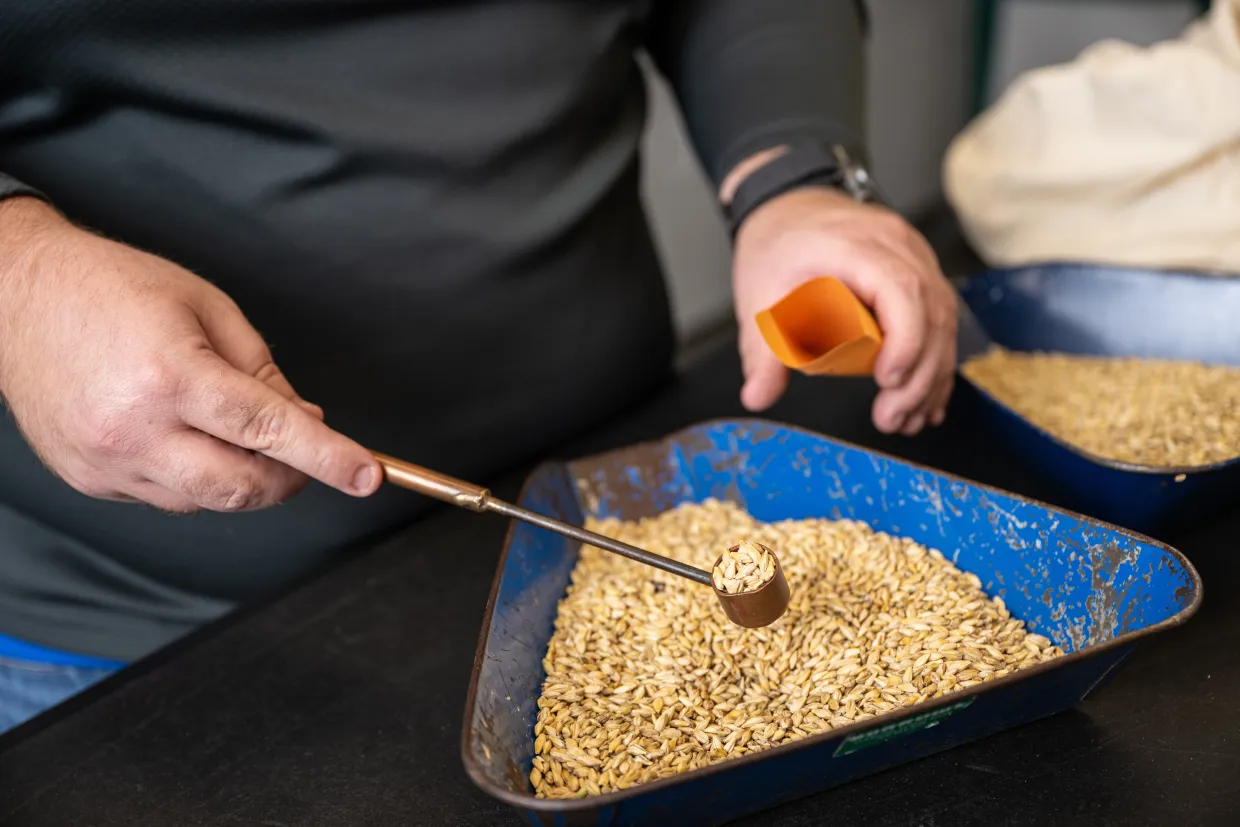
Matthews began working in the new facility this summer when his team moved in. As a graduate research fellow in the barley breeding program, his research is focused on quality traits of barley, including developing resistance to kernel discoloration and studying grain dormancy. He’s also conducting a preliminary study examining how naturally occurring carbohydrates in barley affect the thickness of the liquid produced during brewing.
While much of Matthews’ work centers on barley breeding, the new facility has provided him opportunities to interact with researchers working within other areas of plant sciences, including spring and durum wheat breeding.
“The space has enabled us to be a more efficient in how we do things,” Matthews said. “Previously, groups were very spread out among different buildings. Now we're all together, so we have to find a way to efficiently use what we have and share with others. And sharing has actually been a positive aspect of this building. We’ve learned from each other.”
Among the equipment researchers share in the space are dryer systems used to ensure samples collected in the fields are properly dried. Before, Matthews recalls the tedious task of having to share dryers that each had a limited amount of space for the number of samples that could be dried at a time. Now, Matthews and other researchers have access to two different types of dryer systems depending on their needs.
The result is less time waiting for equipment and more time advancing research.
“We’re getting the data in process and out the door in a quicker fashion,” Matthews said.
For Matthews, that efficiency is about more than convenience: it means researchers can explore more questions and discoveries toward applications that can benefit North Dakota farmers and producers.
“This facility as a whole is going to allow researchers to get into those niche areas they want to get into, and it opens the door for a lot of different research to happen that was not previously happening,” he said. “As a result, not only will we see better research being conducted by hitting more areas, but hopefully the state and the farmers will see it.”
That North Dakota-focused impact is at the heart of Matthews’ work and the broader research taking place at NDSU.
“I think most of the people in this building understand that our ultimate goal is to create an end product that is usable by a farmer and producer in North Dakota,” Matthews said.
Building a research ecosystem
The Bolley Agricultural Laboratory is just one of the most recent state-of-the-art facilities at NDSU built with agriculture in mind.
The Peltier Complex, completed in 2024, supports research in food science, meat science, muscle biology, food safety, nutrition, consumer sensory traits and the development of new agricultural products.
The Jack Dalrymple Agricultural Research Complex, built in 2015, also provides facilities for enhanced education and advanced research in plant breeding, genetics, horticulture, entomology, plant pathology, plant nutrition and associated disciplines.
Together, the three facilities create an environment where researchers can approach agricultural challenges from multiple perspectives.
That breadth of knowledge and the facilities to support it is one of the things that make NDSU stand out according to Matthews, particularly for prospective students.
“It makes the doors pretty wide open to do what students want to do,” he said. “There's a lot of little areas you can get into because you've got all the ends of that spectrum going on in three world-class facilities.”
Now is your moment to make an impact. Apply today or schedule a visit.
NDSU Marketing and Communications
Source: Cameron Matthews
Writer: Meghan Arbegast
Photos: Justin Eiler/NDSU