Headings
Numbered and non-numbered headings are both acceptable styles, though they cannot be used together--you must choose one style and apply it to all the headings in your disquisition.
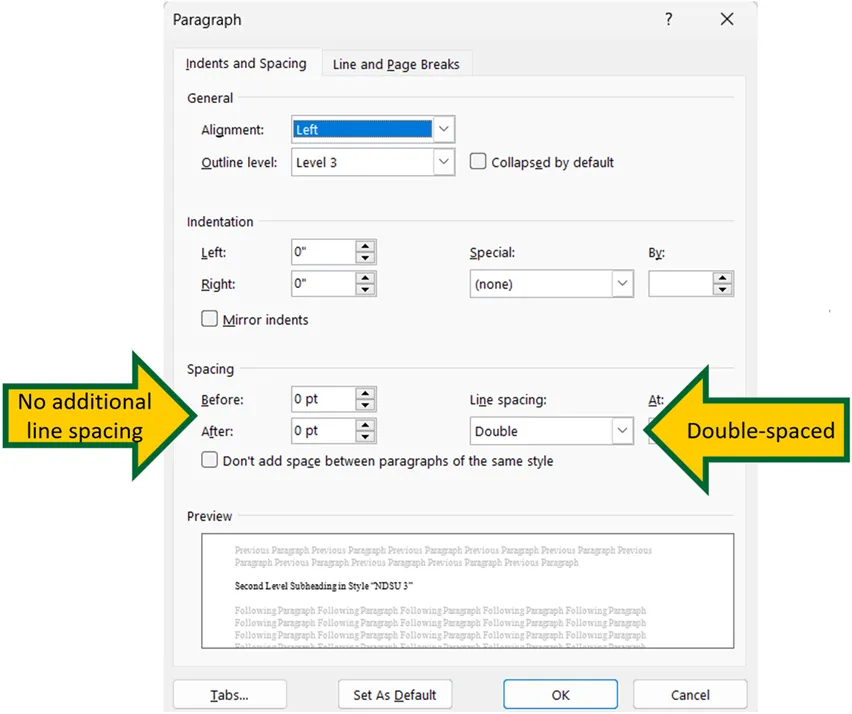
The most common issues with headings are inconsistent line spacing. Headings, like the paragraph text, should be double-spaced with no additional line spacing above or below the heading.
Contents
- Formatting Requirements
- Troubleshooting
- Resources
Guidelines: Headings
Headings identify new sections of your disquisition and should be visually distinct from your paragraph text. If you use several levels of headings, each level should be easily identifiable from its unique formatting. Levels can be established by their alignment, their font style (bold, underline, italics), or their number. Examples are provided in this section.
Quick Answers
Examples of numbered and non-numbered headings
Note the differences in the examples below. For numbered headings, it is acceptable for the second and third level subheadings to both be bolded and left-aligned with no other distinguishing features because numbered subheadings are employed. If you elect to use non-numbered headings, all heading levels must be visually distinct.
Issue: Line Spacing
Requirements:
- Headings should be double-spaced, with no extra line spacing or blank lines above or below them.
Extra line spacing may come from a variety of sources, though there are two common causes: extraneous line breaks and carriage returns, and incorrectly styled headings. To easily find extraneous line breaks and carriage returns, click the pilcrow icon (¶) on the Home tab or press Ctrl+Shift+8 to enable formatting marks, then remove any extra line breaks above or below your headings.
You should also reapply the appropriate style to your headings by placing your cursor in the heading, then clicking the style in the style pane. Even if a heading shows that it has a style applied, its individual settings may have been altered. Less common are issues with heading style settings, but you can check these settings by right-clicking a style and selecting Modify from the context menu. In the bottom left, open the dropdown menu and click Paragraph; here, verify that the heading is double-spaced with no additional line spacing before or after.
You can also modify the line spacing of a heading directly in its paragraph settings. The paragraph settings dialog box can be accessed by right-clicking the heading and selecting Paragraph from the context menu or by clicking the dialog box launcher arrow in the bottom-right corner of the Paragraph section of the Home tab on the ribbon.
We recommend using styles to apply consistent formatting across similar elements in your document. Each heading level should have its own style, and styles can be changed by right-clicking the appropriate style in the style pane on the Home tab then selecting Modify... from the context menu. In the modify style dialog box, click the Format button in the bottom left, then choose Paragraph... from the context menu. Change the line spacing options to be double-spaced with 0 pts before and after. See our template guide on the Formatting Guidelines, Templates, and Forms page for more information on using styles.
Issue: Major Heading Appears in the Middle of Page
Requirements:
- Major headings should be in bold font, aligned center to the page, use ALL CAPS, and appear at the top of a new page.
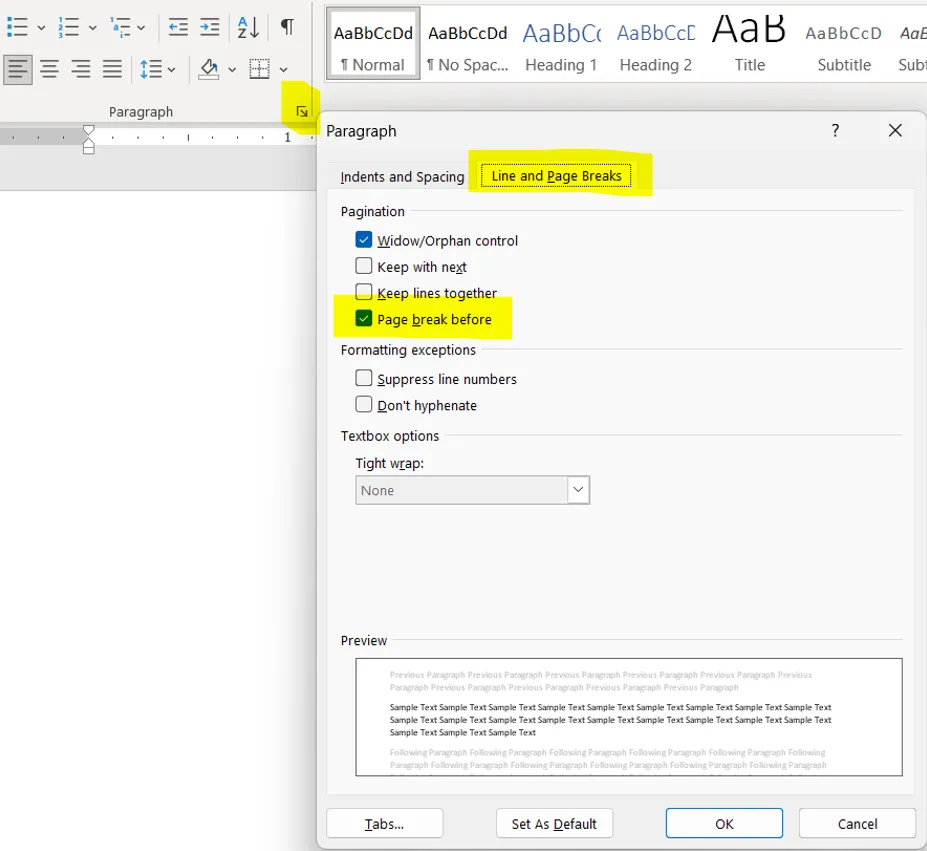
You can force major headings to always appear at the top of new pages by selecting the major heading and enabling the page break before option on the Line and Page Breaks tab of the paragraph settings dialog box. If your major heading uses a style, this setting can be enabled within the style by right-clicking the style within the style pane, then navigating to the setting from Modify... -> Format... (bottom left) -> Paragraph... -> Line and Page Break tab.
We recommend setting page break before because adding blank lines or forcing page breaks to space out content often results in blank lines or blank pages appearing when content shifts due to upstream formatting changes. The page break before setting ensures your major headings stay pinned to the top of whatever page it appears on, even if content above it shifts.

Issue: Headings at the Top of New Pages Are Not Flush with Page Margin
The most common issue is carriage returns or other line breaks above the content. You can view formatting marks by clicking the pilcrow icon (¶) in the Paragraph group on the Home tab, or using the hotkey CTRL+SHIFT+8. Once enabled, remove any extraneous carriage returns and line breaks. We recommend setting page break before in the paragraph settings for major headings instead of using carriage returns or line breaks because upstream formatting may change during your review.
Another common issue is extraneous line spacing above the heading; ensure the heading is formatted to be double-spaced with 0 pts of line spacing above and below. See the line spacing section above for examples of these settings.
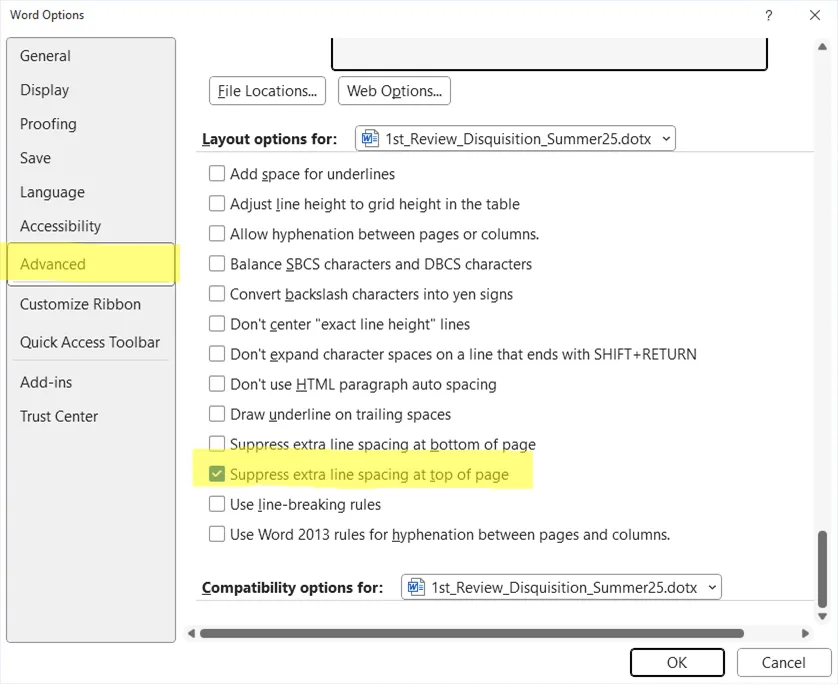
Additionally, you may need to enable "suppress extra line spacing at top of page" if you are using an old template from before July 2025. This is unlikely to affect headings, however it may resolve other issues.
- Go to File on the ribbon.
- Click Options, near the bottom left.
- Click Advanced.
- Scroll down to the bottom and enable suppress extra line spacing at top of page.

Issue: Heading Alignment
Requirements:
- Centered headings should be fully centered. Do not add spaces or tab spaces before these headings, which causes them to appear off-center.
- Left-aligned headings should be flush with the left 1" page margin. Do not add spaces or tab spaces before these headings, which causes them to be indented.
If your centered headings are off-center, check for tab stops or tab spaces in the heading. Tab stops can be seen on the document ruler (enabled from the View tab) or found by opening the "Tabs..." dialog box from the paragraph settings. Tab stops on the ruler appear as black marks, shaped to indicate what alignment the tab stop has. If tab stops are present on the line with the heading, Word may attempt to align the heading around that tab mark rather than centering it on the page. In this case, remove the tab stops.
If a tab space is causing the heading to be out of alignment, remove it. You can view formatting marks by clicking the pilcrow icon (¶) in the Paragraph group on the Home tab, or using hotkey CTRL+SHIFT+8. Tab spaces appear as arrows: "->". (Note that tab spaces should not be used within headings either, such as between the section number and title.)
Issue: Numbered Subheadings Include Label or Major Headings Include Duplicate Section Numbers
Requirements:
- When using numbered headings, major headings for chapters should be numbered.
- When using numbered headings, major headings that are not chapters should not be numbered, such as the prefatory pages or appendices.
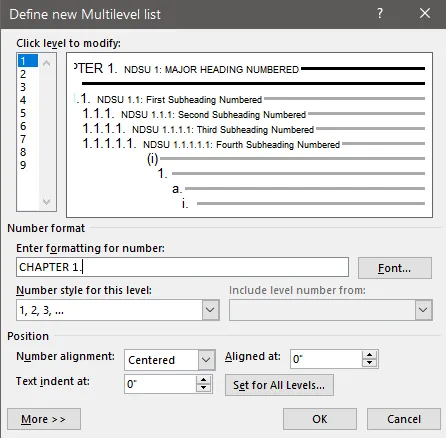
- Unlike subheadings, the chapter numbers of major headings may be preceded with a label; for example, both "CHAPTER 1. INTRODUCTION" and "1. INTRODUCTION" are acceptable styles for a major heading.
Our templates default to using unlabeled major headings, creating major headings formatted like "1. INTRODUCTION". Labels for heading can be edited by right-clicking any section number and selecting Adjust List Indents... from the context menu. To add or remove a label, select the heading level it should apply to, then edit the field under "Enter formatting for number:". For example, if you would like to add chapter labels to your major headings, you can use these settings:

|
|
Disquisition Site Map |
|
|---|---|---|
Preparing to Graduate |
Graduate School Policies • Guidelines & Templates • Pre-submission Requirements • Submit Your Disquisition | |
Formatting Wiki |
General Requirements | Accessibility • Font • Headings • Page Numbers |
| Prefatory Material | Title Page • Approval Page • Table of Contents • List of Tables, Figures, Etc. • List of Abbreviations/Symbols • List of Appendix Tables, Figures, Etc. | |
| Disquisition Body | Paragraph Text • Equations • Tables, Figures, Etc. • References / Citations • Landscape Pages | |
| Appendices | Appendices • Tables, Figures, Etc. | |