

Horseweed
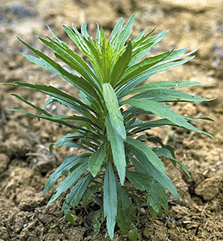
Horseweed - Weed of the Year
Horseweed, also called marestail (Erigeron canadensis / formerly Conyza canadensis), is a winter annual or summer annual weed that is native to North America. In North Dakota, horseweed is most troublesome when it emerges in the fall, overwinters as a rosette, and then elongates (bolts) in early spring. In contrast, in some Midwest states, spring-emerging horseweed has been more troublesome because of late emergence in May and June. Horseweed’s wide emergence window often allows it to escape preplant and PRE herbicides. In addition, many POST herbicides do not provide effective horseweed control. Thus, it is imperative that horseweed be controlled in the fall, the spring burndown, and with spring residual herbicides to control later emerging weeds.
Horseweed typically grows 3 to 6 feet tall and can produce up to 200,000 seeds per plant. Similar to dandelion, horseweed seed is attached to a white pappus that is easily dispersed several hundred yards by wind. It has been reported that up to 91% of the fall-emerging plants survive until spring. Over-wintering rosettes will start to bolt fairly early in the spring. Horseweed is much easier to control in the rosette stage than the bolting stage.
History
Horseweed tends to thrive in no-till systems, but is more easily controlled using conventional tillage. Plants that emerge in the fall are typically killed easily with spring tillage. An Indiana survey showed horseweed was found in 61% of no-till fields, 24% in reduced-till fields, and 8% in conventional-till fields. It has been shown that tilling the top 0.25 inch of soil provides about 95% horseweed control.
Horseweed’s ability to emerge in the fall and throughout the growing season allows it to be very competitive with crops. An Ohio State University study showed the effect of horseweed on soybean yields:
- 51 bu/A where the burndown treatment failed to control emerged plants.
- 57 bu/A where the burndown treatment was effective, but there was no residual herbicide.
- 65 bu/A where the burndown was effective and residual herbicides were used.
Resistance
Horseweed biotypes are tolerant/resistant to many herbicide groups: 2, 3, 6, 8, 9, 14, 15, and 27. Glyphosate-resistant horseweed has been found in several locations in North Dakota. 2,4-D has been a common product used to control horseweed in many states. Some states now indicate that 2,4-D is not as effective as it once was. Thus, it is important to use multiple modes of action to control horseweed and not rely on one herbicide year after year. It is critical that growers not rely on glyphosate alone to control horseweed.
Control
Horseweed is most easily controlled in the fall. Therefore, control efforts should always begin in the fall. Consider rotation restrictions when selecting fall or spring herbicides.
Fall Applied:
- Glyphosate + 2,4-D with/without (w/o) Sharpen.
- Glyphosate + Sharpen.
- Glyphosate + dicamba (follow crop rotation restrictions).
- Glyphosate + Valor + 2,4-D (consider applying Valor separate from glyphosate + 2,4-D to avoid antagonism from rapid burn on foliage).
Wheat:
Preplant or PRE: Glyphosate + 2,4-D or with Sharpen.
POST: 2,4-D + Starane Flex w/o SU, Huskie/Huskie Complete, GoldSky, Kochiavore, PerfectMatch, WideMatch, and Weld.
Dry Pea:
Preplant or PRE: Glyphosate + Sharpen w/o Spartan or Glyphosate + Metribuzin.
POST: Basagran (2 pt/A required for 80% control) + MSO.
Soybean:
Fall: Glyphosate + 2,4-D w/o Sharpen.
Preplant or PRE:
- Glyphosate + 2,4-D ester (7 day plantback for ester).
- Glyphosate + Sharpen (plantback interval: 0 day – 1 oz; 14 days – 1.5 oz; 30 days – 2 oz; 60 days – 3 oz). Tank mixing Sharpen with Group 14 herbicides may increase the plantback interval.
- Glyphosate + 2,4-D + Sharpen (follow plantback intervals).
- 2,4-D + Gramoxone + Metribuzin.
- Apply residual herbicide: Spartan, Valor, or Metribuzin.
POST:
- Basagran - 2 pt required for 80% control.
- FirstRate - will not control ALS-resistant plants.
- Dicamba - only apply approved dicamba formulations in dicamba-resistant soybeans.
- LL Soybeans - Liberty.
Horseweed Control Summary
- Apply effective herbicides in the fall.
- Apply residual herbicides in the spring.
- Apply herbicides to rosette horseweed plants. Bolted plants are much more difficult to control.
- Apply herbicides in at least 10-15 gallons per acre.
- Apply Sharpen or Sharpen + Spartan with MSO + AMS.
