

Palmer Amaranth - Weed of the Year
Palmer Amaranth (Amaranthus palmeri) - Weed of the Year 2014 and 2015
Update: Palmer amaranth has been identified in several North Dakota counties. State Map.
Palmer amaranth (Amaranthus palmeri) is a pigweed species that is not native to North Dakota or to the northern United States. It is well established in the southern U.S. It has not been identified in ND but has been identified in the northern latitude of the U.S. demonstrating it could survive in the northern plains. It was introduced in MI through the spread of manure from dairy cows that were fed cotton by-products as a feed supplement. The weed could easily establish in ND through custom combines moving north into ND and several other ways of weed seed dissemination.
Palmer amaranth was chosen as weed-of-the-year as a proactive approach to increase awareness of its extreme noxious and pernicious capability, to aid in identification, to encourage land owners to keep a vigilant watch and kill all plants that may arise. Below are some reasons why it is being called “Satan” and why growers should destroy any plants found.
- Populations of this weed are resistant to glyphosate and ALS-inhibiting herbicides, leaving very few herbicide options available for management.
- One of the fastest weed growth rates known - over 2 inches/day.
- Long emergence pattern from mid-May through August.
- Can exploit even slight canopy openings.
- Produces over 1 million seeds/plant.
- Seed is short-lived and only 2% of seed is viable after 6 years but the sheer number of seeds produced be a female plant makes eradication difficult once established.
- Female plants can grow to over 10 feet tall with a 5-6 inch stem girth and seed heads over 1 foot in length. Male plants are small and whimpy.
- Pulled plants can re-root and produce seed.
- Cause 78% yield loss in soybean and 91% in corn.
- Biotypes have become resistant to one or more of the following herbicide mode of action groups: ALS (Group 2), Atrazine (Group 5), glyphosate (Group 9), and HPPD inhibitors (Group 27).
Palmer amaranth’s ability to emerge throughout the growing season, rapid growth rate, prolific seed production, and propensity to evolve herbicide resistance quickly makes this the biggest weed threat that ND farmers have ever faced.
Keys to successful management in soybean:
Palmer amaranth is one of the most difficult weeds to manage in soybean. Proper identification and early detection of Palmer amaranth will improve the opportunity for successful management. The following steps out-line the strategies for the best management of herbicide-resistant Palmer amaranth in soybean.
Step 1. Start clean. Use tillage or an effective burndown herbicide, i.e., Gramoxone or Liberty, prior to planting soybean.
Step 2. Always use a PRE herbicide. Apply a full-rate of effective soil-residual herbicides, including those that contain the active ingredients of Valor (flumioxazin), example Fierce, and Authority (sulfentrazone), rates of sulfentrazone need to be equivalent to 8 fl oz/A of Spartan (0.25 lb ai/A). Adding metribuzin to Valor or Authority products (where allowed) will provide additional residual control.
Step 3. Effective POST herbicides (Flexstar, Cobra, Ultra Blazer or Liberty in LL soybean) must be applied before Palmer amaranth is 3-inches tall. Full rates and high spray coverage is essential for all contact herbicides. Plants over 3" tall will survive these herbicides.
Step 4. Add residual herbicides (Dual, Warrant, Outlook, or Zidua) with the POST herbicides. The residual PRE product is essential to reduce other flushes after weed kill from the POST herbicide.
Step 5. Successive POST herbicide applications may be needed. Apply to plants 3-inches or less. If Flexstar was used in the first POST application, Cobra or Ultra Blazer are the only herbicide options remaining. MSO adjuvant will enhance herbicide activity the most but significant contact burn to soybean may result.
Step 6. Additional cultural control measures, such as hand-weeding, should be implemented to prevent any remaining plants from going to seed in the field or surviving around field edges, or along ditch banks.
Keys to successful management in corn:
Grass crops provide the best opportunity for management but due to the species’ propensity to evolve herbicide resistance do not rely solely on one herbicide site of action. Following these steps for management in corn.
1. PRE - two-pass (sequential) herbicide program is required. Full labeled rates of a minimum of 2 effective herbicide sites of action are required.
POST: At least 2 effective POST herbicide sites of action are required and must be applied before 3 inches tall. A group 15 herbicide may also be tank–mixed for additional residual control.
2. Hand-weed to eliminate any remaining plants.
Identifying Characteristics | |
|
|
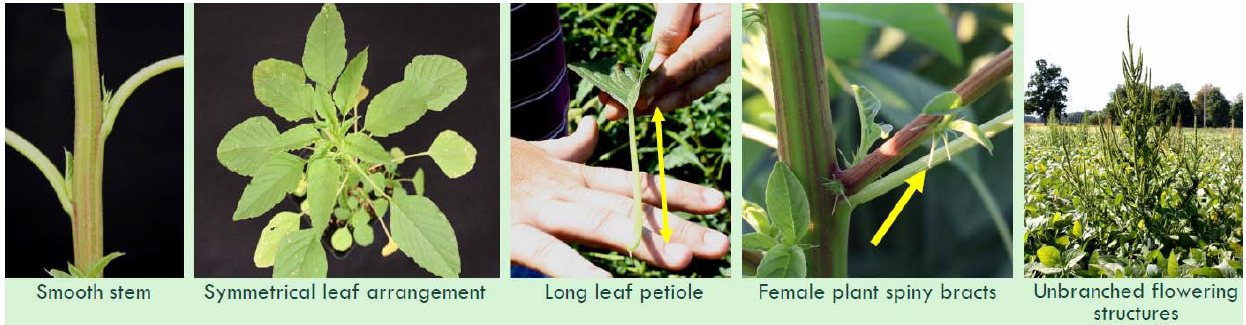
Palmer Amaranth - Weed of TWO Years -Additional Information
Palmer amaranth was chosen as weed-of-the-year for the second year in a row as a proactive approach to prevent Palmer amaranth establishment in ND. This is in continuation of education efforts in 2014 to increase land owner awareness of its extreme noxious and pernicious capability, to aid in identification, and to encourage land owners to keep a vigilant watch and kill all plants that may arise. In 2015, a concerted education effort is continuing under a program
called: Early Detection and Rapid Response.
Early Detection: Prevention is the #1 priority. Early detection is composed of correct identification of small pigweed species (redroot pigweed, waterhemp, and Palmer amaranth) which may be difficult because of phenotypic similarities. Resource information and material showing size and shape of cotyledons, leaves, and small plants is posted on the NDSU Weed Science web site:
www.ndsu.edu/weeds.
County extension educators can assist with rapid identification. We encourage land owners, agronomists, and consultants to keep a
vigilant watch for this weed so if positively identified a Rapid Response program can be initiated.
Rapid Response: Rapid, effective response may save landowners and the state significant time, money and economic reduction. If Palmer amaranth was allowed to spread unchecked, eradication will become much more difficult and costly - Refer to study results below:
In February of 2008, 20,000 glyphosate-resistant (GR) Palmer amaranth seeds were sown in a 1 square meter circle to represent survival of a single GR female Palmer amaranth plant from the 2007 growing season. In Fall of 2008, Palmer amaranth was located as far as 400 ft downslope. It is believed that rainwater dispersed the seeds from the original area of introduction. In 2009, GR Palmer amaranth had expanded to reach all field boundaries, infesting 12 to 31% of total field area. In 2010, infestations reached greater than 95% of total field area. High crop yield reductions were observed 2 yr after the introduction in 2009. In 2010, three years after introduction, Palmer amaranth infestation caused a complete crop loss as it was impossible to harvest the crop. These results indicate that resistance management options such as a “zero-tolerance threshold” should be used in preventing or mitigating the spread of GR Palmer amaranth. This research demonstrates the need for proactive resistance management. Norsworthy et. al. Weed Science 62:237-249. 2014.
Rapid response will require joint cooperation and action from many parties including: NDSU specialists and county agents, agronomists, consultants, ND Dept of Ag, county weed officers, and land owners. Palmer amaranth may be added to the ND State Invasive Species list or added as a state or county noxious weed which may allow NDDOA resources to help in eradication efforts. State and county extension personal can help identify effective chemical options for whole field or spot spraying applications. Hand weeding may be the most efficient method to remove individual plants or small patches but total crop and weed destruction may be necessary for large infestations, if no chemical treatment is available or if plants are too large for effective chemical control. Best Management Practices (BMPs) by crop is also available at the NDSU Weed Science web site.
Palmer Amaranth Distribution and Biology:
Palmer amaranth (Amaranthus palmeri) is a pigweed species that is not native to North Dakota or to the northern United States. It has become resistant to glyphosate and as a result has become well established in the southern U.S. It can spread rapidly especially in glyphosate resistant but also in conventional herbicide weed management systems. It has spread and become established in every U.S. state of the south, mid-west, and east
except Minnesota and North Dakota.
Palmer amaranth is a C-4 carbon assimilating species, thrives in hot environments, and can survive, establish, and spread in the northern latitude of the U.S., including the northern plains. It was introduced to some areas (e.g. Michigan) through the spread of manure from dairy cows that were fed cotton-seed screening that included Palmer amaranth seed as a feed supplement.
Palmer amaranth seed could easily be brought into ND through various ways including:
- Custom combines moving south to north into ND.
- Contaminated crop seed used for seeding.
- Transportation of contaminated hay and forage across state borders.
- Food source for birds and bird migration.
- Water flow - Palmer amaranth seed is small, light, and floats in water which makes water movement a primary source of spread. Waterhemp, another pigweed species, has spread in ND through water flow, especially in drown-out areas where no crop competition allows weeds to grow uninhibited.
Below are reasons why it is being called “Satan” and why growers should quickly destroy any plants found.
- Biotypes of this weed are resistant to one or more of the following herbicide site of action groups: (1) ALS (2), atrazine (5), glyphosate (9), and HPPD inhibitor (27) herbicides, leaving very few herbicide options available for management.
- One of the fastest weed growth rates known - >2 inches/day.
- Long emergence pattern from mid-May through August.
- Can exploit even slight canopy openings.
- Produces from 1 to 1.8 million seeds/plant.
- Seed is short-lived and only 2% of seed is viable after 6 years but the sheer number of seeds produced by a female plant makes eradication difficult once established.
- Female plants can grow to more than 10 feet tall with a 5-6 inch stem girth and seed heads more than 1 foot in length. Male plants are small and generally non-competitive.
- Pulled plants can re-root and produce seed.
- Can cause 78% yield loss in soybean, 91% in corn. Palmer amaranth’s prolonged emergence period, rapid growth rate, prolific seed production, and propensity to evolve herbicide resistance quickly makes this the most pernicious, noxious, and serious weed threat that ND farmers have ever faced.
