

Foxtail Barley
Corresponding Author: Joe Ikely
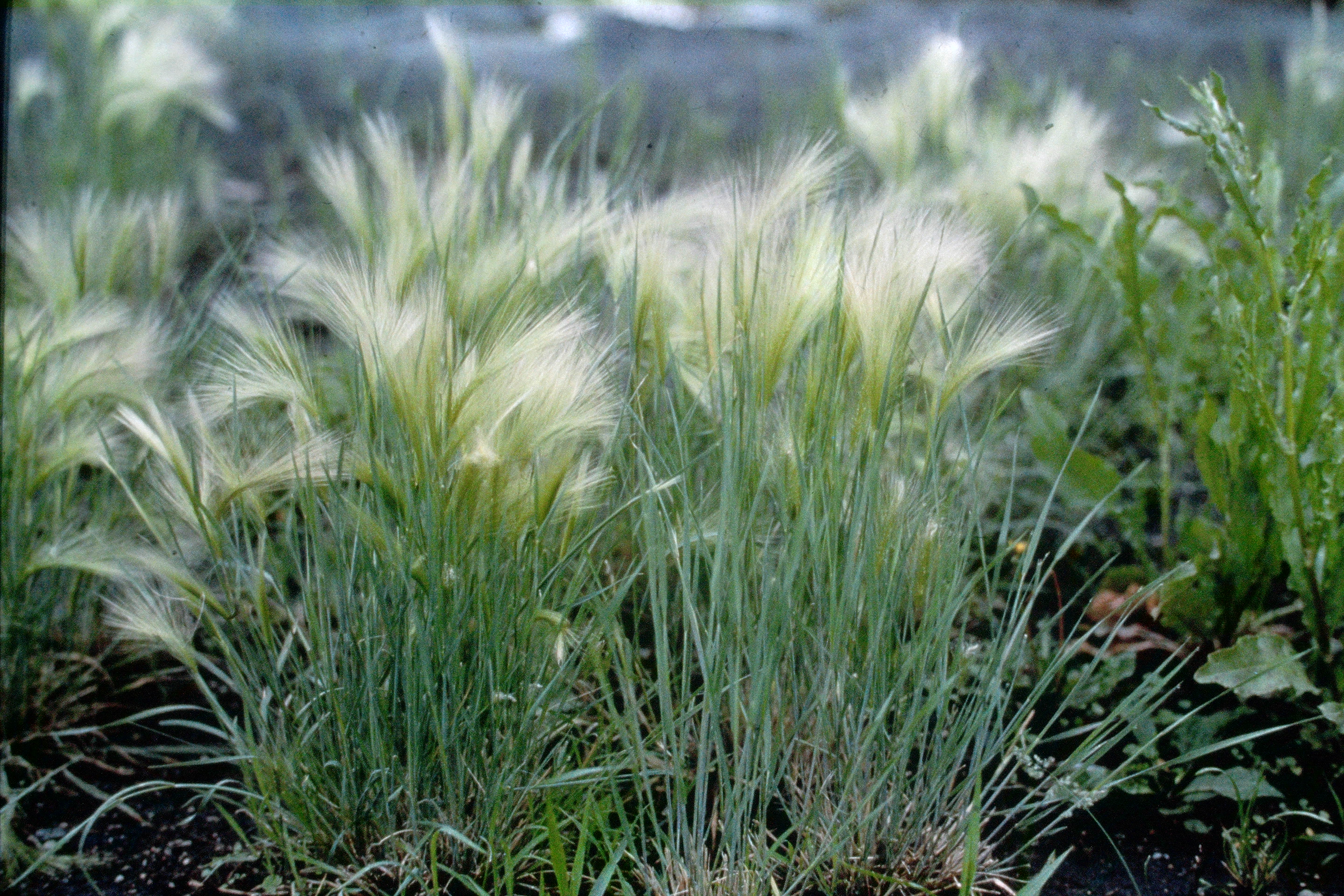
Foxtail Barley (Hordeum jubatum) - 2013 Weed of The Year
Foxtail barley is a perennial bunchgrass, thrives where reduced tillage or no-till is practiced, is native to North America, is found in wet areas, and is tolerant of saline/alkaline soils.
Foxtail barley can germinate in the fall or spring. Fall-germinating plants resume growth early in the spring and have a competitive advantage over spring-seeded crops if not controlled through tillage or chemical control (EPP or PRE).
Foxtail barley seeds primarily spread by wind or can attach to birds or animals for distant distribution.
Foxtail barley 1-2 feet tall and forms a pale green, bushy spike. Leaves are soft to the touch due to very short, but dense hairs which appear a bluish-green or grayish-green.
Foxtail barley is easily controlled with tillage because it has a shallow fibrous root system and does not spread by rootstocks or rhizomes like some other perennial weedy grasses.
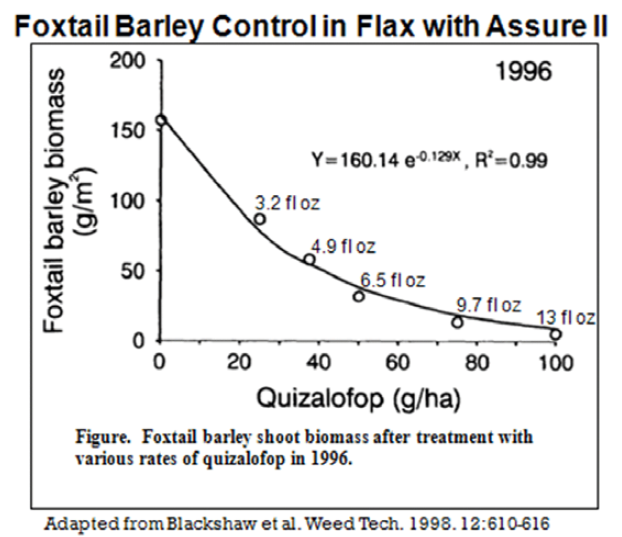
Glyphosate applied EPP, PRE, or post-harvest is critical for long-term control of foxtail barley. The graph below shows the effectiveness of late-summer glyphosate applications. Assure II has been shown to be very effective in broadleaf crops (see graph). In wheat, Group 2 herbicides will provide foxtail barley suppression. See control ratings at the end of the wheat section.
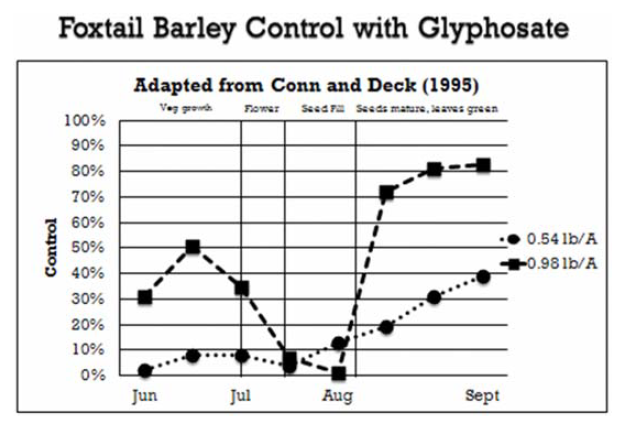
Optimal Glyphosate Application Timing for Foxtail Barley Control (Conn and Deck 1995)
- Tested glyphosate at 8 applications from May to September.
- Two rates (~0.5 and 1 lb/A).
- Foxtail barley control at 0.5 lb = 40% in 1992, =60% in 1993.
- Foxtail barley control at 1.0 lb = 50% - applied during seed fill.
- Foxtail barley control at 1.0 lb = 72-98% - applied Aug-mid-Sept.
- The best and most consistent long-term treatment = glyphosate applied at 1.0 lb/A after foxtail barley seeds had matured.
POST Foxtail Barley Control in Spring Wheat and Flax (Blackshaw et al. 1998)
- Applied POST herbicides to 3- to 4-leaf wheat and 1- to 3-tiller foxtail barley.
Maverick = good control.
Sencor = suppression, but injured wheat.
Achieve, Discover, and Puma = did not control.
Assure II = excellent control.
Poast and Select = suppression but less effective than Assure II.
Fusilade and Fusilade + Puma = suppression.
Integrated Weed Management Approach to Managing Foxtail Barley in Conservation Tillage Systems (Blackshaw et al. 1999)
- Tested combinations of cultural and chemical control to manage foxtail barley in a 4-year study.
- Studied crop row spacing, seeding rate, and application rate and timing of glyphosate in a spring wheat-flax cropping sequence.
- Glyphosate applied preseeding at 0.36 or 0.72 lb ae/A killed foxtail barley seedlings, but suppressed established perennial plants.
- Glyphosate applied post-harvest at 0.72 lb ae/A killed 60-70% of established plants.
- Combinations of preseeding and postharvest glyphosate provided the best control.
- Including flax in the rotation allowed the use of Assure II or Poast to control/suppress foxtail barley.
- An increase in wheat seeding rate from 67 to 103 lb/A reduced foxtail barley growth and increased wheat yield in 3 of 4 years.
Tillage, fertilizer and glyphosate timing effects on foxtail barley management in wheat (Blackshaw et al. Can. J. Plant Sci. 2000)
- Studies combined effects of tillage, N rate, N placement and glyphosate application timing
- Wide-blade tillage in fall and spring reduced foxtail barley all years and increased yield 4 of 5 years.
- N placed mid-row in 4-inch-deep bands reduced foxtail barley in 2 of 5 years and increased wheat yield in 3 of 5 years compared with broadcast N.
- Glyphosate at 0.72 lb/A applied preharvest or postharvest provided similar foxtail barley control in 2 of 3 years.
Established Foxtail Barley Control with Glyphosate Plus AMS (Donald 1988)
- Spring-applied glyphosate at 0.50 lb/A provided good late-season foxtail barley control in only 1 of 3 years.
- Adding AMS to glyphosate significantly increased control to good to excellent late-season control in all three years.
