

Dandelion
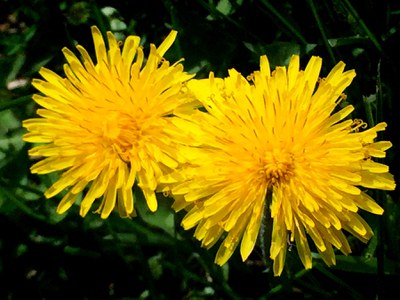
Dandelion (Taraxacum officinale) - Weed of the Year in 2009
Dandelion is a simple perennial weed that is most associated with undisturbed sites such a lawns and continuous no-till fields. The plant is commonly recognized for its bright yellow flowers and pappus attached to seeds that aid in wind-born movement. Above- ground foliage is arranged in a rosette and the large taproot below the soil surface allows the plant to overwinter and continue growth the following year.
Methods of Control
Mechanical Control:
Dandelion is a problem in reduced or no-till fields. Regular aggressive disturbance of the soil root zone by tillage may decrease establishment of dandelion. No-tillage fields that are infested with a dense population of dandelion may benefit from periodic deep cultivation.
Chemical Control:
Herbicide applications of either glyphosate or 2,4-D ester are more effective in the fall than in the spring. Glyphosate applied at 0.75 ae lb/A + AMS at 8.5 to 17 lb/100 gallons water in the fall following crop removal provides approximately 80% control (Table 1). Spring applications are less effective. 2,4-D ester applied at 1 lb ae/A is less effective than glyphosate regardless of application timing.
Tribenuron plus glyphosate and/or 2,4-D ester may provide more consistent control of established dandelion. Because of plant regrowth and new seedling emergence, sequential applications of glyphosate applied POST to Roundup Ready corn, soybean, canola, or sugarbeet will be needed to reduce the population of dandelion.
Table 1. Dandelion control rated at planting in spring
Timing | Glyphosate | 2,4-D ester |
| ---------------------------------------- % Control ---------------------------------------- | ||
| EFall | 78 | 60 |
| LFall | 82 | 58 |
| ESpring | 65 | 35 |
| LSpring | 58 | 30 |
Table 2. POST options for dandelion control.
| Glyphosate + NIS + AMS (Fall-applied) | 0.75 lb ae/A + 25% + 8.5 lb/100 gal | F-G |
| Glyphosate + NIS + AMS (Spring-applied) | 0.75 lb ae/A + 0.25% + 8.5 lb/100 gal | P-F |
| Glyphosate + NIS + AMS (Spring-applied) | 1.5 to 2.25 lb ae/A + 0.25% + 8.5 lb/100 gal | G |
| Glyphosate + 2,4-D ester + AMS (Fall-applied) | 0.75 lb ae/A + 1 pt/A + 8.5 lb/100 gal | G |
| Glyphosate + 2,4-D ester + AMS (Spring-applied) | 1.5 lb ae/A + 1 pt/A + 8.5 lb/100 gal | G |
| Glyphosate + 2,4-D ester + Valor + AMS | 0.75 lb ae/A + 1 pt/A + 2 to 3 oz/A | P-F (Established plants) |
| Glyphosate + 2,4-D ester + Valor + AMS | 0.75 lb ae/A + 1 pt/A + 2 to 3 oz/A | G (Seedling plant) |
| 2,4-D | 1 qt/A | P-F |
| 2,4-D + dicamba | 7 qt/A + 0.5 pt/A | G |
| 2,4-D + tribenuron | 1 qt/A + 0.3 oz/A | F |
| Curtail | 2 yo 4 pt/A | G-E |
| WideMatch | 1 to 1.33 pt/A | G-E |
| Distinct + NIS + UAN | 6 oz/A + 0.25% + 2.5% | G |
| Status + PO + UAN | 5 oz/A + 1 qt/A + 2,5% | G |
| Ignite 280 + AMS | 29 to 36 fl oz/A + 3 lb/A | G-E |
| Liberty + AMS | 24 fl oz/A + 3 lb/A | G |
| Liberty + atrazine + AMS | 24 fl oz/A + atrazine + 3 lb/A | G |
| Callisto + atrazine + Oil + UAN | 3 fl oz/A + 0.5 pt/A + 1% + 2.5% | G |
| Impact + atrazine + Oil + UAN | 0.5 to 0.75 fl oz/A + 0.5 pt + 1% + 2.5% | G |
| Laudis + atrazine + Oil + UAN | 3 fl oz/A + 0.5 pt/A + 1% + 2.5% | G |
Dicamba, Callisto, Impact, Laudis, Curtail, Distinct, and WideMatch may leave a residue in the following cropping season and has crop rotation restrictions.
