DroughDrought Impacting U.S. Winter Wheat Production, but Price Response May be Limited
Frayne Olson, Crop Economist/Marketing Specialist
Based upon the May 26, 2026, USDA Crop Progress report, only 26% of the U.S. winter wheat crop was rated in good or excellent condition. This is the lowest good-to-excellent rating for this time of year since reports began in 1986. The majority of the low crop ratings is due to continuing drought conditions in key winter wheat-producing regions. However, frost damage in the High Plains, which runs from southwest Nebraska into the Texas panhandle, is also contributing to the low ratings.
Figure 1 shows the May 26, 2026, U.S. Drought Monitor map. The key hard red winter wheat production regions in Kansas, Colorado, Oklahoma and Texas are rated in Severe Drought (D2) and Extreme Drought (D3).
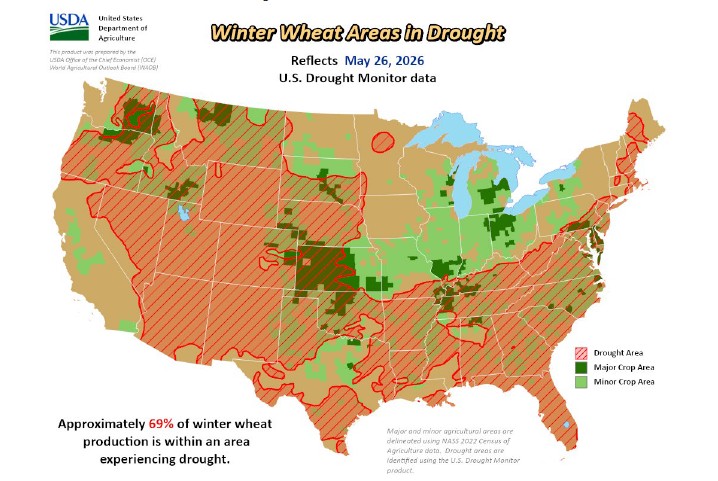
Figure 2 combines the land area categorized in Moderate Drought (D1) or higher from the U.S. Drought Monitor map and the U.S. winter wheat production regions reported by the USDA. The red hatched area represents drought zones, while dark green areas are major winter wheat production regions and light green areas are minor regions.
The USDA winter wheat production regions include hard red winter, soft red winter, hard white winter and soft white winter wheat classes. The USDA Crop Progress crop ratings combine these same classes.
The USDA estimates that about 69% of the total expected winter wheat production is in Moderate Drought (D1) or higher conditions. The May 26 crop report shows especially poor ratings for hard red winter wheat:
- Kansas: 15% good-to-excellent
- Oklahoma: 12%
- Montana: 19%
- Colorado: 7%
- Texas: 14%
Soft red winter wheat regions have much better ratings:
- Illinois: 70%
- Ohio: 68%
- Michigan: 58%
The Pacific Northwest (soft white wheat region) also shows higher ratings:
- Washington: 76%
- Idaho: 80%
- Oregon: 54%
The Wheat Quality Council’s Kansas tour found highly variable crop conditions, with some fields showing severe drought stress, freeze damage and disease, while others had minimal issues. The tour projected Kansas production at 218 million bushels with an average yield of 37 bushels per acre, similar to USDA estimates.
Hard red winter wheat harvest is just beginning in Texas and Oklahoma, and markets will closely monitor yield and quality reports as harvest expands. Another key factor is abandonment rates, which are expected to be higher than normal due to drought and other stresses.
The combination of lower U.S. wheat plantings and declining yield expectations has supported wheat prices. However, the USDA is still forecasting strong U.S. ending stocks.
Even with reduced plantings and lower yields, the stocks-to-use ratio is expected to be above the 25-year average. This means wheat prices will still be influenced by:
- Weather
- Yield reports
- Crop quality
However, price increases may not be as large as many farm managers expect.
U.S. wheat exports account for about 45% of total use, while domestic milling accounts for about 50%. Because of this, U.S. wheat must remain competitively priced in global markets. If prices rise too much, exports may fall and inventories could increase.
As a result, price increases driven by lower production are likely to be limited by global competition. Farm managers need to keep realistic price expectations when planning their 2026 marketing strategies.