
Beef Cow Numbers and Calf Crop Continue to Decline, Replacement Heifers Up
Tim Petry, NDSU Extension Livestock Marketing Specialist | July/August 2026
The USDA National Agricultural Statistics Service (NASS) released the semiannual July 1 Cattle Inventory report on July 24. The current and past reports are available online at https://usda.library.cornell.edu/concern/publications/h702q636h.
The July Cattle Inventory report is important because it gives a midyear indication of possible changes in cattle numbers, beef production and potential market price impact. The July report, which provides only total U.S. cattle inventory numbers, is less detailed than the January report, which provides a more detailed state-by-state breakdown, allowing regional comparisons and weather-related changes to be documented.
NASS pegged the July 1 U.S. beef cow herd at 28.45 million head, down 200,000 head from the 28.65 million last year. The eight straight years of July 1 beef cow liquidation resulted in the smallest inventory in the series since records began in 1973. That decline signals a continuation of short cattle supplies for at least another year.
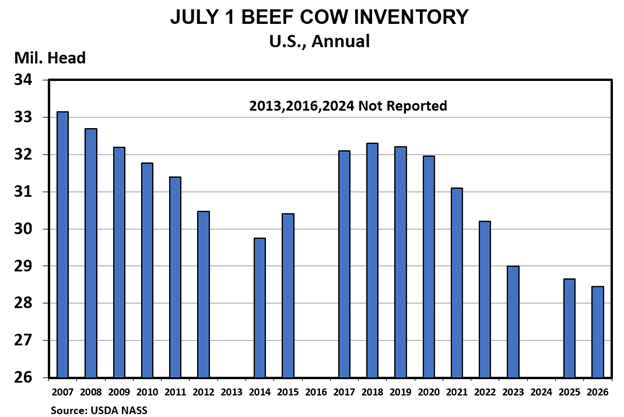
July 1 Beef Cow Inventory — U.S., Annual
Source: USDA NASS
The July 1 beef cow estimate is usually higher than the previous Jan. 1 estimate with the addition of first calf heifers calving, but this year’s 3% increase from 27.6 million to 28.45 million has historically indicated expansion. Improved moisture conditions in several important beef cattle-producing regions, record-high cattle prices and a 16% decrease in beef cow slaughter may have contributed to interest in beef herd rebuilding.
While beef cow numbers declined 200,000 head, milk cow numbers countered with a 200,000 head increase from 9.45 million head on July 1, 2025, to 9.65 million in 2026. That increase may highlight the role of beef-on-dairy genetics in resilient U.S. beef production despite the declining beef cow herd.
Beef replacement heifers were estimated at 3.8 million head – up 2.7%, but still the second-smallest since July 1 records began in 1973.
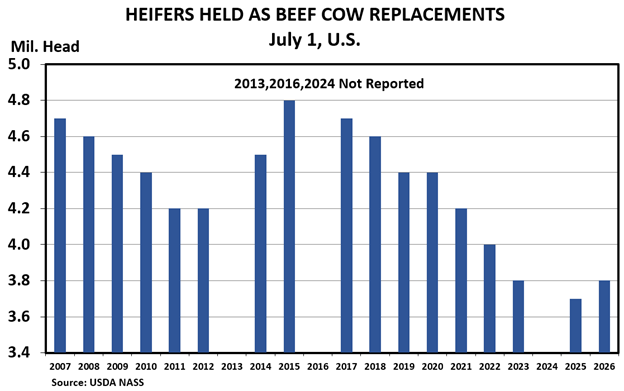
Heifers Held as Beef Cow Replacements — July 1, U.S.
Source: USDA NASS
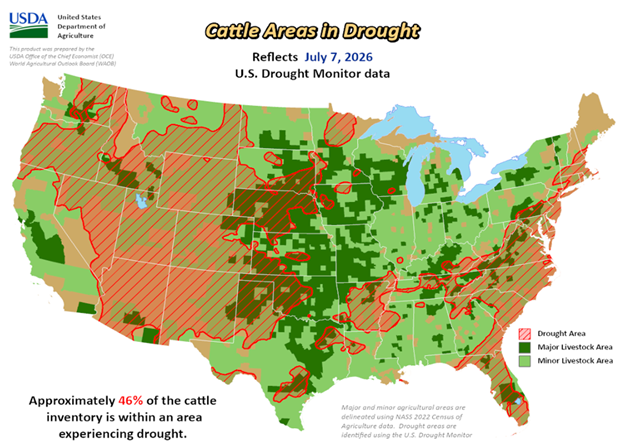
While some producers are retaining more heifers where moisture conditions allow, there has not yet been significant expansion. The USDA reported that 46% of cattle resided in drought conditions on July 7.
The July Cattle Inventory report provided very important information on potential calf and feeder cattle supplies and future beef production. It was NASS’s first estimate of the 2026 calf crop. The calf crop, which includes both beef and dairy calves, is projected to decline 1.5% from just under 33 million head last year to 32.5 million head.
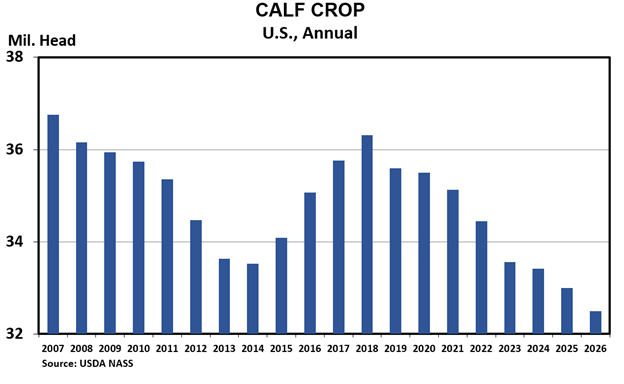
Calf Crop — U.S., Annual
Source: USDA NASS
The USDA estimated 23,900 calves were born in the first half of 2026, with another 8,600 to be born in the second half.
July 1 residual feeder cattle supplies outside feedlots were estimated to be 33.6 million head, down from 33.8 million last year and the lowest in many years. Coupled with a potential increase in beef heifer retention, this will cause historically tight supplies.
The smaller calf crop and tight feeder cattle supplies will mean fewer cattle marketed and a decline in beef production. The USDA predicts that 2026 beef production will fall to 25.36 billion pounds from 26.07 billion pounds in 2025, then decline further to 25.27 billion in 2027.
Fall feeder cattle supplies will likely be impacted by the USDA’s July 24 announcement that a phased reopening of the Mexican border for cattle imports would begin on Aug. 24. The initial opening will be the Douglas, Arizona, port, with New Mexico ports at Columbus and Santa Teresa potentially opening later.
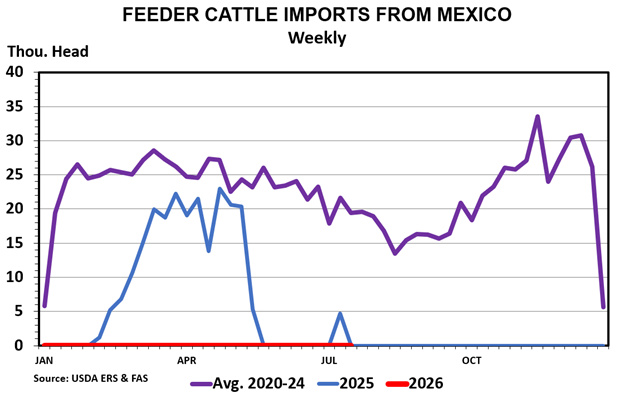
Prior to the ban, Mexican cattle accounted for about 5% of U.S. feedlot placements, but the ban adversely affected feedlot and packing plant capacity in the southern Great Plains. The initial flow of Mexican cattle will likely be slow and well below the levels from before the ban.
Feeder Cattle Imports from Mexico — Weekly
Source: USDA ERS & FAS
Despite lower cattle numbers, cattle on feed in U.S. feedlots on July 1, 2026, increased to 13.2 million head from 13 million in 2025. The increase was due to slow feedlot turnover, which contributed to longer days on feed, higher carcass weights and enhanced beef production.
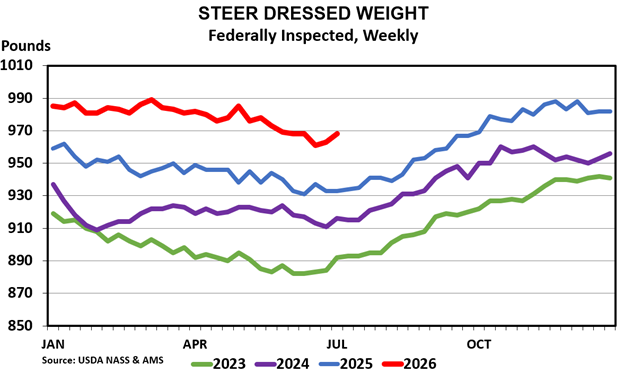
Steer Dressed Weight — Federally Inspected, Weekly
Source: USDA NASS & AMS
Tighter cattle supplies will be supportive to fall calf prices. But many uncertain supply-and-demand factors cause the cattle market to be quite volatile: record-high retail beef prices, Iran war uncertainty (especially higher gas prices affecting consumers’ budgets), President Trump’s comments about lowering retail beef prices with increased beef imports, foreign and U.S. stock market volatility, the Mexican border phased reopening to cattle imports, beef packing plant closures and labor strikes, tariff and trade agreements negotiations, managed money funds entering or exiting cattle futures markets, beef export market headwinds, and weather impacting forage and feed grains production and prices.
Marketing plans with price risk management strategies that set a floor price, but leave the top side open, should be considered.
