
Feeder cattle futures market volatility and the CME Feeder Cattle Index price
Tim Petry, NDSU Extension Livestock Marketing Specialist | September 2026
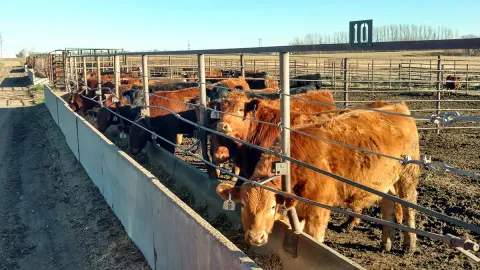
Chicago Mercantile Exchange Group (CME) live cattle and feeder cattle futures market prices have been quite volatile this year. Futures markets try to anticipate what the cash market will be.
Feeder cattle cash and futures prices traded at record-high levels in the first half of 2026 due to lower cattle and beef supplies and relatively strong consumer beef demand. When futures prices are record-high, volatility is usually also high because many fundamental supply-and-demand factors can affect the market in the future.
Cattle and beef supply factors are well-documented. The July USDA Cattle Inventory report confirmed the eighth-straight year of drought-forced beef cow liquidation, causing smaller calf crops and declining beef production. The report is available at
https://usda.library.cornell.edu/concern/publications/h702q636h.
Lower supplies have been supportive to prices.
Beef demand has been strong, as consumers become more protein driven. However, many dynamic, fundamental supply-and-demand factors are causing enough uncertainty to make the futures and cash markets volatile.
Some factors causing market volatility include record-high retail beef prices, Iran war uncertainty (especially causing higher gas prices affecting consumers’ budgets), President Donald Trump’s comments about lowering retail beef prices with decreased tariff-rate quotas to increase beef imports, foreign and U.S. stock market volatility, the Mexican border closure to cattle imports due to New World Screwworm and subsequent phased reopening on Aug. 24, beef packing plant closures and labor strikes, tariff and trade agreements negotiations, managed money funds entering or exiting cattle futures markets, beef export market headwinds, and weather impacting forage and feed grains production and prices.
For example, wet conditions in the eastern Corn Belt and dry conditions in the western Corn Belt are causing volatile corn futures prices. Typically, a 10-cent-per-bushel change in corn prices causes a $1 per hundredweight change in calf prices in the opposite direction.
That being said, arbitrage causes futures and cash markets to be the same at futures market contract maturity.
Since there are many weights and grades of calves and feeder cattle marketed at many markets throughout the U.S., what is the cash market that the feeder cattle futures market is anticipating?
The answer is the CME Feeder Cattle Index.
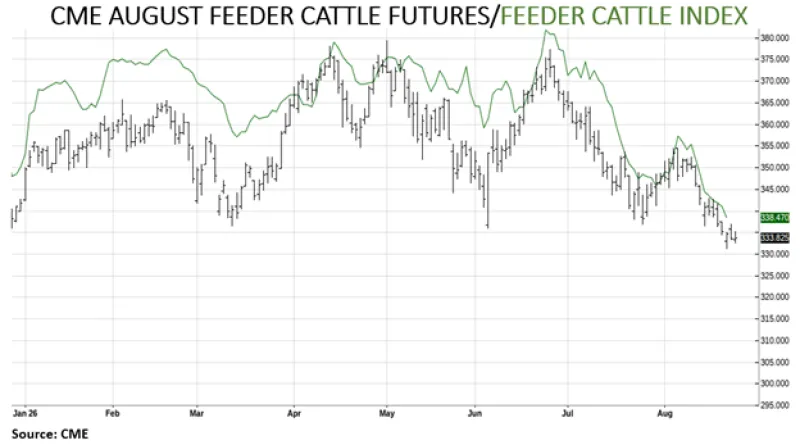
Since CME feeder cattle futures contracts are cash-settled rather than by actual delivery of cattle to a physical site, all open contracts after termination of trading on the last Thursday of the contract month are settled with the Index.
The Index is based on feeder cattle auction, direct trade, video sale and internet sale transactions within the 12-state region of Colorado, Iowa, Kansas, Missouri, Montana, Nebraska, New Mexico, North Dakota, Oklahoma, South Dakota, Texas and Wyoming for which the number of cattle, weighted average price and weighted average weight are reported by the USDA’s Agricultural Marketing Service (AMS).
The three North Dakota markets reported by AMS and included in the Index are Kist Livestock Auction in Mandan, Napoleon Livestock in Napoleon and Stockmen’s Livestock Exchange in Dickinson.
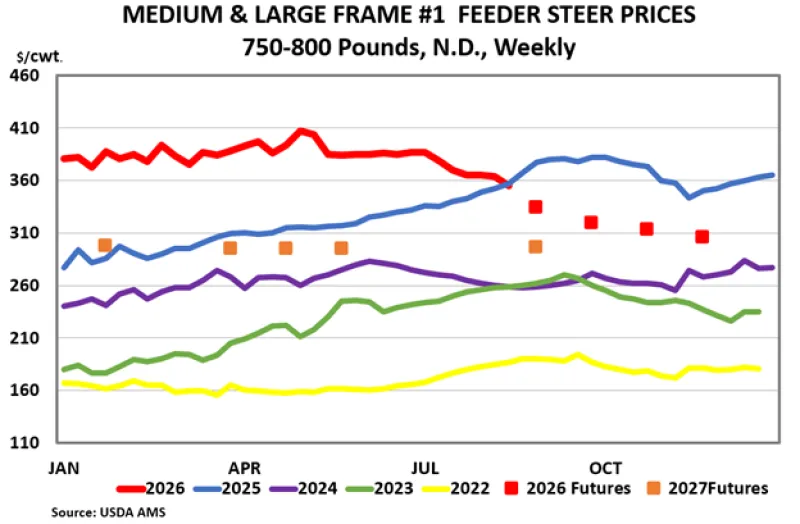
Individual market reports are available on the AMS website at
www.ams.usda.gov/market-news/livestock-poultry-grain#cattle.
Feeder cattle weights and USDA grades included in the Index are 700- to 899-pound medium- and large-frame No. 1 feeder steers, and 700- to 899-pound medium- and large-frame Nos. 1 and 2 feeder steers.
Feeder cattle identified as having predominantly dairy, exotic, or Brahman breeding and cattle from an origin outside the U.S. are excluded.
A detailed description of the Index specifications is available in the CME feeder cattle rulebook at
www.cmegroup.com/rulebook/CME.
The Index is a seven-day weighted average, defined as the total dollars sold divided by the total pounds of eligible feeder steers sold.
Each market day, the CME posts the Index price at
www.cmegroup.com/market-data/reports/cash-settled-commodity-index-prices.html.
The Index is also important for calf and feeder cattle producers who use the USDA’s Risk Management Agency’s Livestock Risk Protection (LRP) insurance, a valuable price risk management tool when prices are volatile. The USDA uses the Index price to determine the “Actual End Value” for calf and feeder cattle LRP insurance policies.
The 600- to 1,000-pound feeder steer and 100- to 599-pound heifer calf contracts’ actual ending values are the Index price. The 100- to 599-pound steer contracts receive a 10% premium, and the 600- to 1,000-pound heifer contracts receive a 10% discount. So, LRP contracts for calf and feeder cattle are affected by the Index.
