
Waterhemp
Corresponding Author: Joe Ikely
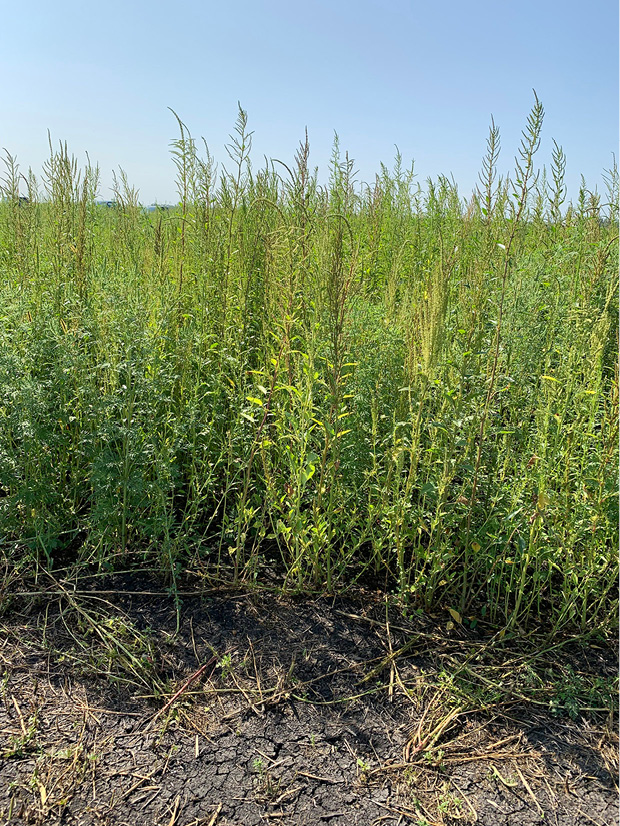
Waterhemp (Amaranthus tuberculatus) - 2012 Weed of The Year
Waterhemp is prevalent in the eastern ND because of:
- Mistaken identification for redroot pigweed and Powell amaranth and ineffective herbicide selection
- Movement of small, light seeds by water and overland flooding
- Continuous emergence until early August
- Rapid plant establishment along field perimeters, standing water, and drainage ditches
- A regional wet cycle creating an ideal environmental condition for germination and establishment
- Few effective postemergence herbicides in dry bean, soybean, and sugarbeet
- Lack of foundation (soil-applied) herbicide use
- Not making timely applications to small plants
- Early infestations (small patch of 5-10 plants) of resistant plants (resistant genes) were not killed or removed from the field
- Mistaking herbicide resistance for herbicide non-performance
- Pollen from resistant plants can travel a moderate distance and pollinate flowers on susceptible plants which increases the frequency of resistant plants in the population.
- Extremely high seed production - up to 5 million seeds / plant
- Low-level resistance can amplify through successive generations requiring higher herbicide rates for similar control
- Most waterhemp populations are resistant to ALS herbicides
- Over-reliance on glyphosate applied alone resulting in selection of resistant biotypes
- Diverse genetics (like kochia) resulting in mutant biotypes expressing cross and multiple herbicide resistance to the following herbicide modes of action:
- ALS inhibitor
- Growth regulator
- Triazine
- Glyphosate
- PPO inhibitor
- and HPPD inhibitor
Glyphosate-resistant waterhemp has been confirmed in Richland County, ND, is highly suspected in Cass and Ransom Counties, ND and may also be present in Barnes, Dickey, Lamoure, Sargent, and Traill Counties, ND.
Biology of Waterhemp:
Waterhemp is in the pigweed (Amaranth) family, has a summer annual life cycle, is dioecious (male and female flowers are found on separate plants), and has stems with little to no hair compared to redroot pigweed and Powell amaranth. Leaves are longer, narrower, and waxier (shinier) than redroot pigweed and Powell amaranth. Waterhemp can easily produce 300,000 seeds per plant and produce 1.5 times more seed than other pigweed species of similar size. A waterhemp plant in Iowa was documented to produce almost 5 million seeds per plant. Seed can remain viable in the soil for at least 4 years and high seed production can cause rapid changes in population density. Waterhemp emergence begins in mid-May and continues through the early August. Waterhemp is
a moderate competitor, capable of reducing corn and soybean yield by 15 to 44%, respectively.
Management of Waterhemp:
Waterhemp control is best using a combination of PRE followed by POST herbicides. Due to a late-season emergence pattern, two POST herbicide applications may be necessary even following a PRE herbicide. Use full PRE herbicide rates for full herbicide activity during waterhemp germination and to extend residual herbicide control. The frequency of herbicide resistant biotypes requires full rates of PRE herbicides. Apply POST herbicides to small (1 to 3”) plants. Waterhemp biotypes resistant to glyphosate usually has a higher level of resistance compared to common or giant ragweed, causing glyphosate to be less effective. The most important goal of managing waterhemp is to nearly eliminate seed production using all available tools, including hand-weeding.
Chemical Control of Waterhemp (ALS-Resistant):
The indicated level of control from herbicides listed below will occur ONLY if PRE herbicides are activated by sufficient rainfall and POST herbicides are applied to small (1 to 3”) waterhemp:
Corn: See pages 18-23 in the ND Weed Control Guide for additional herbicide information
E control from PPI/PRE herbicides = Camix2, Lumax (3 pt/A)2, Verdict (> 12 oz/A).
G-E control from PPI/PRE herbicides = Balance Flexx2, Callisto2, Harness/Surpass, Prequel2, Sharpen
(3 oz/A).
E control from POST herbicides = Callisto2 + atrazine/Callisto Xtra2, Halex GT1,2 (RR corn only),
Impact + atrazine2, Laudis + atrazine2, Lumax2.
G-E control from POST herbicides = Callisto2, Impact2, Laudis2
Soybean: See pages 24-29 in the ND Weed Control Guide for additional herbicide information
E control from PPI/PRE herbicides = Fierce.
G-E control from PPI/PRE herbicides = Boundary2, Gangster1,2, Sonalan2, Treflan*2, Valor.
E control from POST herbicides = Flexstar2 (< 3” plants), Flexstar GT 3.52 (RR soybean only)
G-E control from POST herbicides = Cobra (< 2” tall), Ultra Blazer (< 2” tall)
Wheat: See pages 7-13 in the ND Weed Control Guide for additional herbicide information
E control from PPI/PRE herbicides = None
G-E control from PPI/PRE herbicides = None
E control from POST herbicides = None
G-E control from POST herbicides = GoldSky2, Huskie, Wolverine
Dry Bean: See page 30-31 in the ND Weed Control Guide for additional herbicide information
E control from PPI/PRE herbicides = None
G-E control from PPI/PRE herbicides = Sonalan2, Treflan*2
E control from POST herbicides = None
G-E control from POST herbicides = Reflex*2
Sugarbeet: See page 42-43 in the ND Weed Control Guide for additional herbicide information
E control from PPI/PRE herbicides = None
G-E control from PPI/PRE herbicides = None
E control from POST herbicides = None
G-E control from POST herbicides = None
*Or generic equivalent
1Will not effectively control resistant waterhemp populations
2May carry over more than one cropping season, especially to sugarbeet. Follow labeled crop rotation restrictions, see specific product label or see pages 108-109 in the ND Weed Control Guide.
