

Understanding and Using the SCN Profit Checker
What is the SCN Profit Checker?
The SCN Profit Checker is a free, web-based tool developed by The SCN Coalition to help farmers estimate the yield and economic losses caused by SCN. By inputting field-specific data, such as SCN egg counts from soil tests, average yield, and current soybean prices, farmers can quantify losses in bushels and dollars per acre, revealing the hidden impact of SCN. The tool is tailored to North Dakota’s soybean-growing regions and provides insights to prioritize management strategies like resistant varieties and crop rotation, giving farmers data-driven tools to protect profits on their operation. Access this tool at https://www.thescncoalition.com/profitchecker/.
The SCN Profit Checker:
- Estimates yield and profit losses based on your field’s SCN egg counts, field characteristics, expected yield, and soybean prices.
- Estimated losses help farmers evaluate input costs associated with SCN management practices, such as soil testing, resistant varieties, and seed treatments.
- Helps farmers to prioritize fields for intensive management, especially in high-risk areas.
Step-by-Step Guide to Using the SCN Profit Checker
Step 1: Collect SCN Egg Count from Soil Sampling
To use the SCN Profit Checker, you need an SCN egg count from your field. Soil testing is critical because SCN populations vary across North Dakota fields, even within a single farm.
- When to Sample: Fall (post-harvest) or spring (pre-planting) for accurate egg counts.
- How to Sample:
- Use a soil probe to collect 10–20 cores (6–8 inches deep) per 10 acres.
- Focus on high-risk areas such as field entrances, low spots, or areas with lower than expected yields.
- Mix cores thoroughly in a bucket and submit at least a 1 cup sample to a testing lab.
- Refer to the LINK TO HOW TO SOIL SAMPLE. webpage for a more detailed description.
Step 2: Access the SCN Profit Checker
- Visit https://www.thescncoalition.com/profitchecker/. No account or software download is required. This tool is web-based and mobile-friendly.
Step 3: Input Your Data
The SCN Profit Checker requires the following factors to be entered.
- Select State: Select which state the field of interest is located.
- SCN Egg Count: Enter the number of SCN eggs per 100 cc of soil from your soil test report (e.g., 2,000 eggs/100 cc). When entering this value, ensure that the test is reading eggs per 100 cc of soil (roughly ½ of a cup).
- SCN Female Index: A value is automatically assigned based on the state selected, which represents an estimated average Female Index from that state (in North Dakota, this is determined by NDSU plant pathologists). This value represents the ability of SCN populations to reproduce on PI88788 resistant soybean line. If you have performed an SCN HG type test, then enter the female index value that was determined. Or, if you have grown soybeans for many years and are in an area known to have SCN, you may consider increasing the estimated number (e.g., 30).
- Enter the Percent Sand and Soil pH: SCN are known to have increased rates of reproduction in soils with higher sand content as well as in high soil pH levels.
- Average Yield: Use your field’s 3–5 year average yield (e.g., 50 bushels/acre). Check yield monitor data or consult your records.
- Soybean Price: Input the current or projected sale price (e.g., $10/bushel).
Step 4: Interpret the Results
After entering your data, the tool provides the following output.
- Estimated Yield Loss: The percentage of bushels/acre lost due to SCN.
- Economic Loss: The dollar value of lost yield per acre (e.g., $60/acre at $10/bushel).
- Management Insights: Recommendations, such as adopting Peking resistance or extending crop rotations, if losses are high.
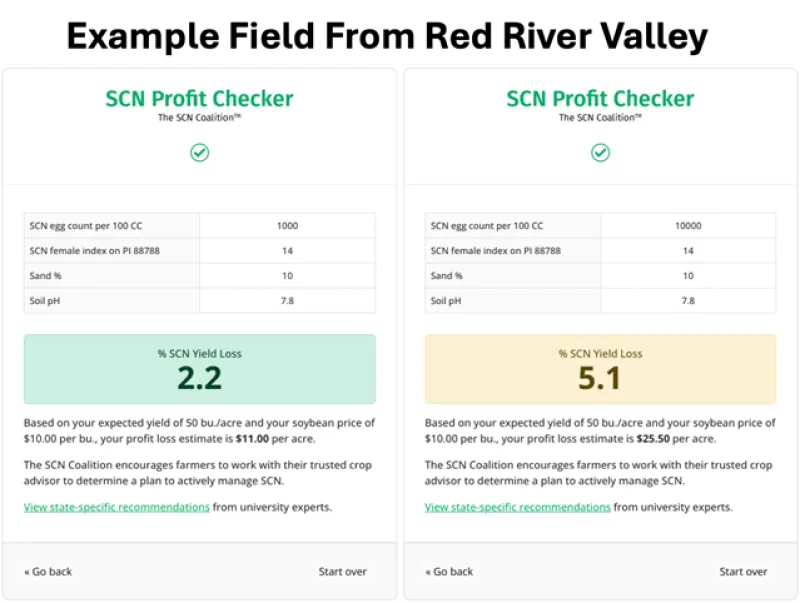
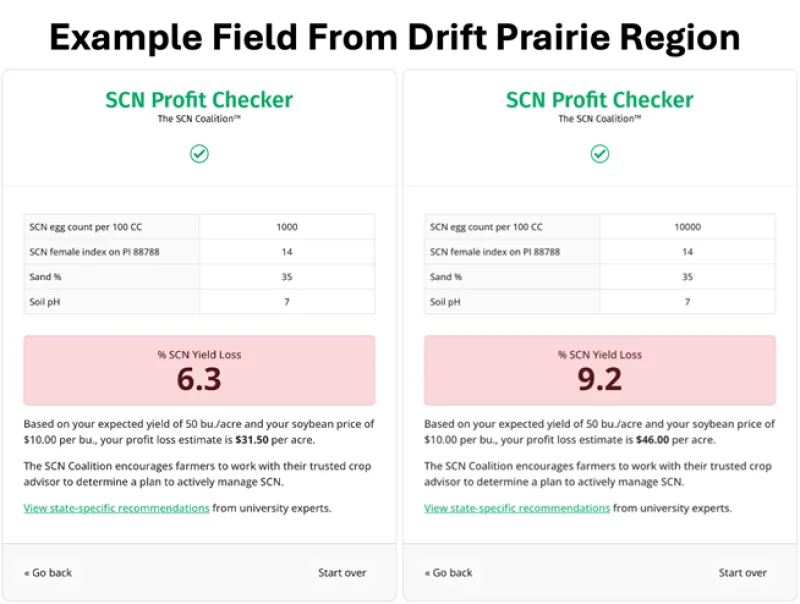
Field Example: For a Cass County field with 10,000 eggs/100 cc, 50 bushels/acre yield, and $10/bushel, the tool might estimate a 5.1% yield loss (2.55 bushels/acre), leading to an estimated loss of $25.50/acre. This example is seen in Figure 1.
Compare the results across different fields to prioritize management. Fields with egg counts above 2,000 eggs/100 cc may require immediate action. However, egg counts at any level could quickly lead to significant yield losses if not managed appropriately.
For More Information
Visit www.thescncoalition.com for comprehensive SCN resources, including videos, farmer testimonials, and management strategies. Your county Extension agent or the NDSU Plant Pathology team (701-231-8362) or via https://www.ndsu.edu/agriculture/academics/academic-units/plant-pathology can provide localized advice. The NDSC/NDSU sampling program’s cumulative data (2013–2024) offer insights into SCN’s spread across North Dakota, available through NDSU Agriculture publications.
Wade Webster, Extension Soybean Pathologist, NDSU
richard.webster@ndsu.edu
701-231-7057
Guiping Yan, Nematologist, NDSU
guiping.yan@ndsu.edu
Updated: May 2025
