

The impact of emergency diesel tax relief for agricultural producers
Matthew Gammans, NDSU Department of Agribusiness and Applied Economics assistant professor | October 2026
On Sept. 29, Gov. Kelly Armstrong announced a fuel emergency and an executive order letting licensed vehicles used in agricultural operations utilize red-dyed diesel on North Dakota highways through Nov. 30. Typically, red-dyed diesel can only be used for certain off-highway purposes. Red-dyed diesel includes 4 cents per gallon of North Dakota excise tax, compared to the 23 cents per gallon charged on regular diesel. The federal tax of 24.4 cents per gallon is unaffected by this policy. This policy comes in response to historically high diesel prices, which exceeded $6.50/gallon last month according to the U.S. Energy Information Administration. The historical time series of diesel prices can be seen in Figure 1 below:
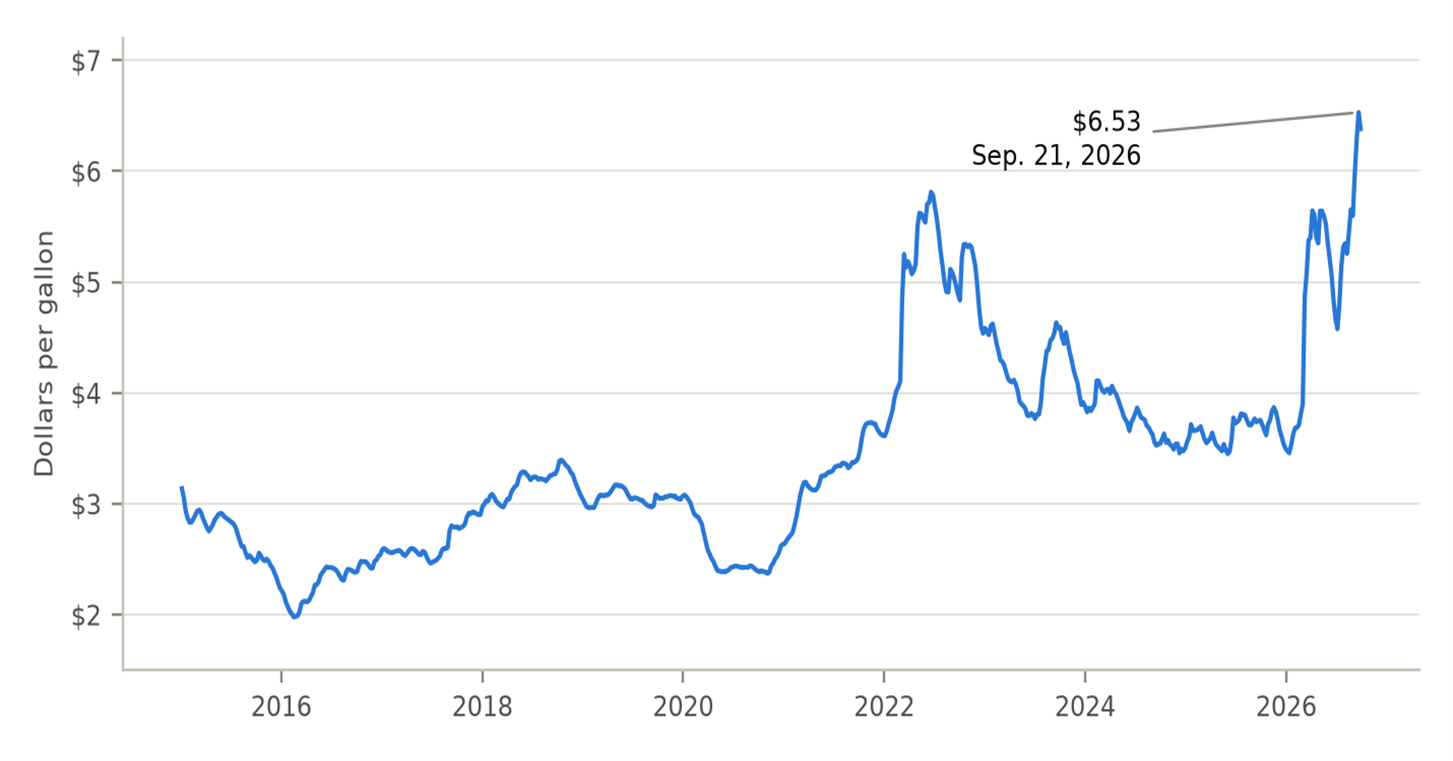
Figure 1. U.S. average retail price of No. 2 diesel, weekly, 2015-2026. Prices peaked at $6.53 per gallon in the week of Sept. 21, 2026.
Source: U.S. Energy Information Administration, Weekly Retail Gasoline and Diesel Prices (FRED series GASDESW).

The recently announced diesel tax relief will generate savings for farmers who utilize diesel fuel for on-highway purposes. This article estimates the impact of this executive order on North Dakota's corn and soybean farmers.
To estimate savings generated, I first estimated the total number of truckloads hauled on-highway during the harvest season. Assumptions and data sources are shown in Table 1. I use USDA NASS Crop Production forecasts for 2026 production of each crop, USDA NASS Grain Stocks reports for the share of each crop hauled off the farm between Sept. 29 and Nov. 30, and NDSU's Upper Great Plains Transportation Institute (UGPTI) farm truck survey (Northern Plains Grain Farm Truck Fleet & Marketing Patterns report) for the average truckload.
I combined the above estimates of truckloads with an assumed average one-way trip length of 27.8 miles, based on the UGPTI farm truck survey. Assuming each truck returns empty over the same distance, this gives the total miles driven. I then apply an assumed truck fuel economy of 6.2 miles per gallon, as reported in Oak Ridge National Laboratory's Transportation Energy Data Book, to convert miles to gallons of diesel. Each gallon that switches to dyed diesel saves 19 cents in state tax.
Table 1. Assumptions and data sources
| Assumption | Corn | Soybeans | Sources and notes |
|---|---|---|---|
| 2026 production (million bushels) | 578.5 | 203.7 | USDA NASS, Crop Production (Sept. 11, 2026) |
| Share of crop hauled off the farm, Sept. 29-Nov. 30 | 43.3% | 60.5% | (Production − Dec. 1 on-farm stocks) ÷ production. Source: USDA NASS, Grain Stocks, North Dakota on-farm stocks, 2024-2025 average |
| Average load (tons per truck) | 21.5 | 21.7 | Northern Plains Grain Farm Truck Fleet & Marketing Patterns report. Bushels per load by truck type (Table 3.65), weighted by each type's share of ND grain hauling (UGPTI 2024, Table 12) |
| Average one-way trip (miles) | 27.8 | 27.8 | Northern Plains Grain Farm Truck Fleet & Marketing Patterns report Table 3.56, North Dakota corn deliveries (this value is used for both corn and soy) |
| Truck fuel economy (miles per gallon) | 6.2 | 6.2 | Oak Ridge National Laboratory, Transportation Energy Data Book, Ed. 40, Table 5.2 |
| State tax savings (cents per gallon) | 19 | 19 | 23¢ on clear diesel minus 4¢ on dyed diesel |
Total savings by crop are shown in Table 2 below. I found that the executive order saves corn farmers a total of roughly $560,000 and soybean farmers a total of roughly $290,000, for a total of about $850,000 on 4.5 million gallons of diesel. This total assumes every eligible truck switches to dyed diesel. If only trucks already fueled from on-farm tanks switched (about 53% of heavy farm trucks in the 2021 Vehicle Inventory and Use Survey), savings would be about $450,000. Federal penalties for using dyed diesel on highways also still seem likely to apply, which could potentially limit use unless the IRS grants relief.
Two other factors also push these figures down. First, some of the crop had already been harvested before the order took effect: 8% of corn and 22% of soybeans by Sept. 27 (USDA NASS Crop Progress). If that grain left the farm at the same rate, savings would be about $740,000. Second, some grain is picked up at the farm by elevators or commercial haulers; in a 2001 UGPTI elevator survey, North Dakota elevators reported buying 14% of their grain this way. Those trucks rarely carry dyed diesel, and any savings would go to the hauler rather than the farmer. So, the realized savings may be slightly lower than those reported here.
Table 2. Estimated savings by crop, Sept. 29-Nov. 30, 2026
| Crop | Bushels hauled (million) | Truckloads | Miles driven (million) | Diesel (million gallons) | Savings |
|---|---|---|---|---|---|
| Corn | 250.6 | 326,672 | 18.2 | 2.93 | $560,000 |
| Soybeans | 123.2 | 170,095 | 9.5 | 1.53 | $290,000 |
| Total | 373.8 | 496,766 | 27.6 | 4.45 | $850,000 |
Assumes every eligible truck gallon switches to dyed diesel. Excludes other crops, trips from field to on-farm bins, and livestock and fertilizer hauling.
Dividing these total savings by total crop acreage implies that a 2,000-acre corn/soy operation would see total savings of about $170 this fall. Overall, the executive order should generate savings for North Dakota farms, although the magnitude of these savings will be quite small relative to the substantial increase in diesel expenditures due to high prices. The USDA's Economic Research Service forecasts U.S. farm fuel expenses to rise 29% in 2026, from $16.8 billion to $21.6 billion. Applied to the $360 million North Dakota farms spent on diesel in 2025, that implies roughly $100 million in additional diesel costs this year.
