Talkin’ turkey, Givin’ thanks
Tim Petry, NDSU Extension Livestock Marketing Specialist | November 2026
As the calendar turns to November, our thoughts may turn to planning Thanksgiving family get-togethers, which, of course, include bountiful holiday meals that may feature turkey. Included are abundant side dishes from a wide variety of ingredients, many of which originate from a very productive and diverse U.S. agricultural industry.
Dining room tables may also have beef, veal, lamb, pork, chicken or other poultry. A novelty Thanksgiving meat made famous by legendary sports broadcaster John Madden is the turducken, which is a deboned chicken inside a deboned duck inside a deboned turkey.
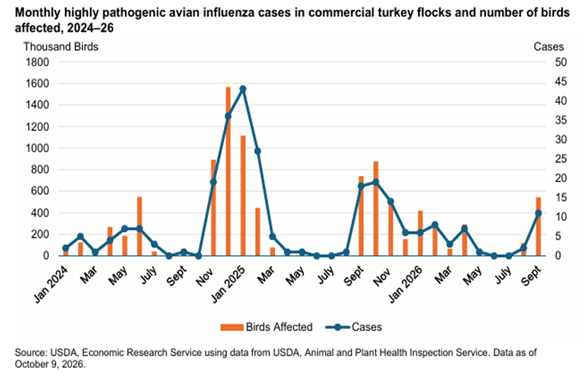
U.S. turkey production has been below average for the last several years due to increased cases of highly pathogenic avian influenza (HPAI) occurring in turkey flocks.
Annual turkey production averaged 5.42 billion pounds in 2020-2024, but turkey production fell to 4.8 billion pounds in 2025 when more HPAI cases occurred.
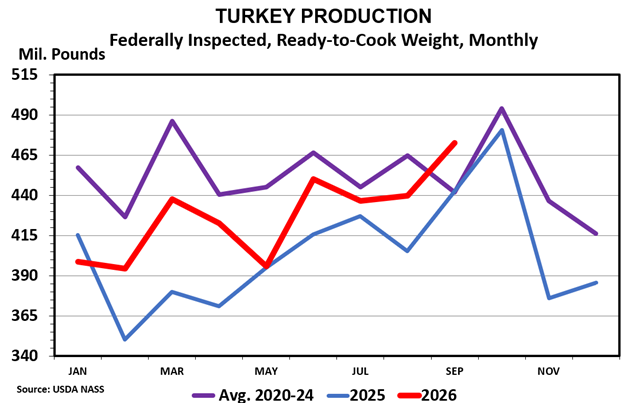
The USDA is predicting a rebound in 2026 turkey production to 5.13 billion pounds. However, a watch factor for production will be the fall wild bird migration because HPAI has reappeared in several commercial turkey flocks in Minnesota, Wisconsin, North Dakota and South Dakota this fall.
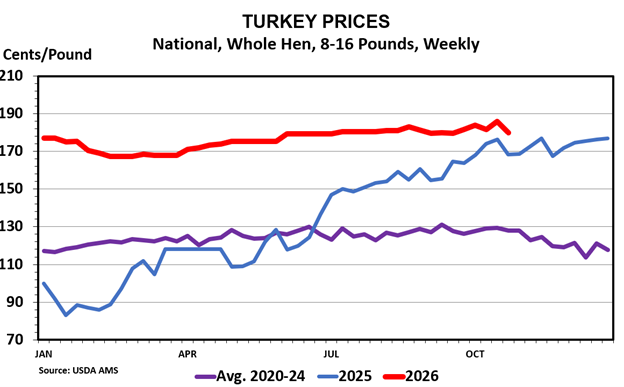
A normal seasonal pattern for turkey prices is a steady yearly increase until October, right before the peak Thanksgiving holiday demand. However, in 2025, prices increased at a higher rate due to lower production.
The USDA Agricultural Marketing Service (AMS) reported a more normal seasonal pattern in turkey prices (national, whole hen, 8-16 pounds) in 2026.
Current turkey prices are $1.80 per pound compared to $1.68/lb. last year.
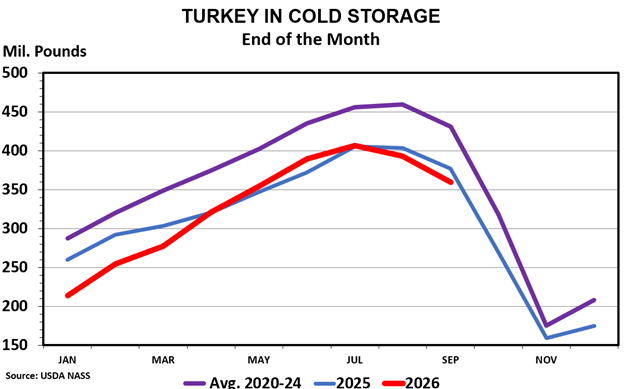
Most turkey hens are sold as frozen whole birds, with many kept in cold storage year-round until just before Thanksgiving. Toms are mostly destined for further processing and made into many consumer products such as breasts, legs, bacon, deli meats and ground turkey that are consumed year-round.
The latest USDA National Agricultural Statistics Service (NASS) Cold Storage report, released on Oct. 23, indicated 11% less turkey in cold storage on Sept. 30 compared to last year, even though production increased.
Turkey hens were down 13%, while toms declined 9%, due to strong domestic and export demand.
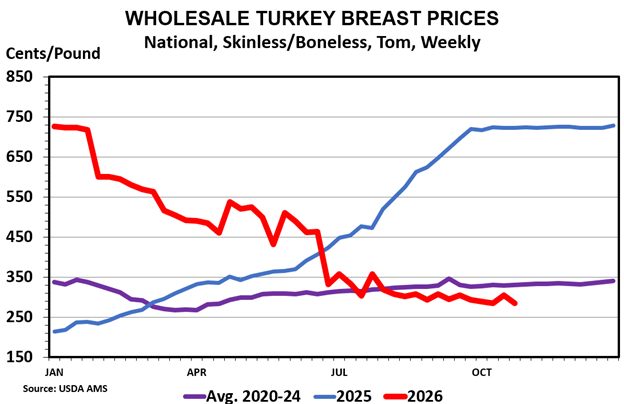
While whole turkey prices are up, turkey breasts could be a bargain for consumers this year, as wholesale prices have declined to $2.85 per pound from $7.23 per pound last year. Turkey breast storage stocks are up 17%.
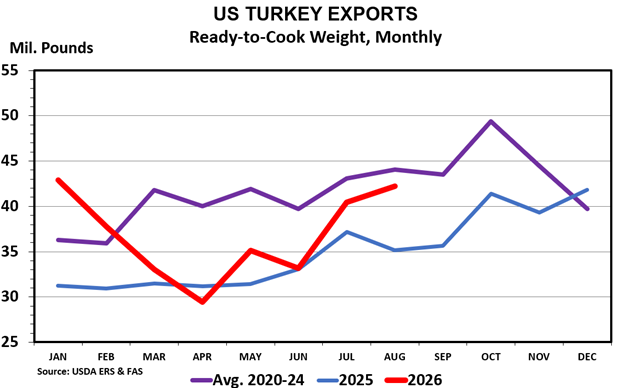
The U.S. is the world’s leading producer of turkeys and turkey meat and is the world’s leading exporter of turkey meat, too. Mexico is by far the leading importer of U.S. turkey meat, followed by Canada, Guatemala, the Dominican Republic and Panama.
With strong foreign demand and increased production, turkey exports in 2026 are projected to rise from 420 million pounds in 2025 to 461 million pounds.
The U.S. is also the leading producer of chicken and is second only to Brazil in beef production and China in pork production.
Likewise, the U.S. is also the leading exporter of high-quality beef and pork and is second only to Brazil in chicken exports.
The U.S. meat industry is crucial to the U.S. economy and livestock producers. Consumers also benefit from an ample, year-round supply of a wide variety of meat products, especially at Thanksgiving.
The USDA is forecasting that 198.5 million turkeys will be raised in 2026, up from 193.5 million in 2025.
Minnesota is the leading turkey-producing state with 34 million birds expected to be produced in 2026. North Carolina ranks second with 29.5 million, and Arkansas third with 21 million. South Dakota ranks 11th at 1.9 million. The USDA does not publish North Dakota turkey production data, but according to the North Dakota Turkey Federation, about 1 million birds are produced annually on nine turkey farms in the state.
How much turkey do we gobble up at Thanksgiving? According to the USDA, about 46 million turkeys are on Thanksgiving tables. U.S. per capita turkey consumption has averaged about 15 pounds over the last 10 years, with 13.2 pounds per person in 2025. The USDA estimates per capita consumption will increase to 13.6 pounds in 2026 due to decreasing production and strong demand.
Although turkey prices have increased, consumers may find bargains when shopping for Thanksgiving turkeys. Some retail chains contract turkeys at lower prices earlier in the year. Retail food stores may feature turkeys as loss leaders, selling them at a below-cost price to lure customers in to purchase higher-margin items that complete the Thanksgiving meal. Sometimes even local price wars emerge.
Even though some food item prices have increased, we still have a lot to be thankful for. U.S. consumers enjoy the safest, largest-quantity, lowest-cost and most diverse food product line, including meat, in the world. Happy Thanksgiving to all of you.