
Farmers should take stock of their forage supply before winter feeding begins
Completing a forage inventory now will aid in ranch-level decision-making and save costs.
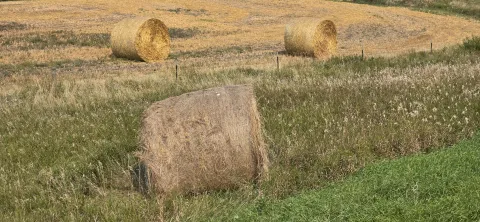
Early fall is a good time for cattle producers to evaluate forage supplies and develop a feeding plan for winter.
Understanding how much forage is available, what it costs and how much may be lost during feeding can help producers manage one of the largest expenses in cattle operations.
The first step is to conduct an inventory of hay, silage and other feeds available for winter. For harvested hay, bales should be grouped by lot, defined as similar species harvested from the same field within a 48-hour period.
Use a commercial scale to estimate bale weight by weighing several loads or multiple individual bales. Once the weight is known, determine the dry matter content because moisture affects weight but does not provide nutrients to the animal.
Dry matter can be determined using a Koster moisture tester, the microwave moisture testing method, any other electronic method or by submitting a sample to a commercial laboratory. If dry matter is unknown, an estimate of 85%-90% can be used for an initial hay inventory; however, laboratory analysis is recommended for ration balancing.
The second step is to estimate feed needs. Intake varies depending on forage quality, animal size, production stage, weather and supplementation. For initial planning, an estimate of 2.5% of body weight can be used to determine forage dry matter intake per animal per day.
For example, consider this herd:
175 mature cows × 1,350 pounds × 2.5% = 5,906 pounds of dry matter per day
8 bulls × 1,800 pounds × 2.5% = 360 pounds of dry matter per day
26 yearling heifers × 670 pounds × 2.5% = 436 pounds of dry matter per day
Total = 6,702 pounds of dry matter per day
If each bale weighs 1,400 pounds and contains 88% dry matter, each bale provides 1,232 pounds of dry matter. The herd would require approximately 5.5 bales per day (6,702 ÷ 1,232 = 5.44), or about 1,155 bales during a 210-day feeding period.
This estimate does not account for storage or feeding losses and assumes the entire diet is hay. Other feeds, crop residues, supplements or grazing would change the amount of hay required.
Having enough hay on paper does not mean all of it will be consumed. If forage is stored outside, dry matter losses could be as high as 20%, while losses may decrease to about 7% when stored inside.
Feeding losses also vary by feed quality and feeding system. When hay is fed in bunks, waste may range from 3% to 14%. If bales are rolled out on the ground, waste could reach 45%, particularly when cattle are provided multiple days of hay at one time. With free-choice access to large quantities of forage, intake also may increase beyond what is needed to meet requirements.
If conditions allow, daily feeding can help reduce waste. For example, if hay costs $100 per ton, reducing waste by 25% could save approximately $25 per ton. These savings may help offset the cost of investments in equipment such as feed bunks, bale processors or feed wagons.
Producers also should include an allowance for potential storage and feeding losses. Adding a 15% allowance to the example above would mean planning for approximately 173 additional bales, or 1,328 bales total.
When purchasing hay, price per ton or bale does not necessarily indicate the best value. Producers should consider bale weight, moisture content, nutrient concentration and transportation costs. A less expensive bale is not necessarily a less expensive source of nutrients.
These calculations can help identify a potential forage shortage, but actual feeding decisions should consider forage quality and cattle nutrient requirements. Laboratory forage analysis and a balanced ration are recommended when developing the winter feeding program.
Farmers and ranchers looking to buy or sell hay, corn and other feedstuffs can use NDSU’s FeedList to connect with other producers. The free service also includes pasture available for rent and information about available feeds.
In addition to NDSU’s FeedList, the North Dakota Department of Agriculture’s Hay Hotline and interactive map can help producers locate hay and feed for sale, pasture or hay land for rent, and hay transportation services across the state. The map is available at https://www.nd.gov/ndda.
Forage prices are likely to increase as the winter feeding period approaches. For assistance in completing a forage inventory, producers should contact their local NDSU Extension agent.
