

What does the USDA say about the cattle market?
Tim Petry, NDSU Extension Livestock Marketing Specialist | October 2026
When agricultural market news services discuss cattle prices, they say, “according to USDA…” or “USDA predicts…”. However, several USDA agencies publish crucial information about livestock production and marketing. Each agency has distinct responsibilities to provide different, unbiased information.
The USDA’s National Agricultural Statistics Service (NASS) provides important supply-related updates. Of major importance to the cattle industry are the semiannual cattle inventory reports published in January and July. Current and past reports are available at
https://usda.library.cornell.edu/concern/publications/h702q636h.
The January cattle report provides a more detailed state-by-state breakdown, which allows regional comparisons and weather-related changes to be documented. The July report only provides total U.S. cattle inventory numbers.
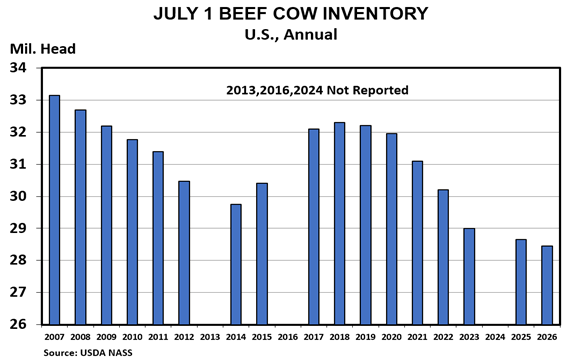
The latest cattle report released on July 24 reported the July 1 U.S. beef cow herd at 28.45 million head, down 1% from last year. That was the eighth straight year of liquidation from the 2018 cyclical peak of 32.3 million head. The 2026 U.S. calf crop at 32.5 million head, including both beef and dairy calves, is projected to decline 1.5% from just under 33 million head last year.
July 1 Beef Cow Inventory – U.S., Annual
Source: USDA NASS
NASS also publishes a monthly Cattle on Feed report, available at
https://usda.library.cornell.edu/concern/publications/m326m174z.
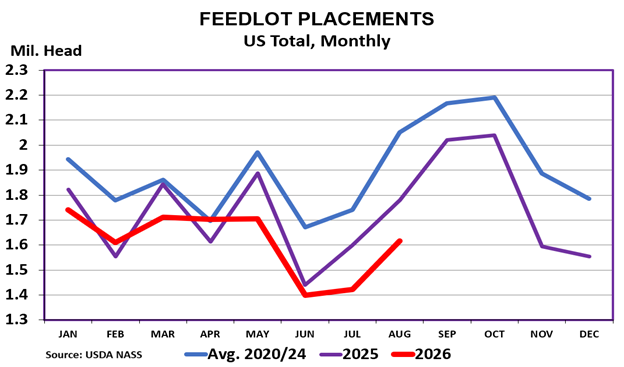
The Sept. 18 report showed cattle and calves on feed for the slaughter market on Sept. 1, up 1% from a year ago. August cattle placements on feed were down 9%, and cattle marketed were down 3%. Placements were the lowest for August since the series began in 1996. Despite lower cattle numbers, the increase in cattle on feed was due to slower feedlot turnover, with more days on feed, which contributed to higher carcass weights.
Feedlot Placements — U.S. Total, Monthly
Source: USDA NASS
The USDA’s Office of the Chief Economist publishes a monthly World Agricultural Supply and Demand Estimates (WASDE) report, available at www.usda.gov/oce/commodity/wasde.
The WASDE report provides annual forecasts for supply, use (including exports) and prices for major crops, oilseeds and livestock (including cattle and beef).
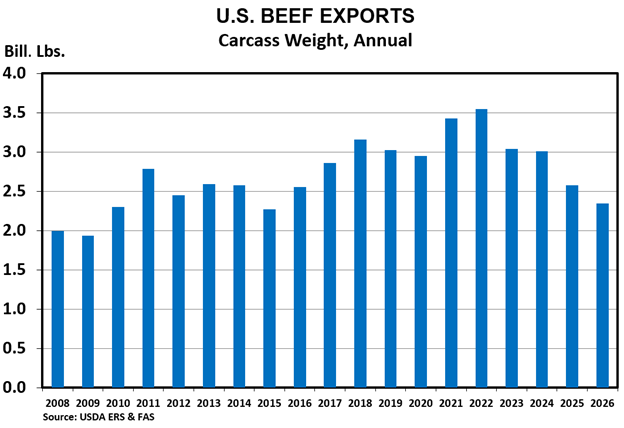
The September WASDE released on Sept. 11 forecast 2026 beef production at 24.95 billion pounds, down from 26.07 billion pounds last year. The 2027 beef production is forecast to decrease slightly to 24.9 billion pounds due to fewer fed cattle and cows slaughtered but was somewhat offset by higher carcass weights. The 2026 beef exports are projected at 2.34 billion pounds, down from 2.58 billion pounds in 2025.
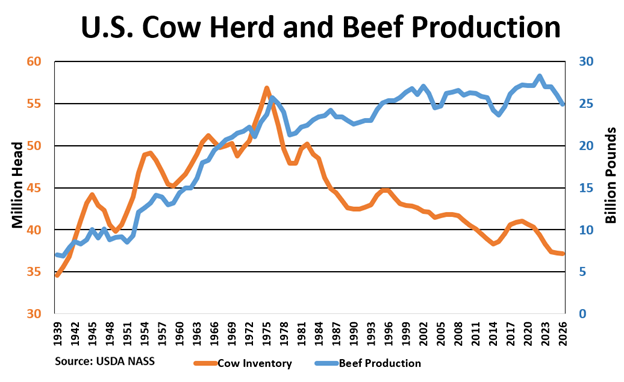
The U.S. cow herd is 37.27 million head – including both beef and dairy cows – and is below the last cyclical low of 38.3 million head in 2014. But beef production in 2026, at 24.95 billion pounds, is over a billion pounds higher than in 2015, when it was 23.76 billion pounds. That shows the resiliency of the U.S. cattle industry in producing beef.
U.S. Cow Herd and Beef Production
Source: USDA NASS
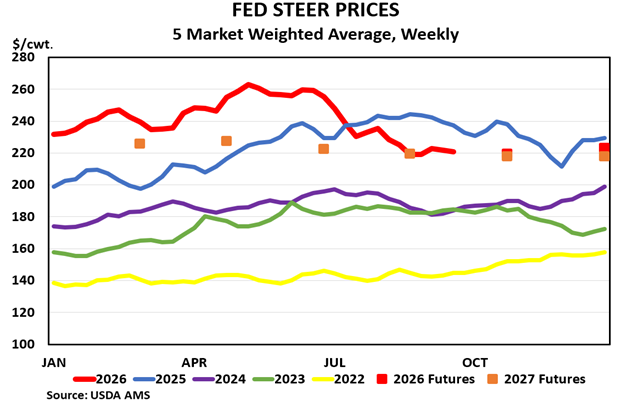
The 2026 annual fed steer prices are projected at a record $237.35/cwt., up from last year’s $224.37. The 2027 fed steer prices are forecast to increase slightly to $238/cwt.
Fed Steer Prices — 5 Market Weighted Average, Weekly
Source: USDA AMS
The USDA’s Economic Research Service (ERS) publishes a monthly Livestock, Dairy, and Poultry Outlook publication, available at https://www.ers.usda.gov/publications/115136.
The report provides in-depth analyses of fundamental supply-and-demand factors affecting the U.S. and international markets for beef, pork, lamb, poultry and dairy products. Fed steer, feeder cattle and cow prices are analyzed in detail.
The USDA’s Foreign Agriculture Service (FAS) publishes a quarterly (January, April, July, October) Livestock and Poultry: World Markets and Trade circular, available at https://www.fas.usda.gov/report-release-announcement/livestock-and-poultry-world-markets-and-trade-18.
The circular analyzes the current situation among the major players in the world beef, pork and chicken trade. Top country summaries for beef production, consumption, exports and imports are shown. The U.S. is the world's leading producer and consumer of beef and the third-largest exporter, behind only Brazil and Australia.
ERS and FAS jointly publish monthly U.S. livestock and meat trade data by country, available at www.ers.usda.gov/data-products/livestock-and-meat-international-trade-data.
The data confirm that 2026 beef exports are declining and imports are increasing due to shorter beef supplies and record-high prices.
U.S. Beef Exports — Carcass Weight, Annual
Source: USDA ERS and FAS
The USDA’s Agricultural Marketing Service publishes weekly U.S. livestock auction market reports. North Dakota market reports are available for Kist Livestock Auction in Mandan, North Dakota; Napoleon Livestock in Napoleon, North Dakota; Stockmen’s Livestock Exchange in Dickinson, North Dakota; and a combined North Dakota auction summary, available at www.ams.usda.gov/market-news/feeder-and-replacement-cattle-auctions#North%20Dakota.
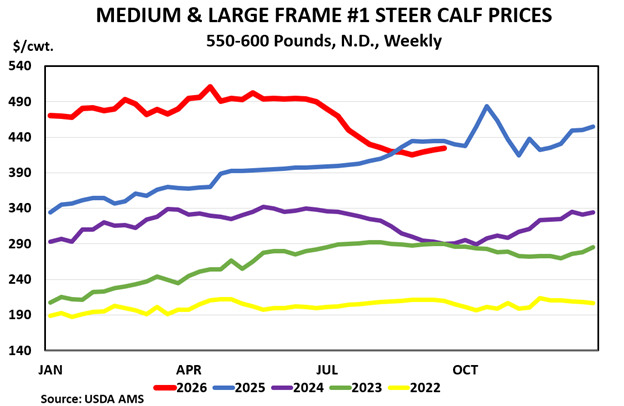
Current calf and feeder cattle prices in North Dakota are down seasonally from spring highs but near last year’s record-high levels.
Medium and Large Frame #1 Steer Calf Prices — 550-600 Pounds, N.D., Weekly
Source: USDA AMS
The USDA’s Risk Management Agency publishes Livestock Risk Protection (LRP) coverage prices, rates and ending values at www.rma.usda.gov/tools-reports/livestock-reports-lrp-lgm.
LRP insurance is a valuable price risk management tool when prices are volatile and uncertainty exists due to the many supply-and-demand factors affecting the cattle market.
So, what does the USDA say? The cyclical decline in beef cow herd and calf crops has supported cattle prices at record-high levels. But many dynamic, fundamental supply-and-demand factors are causing enough uncertainty to make cattle futures and cash markets volatile.
