

Understanding the U.S.-China Trade Agreements
Frayne Olson, NDSU Extension Crop Economist/Marketing Specialist | October 2026
U.S. President Donald Trump and President Xi Jinping of China met in Washington on Sept. 23-25, 2026. There were rumors that U.S. and Chinese negotiators would announce additional agricultural trade commitments as a result of the meeting. While progress was made in U.S.-China trade relations, no new agreements on agricultural trade were announced.
The most significant trade-related announcement operationalized the U.S.-China Board of Trade, which was initially established during President Trump’s visit to Beijing in May 2026. The overall mission of the Board of Trade is to “optimize bilateral trade” between the two countries. The Board’s first major task is to reach agreement on import tariff reductions for $60 billion of nonsensitive goods traded between the two countries.
The $60 billion in goods is divided equally between the U.S. and China, with $30 billion in goods imported by each country. The U.S. tariff reductions target small appliances, toys, holiday decorations and children’s car seats. The Chinese tariff reductions focus on agricultural goods such as fish, seafood, logs and wood products, cosmetics and medical devices. However, the additional 10% Chinese import tariff on U.S. soybeans was not reduced and remains in place.
Each country provided an initial list of products targeted for tariff reductions. A summary of the Chinese list of U.S. agricultural products is provided in Table 1.
Table 1 – Summary of U.S. Agricultural Products Targeted for Chinese Tariff Reductions
| Corn | Sunflower | Fruits |
| Sorghum | Rapeseed (Canola) | Nuts |
| Wheat | Vegetable Oils and Meals | Sugar |
| Barley | Pulses | Spices |
| Rice | Meats (beef, pork, poultry) | Pasta |
| Oats | Dairy products | Tobacco |
| Potatoes | Eggs | Distilled Spirits |
| Cotton | Fish | Other Products |
Sept. 27, 2026 U.S.-China Board of Trade White House Fact Sheet
Even though the most recent U.S.-China trade negotiations did not result in additional Chinese commitments, previous agreements targeting agricultural products are supporting crop markets. The October 2025 summit in Busan, South Korea, resulted in a commitment from China to purchase at least 25 million metric tons of U.S. soybeans during the 2026-2028 calendar years.
The U.S.-China summit in Beijing, China, in late May 2026 included an additional commitment for China to purchase at least $17 billion of U.S. agricultural products in calendar years 2026-2028. This additional purchase commitment excludes soybeans and is prorated for calendar year 2026.
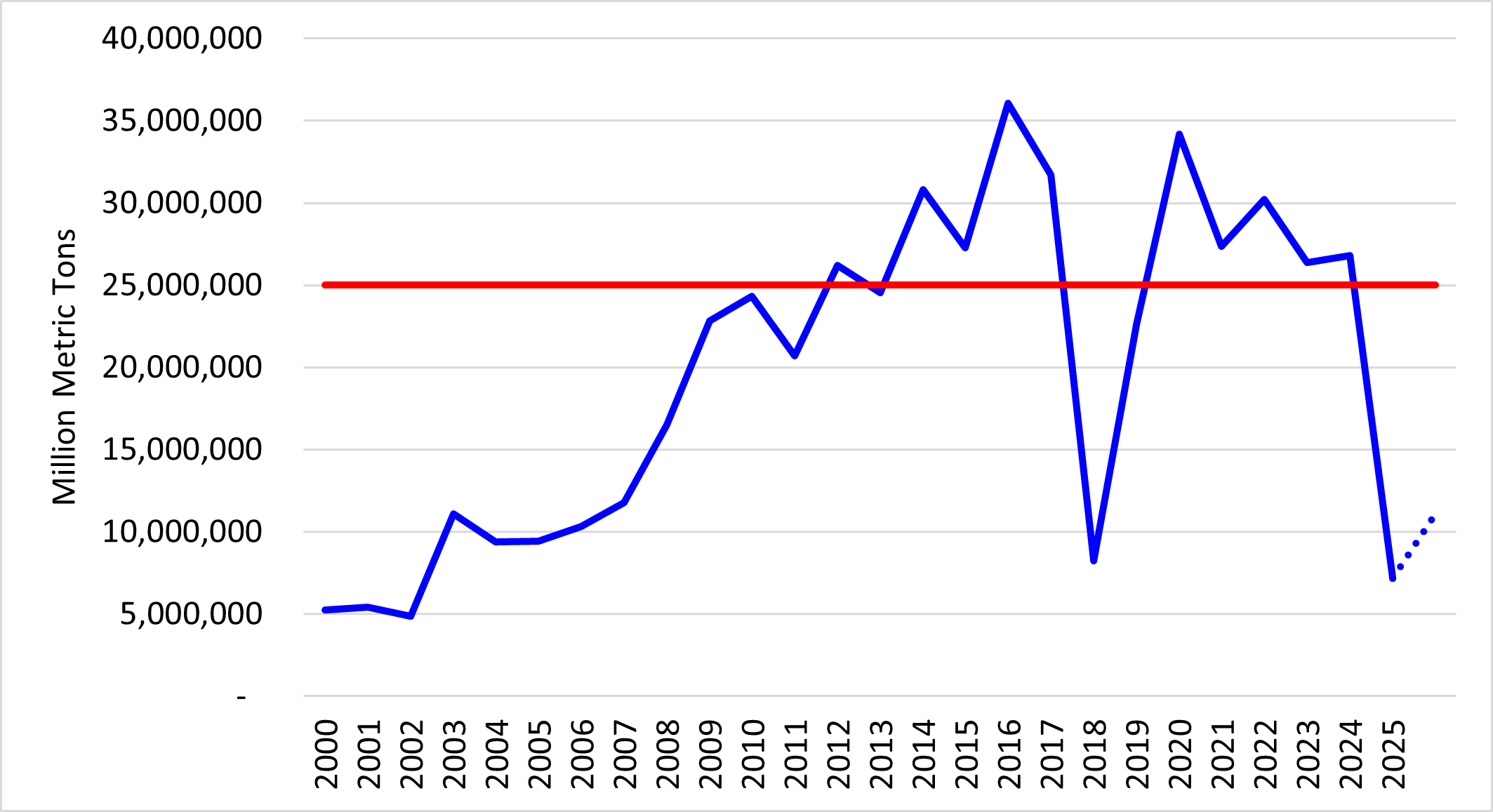
Understanding the significance of these agreements can be difficult without some historical context. Figure 1 shows the historical Chinese soybean purchases per calendar year in million metric tons from the U.S.
Figure 1 – Historical Chinese Soybean Purchases from the United States
U.S. Department of Agriculture Foreign Agriculture Services Global Agricultural Trade System
The blue line in Figure 1 shows U.S. soybean export sales to China by calendar year. The dashed line on the right-hand side is soybean export sales from January through July 2026. The red line represents the 25 million metric ton export target outlined in the agreement. The low export sales volumes in 2018 and 2025 represent the impact of previous U.S.-China trade disputes.
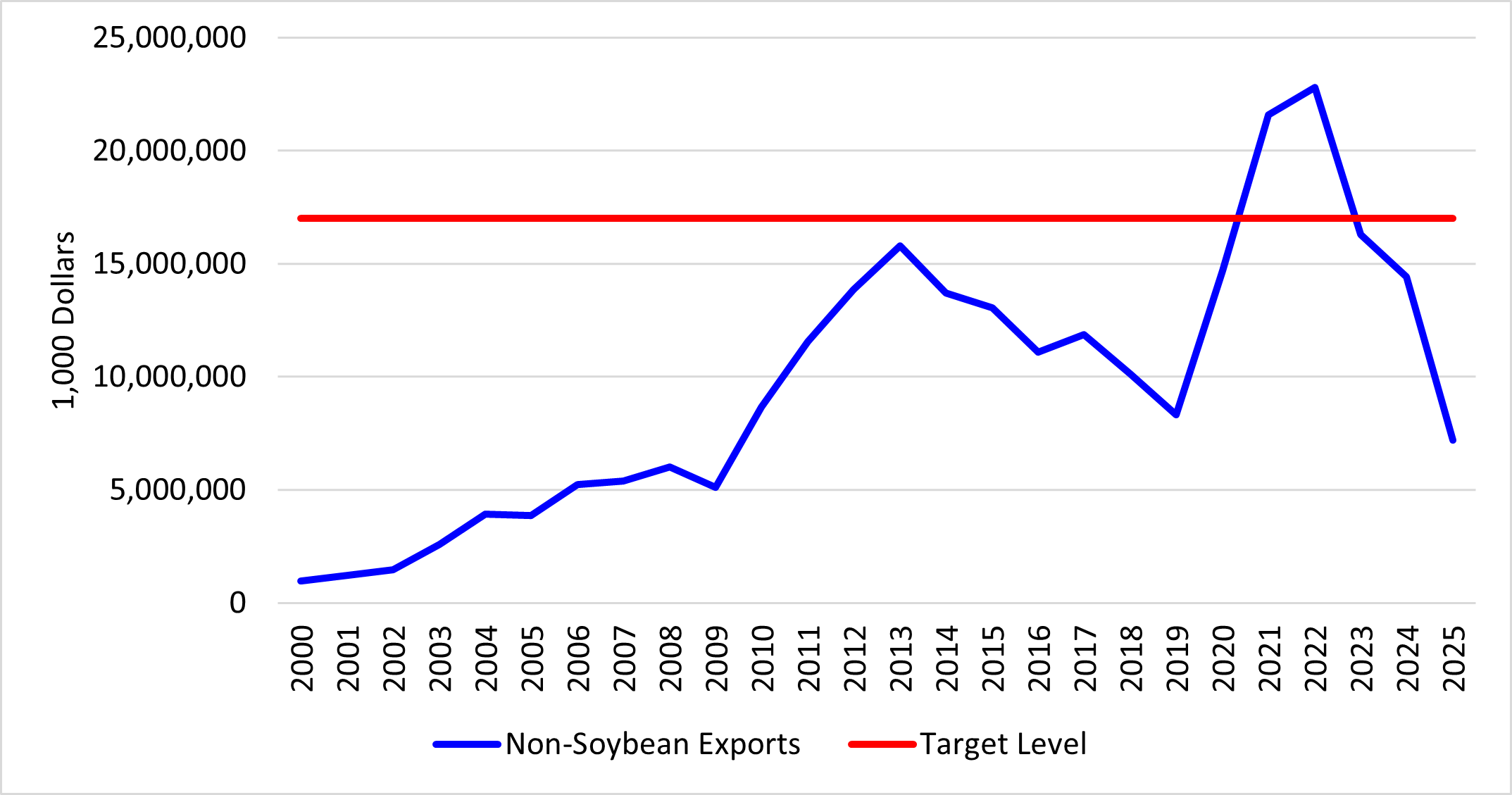
Figure 2 shows the historical value of Chinese agricultural product purchases from the U.S., excluding soybeans. The blue line shows the historical value of U.S. agricultural exports to China, and the red line is the $17 billion target. It is still unclear which specific agricultural products are included in the $17 billion target. The blue line includes the value of bulk grains, fruits, nuts, vegetables, meat products and hides, dairy products and seafoods. It does not include soybeans (which were specifically excluded in the agreement), wood products and biofuels, such as ethanol and biobased diesel.
Figure 2 – Historical Chinese Imports of U.S. Agricultural Products, Excluding Soybeans
U.S. Department of Agriculture Foreign Agriculture Services Global Agricultural Trade System
The only previous time period when the value of Chinese imports exceeded the $17 billion target was during 2021 and 2022. This was due to the terms of the Phase One agreement negotiated at the end of the first trade dispute with China.
The combined impact of the two trade agreements has the potential to notably impact U.S. crop prices. However, the impacts on specific crops will heavily depend on the timing and amount of Chinese purchases.
The goal of an international buyer is typically to purchase U.S. ag products at the lowest price possible and within a specific time window. This means that Chinese buyers will likely buy specific U.S. ag products that provide them the most value. The most likely time period of purchases would be during harvest, when prices are typically lower. The products most likely chosen would be those with the largest available supplies. This buying strategy may not result in the price rallies that many farm managers are looking for, but it should provide price support through the winter marketing season.
