

Retain topsoil by skipping fall tillage
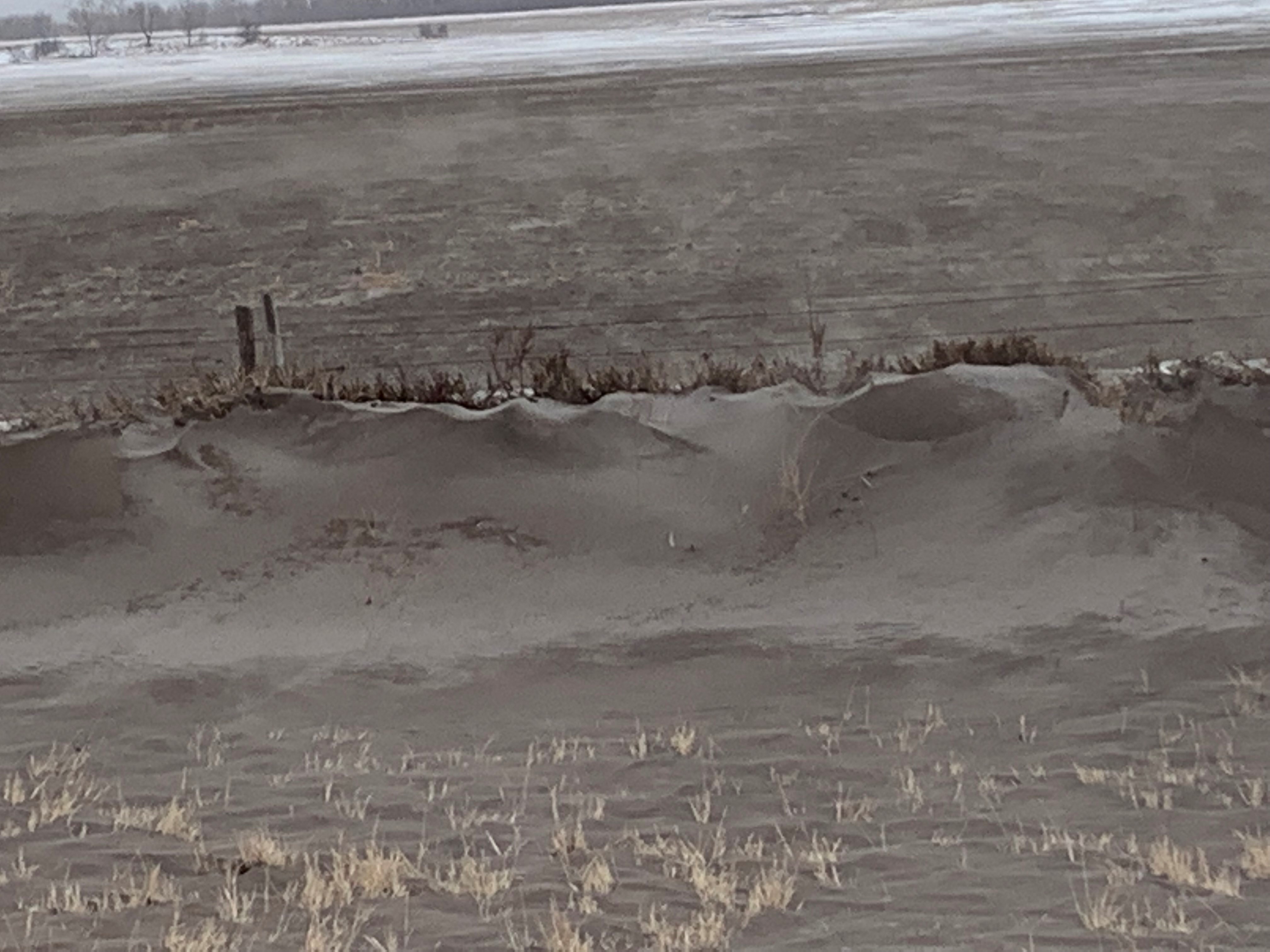
Retain topsoil by skipping fall tillage
Topsoil is the most fertile layer of soil, rich in microbial activity and essential for crop production. When it erodes, thousands of dollars’ worth of nutrients and organic matter erode with it.
Much wind-related soil erosion happens in the winter – not just the planting, growing or harvest season – and is a direct result of fall tillage.
Tillage loosens soil that would otherwise be held together by crop roots and fall volunteer crop growth, even if no cover crop is planted.
Leave crop stubble as high as possible for all crops, and spread crop residue evenly across the field during harvest if not tilling in the fall.
Leaving the crop stubble high will help capture snowfall, reduce or eliminate wind soil erosion, and dry out the soil in the spring. By not conducting fall tillage, crop residue is more likely to remain in the field, allowing residue decomposition and nutrient cycling to continue rather than blowing away.
Topsoil blowing from fall-tilled fields either blows far away or gets deposited into the ditches or shelter belts next to the fields. Winter-blown soil blackens fields and roadside ditches, whereas nontilled fields and nearby ditches remain white.
If a living cover crop is left in the field in the fall, plants can remove water from the soil and help dry it out for spring planting.
Avoiding fall tillage and performing spring tillage as needed may not be a perfect system from a soil health perspective, but it would be a step in the right direction to minimize topsoil blowing in the winter.
Nutrient cost of losing topsoil
NDSU research in 2025 determined that topsoil loss in the winter of 2024-2025 resulted in nutrient losses costing $6,682.95 per acre to replace only five of the 10 nutrients lost (based on 2025 prices applying commercial fertilizer for a 0-6-inch-deep soil sample per acre), whereas nutrient loss through every inch of topsoil per acre costs $1,113.81 to replace.
Based on this information, farmers are better off not tilling the soil after harvest and letting the volunteer crop plants thrive.
Crop stubble will hold the topsoil together and capture more snow, improving soil moisture availability for the next year’s crops. Volunteer crop growth will add organic material to the soils.
Weed control
If not conducting fall tillage, farmers will need to apply herbicides to control winter annual weeds, such as horseweed (marestail), and perennial weeds, such as foxtail barley and Canada thistle.
There is no type of fall tillage to control foxtail barley. Only a glyphosate application at 1.5 pounds acid equivalent per acre this fall will provide the most effective foxtail barley control.
If herbicide-resistant horseweed is present in a field as small seedlings, apply 2,4-D ester at a rate of at least 0.75 pounds acid equivalent per acre.
If residual herbicides are applied in the fall to control summer annual weeds for the next growing season, depending on the herbicide applied, spring tillage will reduce the herbicide effectiveness in the spring. Fall-applied residual herbicides should not be applied until the soil temperature stays below 50 degrees Fahrenheit. If spring tillage is conducted, only a field cultivator will control winter annuals and emerged summer annual weeds; straight vertical tillage will not.
For more NDSU Extension information about soil health, visit ndsu.ag/soil-health-26.
