H-2A trends and wages in North Dakota
Katelyn Duchscher, NDSU Department of Agribusiness and Applied Economics graduate student, and Matthew Gammans, NDSU Department of Agribusiness and Applied Economics assistant professor | November 2026
In October 2025, the United States Department of Labor altered the minimum wage calculation for H-2A positions. Previously, minimum wages were based on the now-discontinued United States Department of Agriculture Farm Labor Survey. The new minimum wage rule will be based on data from the Bureau of Labor Statistics Occupational Employment and Wage Statistics survey. The new policy will introduce a tiered minimum wage, with the level based on experience and job requirements, as well as whether the employer provides free housing. This change in the H-2A minimum wage is estimated to transfer $2.46 billion from H-2A workers to H-2A employers each year (U.S. Department of Labor, Employment and Training Administration [DOL], 2025).
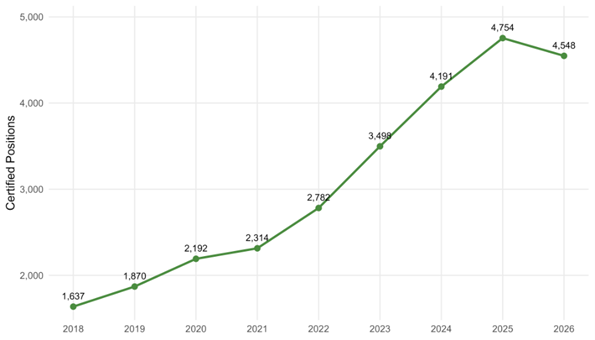
In North Dakota, the H-2A program is an integral part of farming operations and agricultural service provision. Using historical disclosure data from H-2A employer applications, we analyzed the H-2A program in North Dakota prior to the new wage adjustment. In 2020, 2,192 H-2A positions were certified in the state. In 2025, this number more than doubled, as 4,754 positions received certifications. (U.S. Department of Labor, Office of Foreign Labor Certification [OFLC], 2026). The 2026 observation includes only half of the fiscal year.
Certified H-2A Positions in North Dakota, 2018-2026
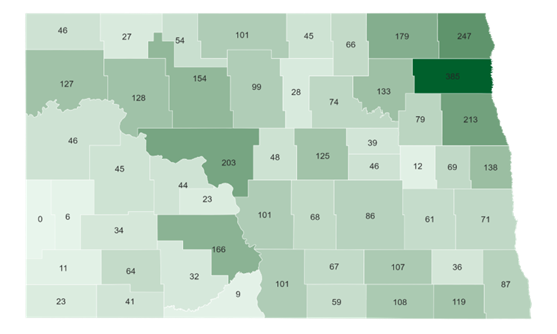
Positions certified in the H-2A program are spread across the state in 52 of North Dakota’s 53 counties. The county with the largest number of H-2A positions certified is Walsh County. The number of H-2A positions per county is measured by worksite location, not necessarily employer location. (OFLC, 2026).
Certified H-2A Position Count per County in North Dakota, 2025
The new minimum wages depend on whether a job is classified as Skill Level I or Skill Level II. Employers seeking H-2A workers first fill out Form ETA-790A. On it, they outline the job’s duties, requirements and a proposed wage, set at or above the floor for the skill level they believe their job requires. The DOL then reviews the submitted forms and assigns the job a Standard Occupational Classification (SOC) code based on those duties and requirements, which determines whether it falls under Skill Level I or II, and certifies the offered wage meets the applicable rate.
The DOL defines Skill Level I as “entry-level positions where workers need no formal education or specialized training credentials…” (DOL, 2025, p. 47932). Skill Level II, by contrast, covers workers who “possess, either through education, training, or experience, demonstrated skills or knowledge to perform the work…” (DOL, 2025, p. 47932).
The graphic below describes the wages offered by employers that have been certified, as compiled in the DOL’s H-2A disclosure data (OFLC, 2026) from Form ETA-790A. Using data from the first half of FY2026, combined with the skill-level and ACA rates in the DOL set, we find that over half of certified positions were offered the Skill Level II wage.
FY2026 Q1 and Q2 Offered Wages for Certified Positions
Each dot represents a position certified.
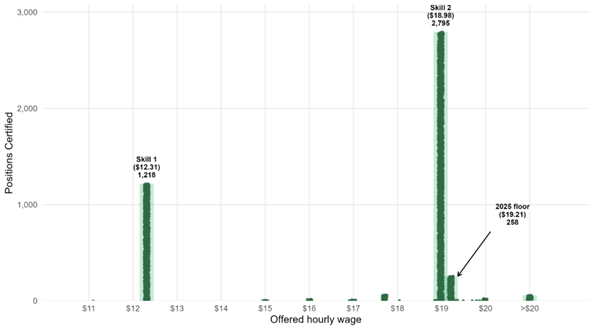
- 1,218 certified positions were offered at the Skill Level 1 wage.
- 2,795 certified positions were offered at the Skill Level 2 wage.
- 258 certified positions fell at the 2025 wage floor. This was the wage floor for most of North Dakota’s H-2A workers in 2025. The 2025 wage floor was $19.21.
The figure above reflects proposed wages offered and certified in the application process, not necessarily the wage ultimately paid. It also only depicts the amount and skill level of the H-2A workers requested, not necessarily the true number present in the state. As discussed above, job requirements and duties are outlined by the employer in Form ETA-790A, and the DOL Office of Foreign Labor Certification determines if the proposed wage reflects the skill level required. This is an important caveat, as it indicates that accurate job descriptions and duties are an important part of the H-2A process.
In North Dakota, the Skill Level 1 wage for the period analyzed is $12.31. The Skill Level 2 wage is $18.98. The ACA adjustment is -$1.27. These wages and ACA adjustments are set each year by the Department of Labor. (DOL, 2025, p. 47926). The ACA adjustment is the downward wage adjustment an employer may take if the employer provides housing.
An analysis conducted in Michigan showed that 73.6% of its H-2A employees were at Skill Level 1, and 10.1% were at Skill Level 2. (Rutledge & Zhu, 2026). In contrast, North Dakota’s Skill Level 1 employees only make up about 27% of H-2A employment, while Skill Level 2 employees make up 61.9%. One likely driver is the difference in the states’ crop mix. North Dakota’s row-crop and livestock production depends on experienced equipment operators, whereas Michigan’s specialty, hand-harvested crops rely largely on entry-level labor.
One of the motivations for this change in wage calculations was to transfer cost savings to H-2A employers. In its original regulatory impact analysis, the DOL assumed that 92% of H-2A positions would be paid at the Skill Level I wage. (DOL, 2025, p. 47955). In North Dakota, moving from the 2025 AEWR of $19.21 to the new Skill Level I wage of $12.31 represents a reduction of $6.90 per hour per worker. However, because many of the state’s positions were offered the Skill Level II wage of $18.98, the actual reduction for roughly 62% of North Dakota positions is only about $0.23 per hour per employee.
Even with advancements in technology, agriculture remains a labor-intensive industry. As producers and agriculture service providers face labor shortages, H-2A employees have become a way to bridge the gap. While these employees help drive profitability, their wages are a cost to the operation. Allowing producers greater flexibility in wages through these wage adjustments may help reduce costs. However, as seen above, North Dakota remains heavily reliant on high-skilled H-2A employees; these employees did not see significant wage adjustments. Therefore, these wage adjustments offer limited cost relief in states such as North Dakota, where high-skilled labor is required, and wages remain relatively fixed.
Recent court rulings have raised questions about the durability of these new minimum wage levels. In August 2026, a federal district court in United Farm Workers v. U.S. Department of Labor found elements of the interim final rule arbitrary and capricious, then ordered DOL to produce a new AEWR methodology. The current AEWRs remain in effect until new rates are published. On Sept. 2, 2026, DOL issued a court-ordered notice that employers may owe back wage adjustments for work performed between the notice date and publication of the new AEWRs, while emphasizing that no such obligation currently exists. North Dakota's exposure is likely more muted than elsewhere, as over 60% of certified positions already offered near the old wage floor.
References
Cornell Agricultural Workforce Development. (2025, October 10). Major H-2A wage changes: Overview of new AEWR methodology. Cornell University, College of Agriculture and Life Sciences. https://agworkforce.cals.cornell.edu/2025/10/10/major-h-2a-wage-changes-overview-of-new-aewr-methodology/
Rutledge, Z., & Zhu, J. (2026, June 16). Michigan’s H-2A wage offers in first half of Fiscal Year 2026. Michigan State University Extension. https://www.canr.msu.edu/news/michigan-s-h-2a-wage-offers-in-first-half-of-fiscal-year-2026
U.S. Department of Labor, Employment and Training Administration. (2025). Adverse effect wage rate methodology for the temporary employment of H-2A nonimmigrants in non-range occupations in the United States (RIN 1205-AC24). Federal Register, 90(190), 47914–47963. https://www.federalregister.gov/documents/2025/10/02/2025-19365/adverse-effect-wage-rate-methodology-for-the-temporary-employment-of-h-2a-nonimmigrants-in-non-range
U.S. Department of Labor, Office of Foreign Labor Certification. (2026). OFLC performance data [Data set]. Employment and Training Administration. https://www.dol.gov/agencies/eta/foreign-labor/performance