What’s the difference between 2025 and 2026 fall calf markets?
Tim Petry, NDSU Extension livestock marketing specialist | November 2026
What’s the difference between 2025 and 2026 fall calf markets? There are similarities but also differences.
Fall North Dakota 550-600-pound steer calf prices have been similar this year compared to last year. The latest 2026 weekly average price reported by the USDA Agricultural Marketing Service is $442 per hundredweight (cwt) compared to a temporarily elevated $463/cwt. in 2025.
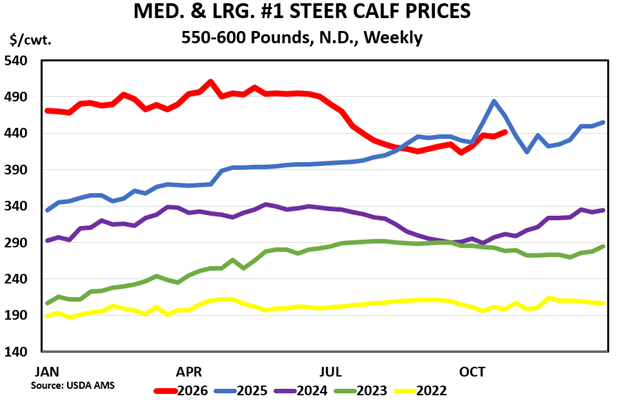
Keep in mind that there is a wide range in prices for the same weight and grade of calves at the same market due to the many market factors that also determine value. The latest USDA North Dakota auction summary for 550-600-pound steers shows a $50/cwt. price range from $409/cwt. to $459/cwt.
Even though fall steer calf prices are similar, the paths to them are different.
In 2025, prices increased throughout the year, reaching a counterseasonal high point. However, in 2026, prices increased as they usually do in the first half of the year, but have since declined in a more typical seasonal pattern. That may have led to the impression that prices are lower than the record highs at this time last year.
The three most important factors that affect fall calf prices are potential calf supplies, corn prices and fed cattle prices, especially the distant live cattle futures prices for contract months when the calves will ultimately reach slaughter weight.
2025 fall calf prices were supported at record-high and seasonally high levels by record-high fed cattle prices, a smaller calf crop, increased replacement heifer retention, the Mexican border closed to cattle imports due to New World screwworm detected in Mexico, very good winter wheat grazing conditions, increased Canadian demand for calves and lower corn prices stimulating Corn Belt feedlot demand.
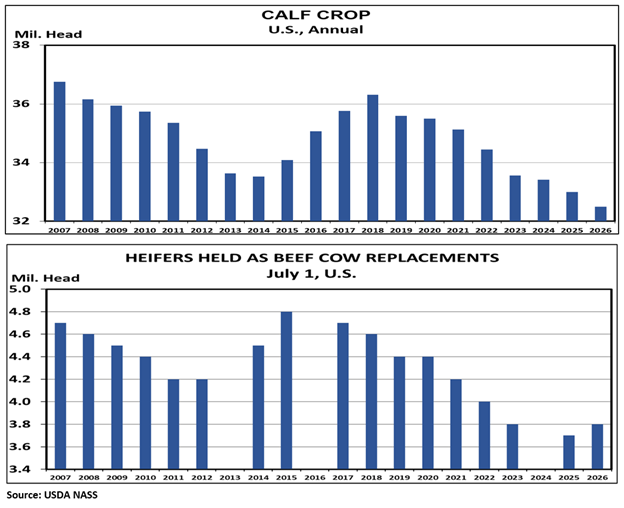
The 2025 U.S. calf crop, at 33 million head, was down about 2%, while Jan. 1, 2026, beef heifers held for replacement totaled 4.7 million head, up 1%.
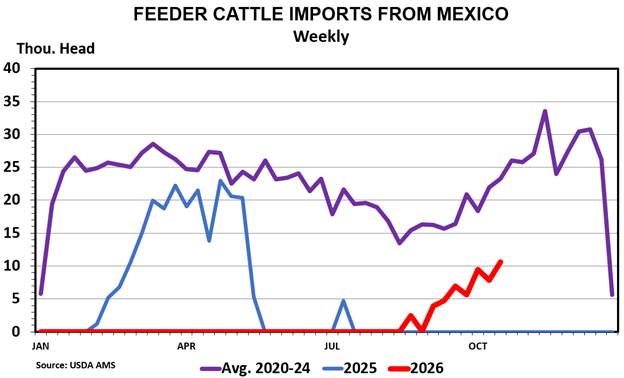
Historically, fall Mexican feeder cattle imports were 80,000-100,000 head per month, with many grazing southern Great Plains wheat pastures. But none were imported in the fall of 2025.
Fall 2025 winter wheat grazing conditions in the southern Great Plains were the best in several years.
A very good 2025 feed barley crop in the western Canadian cattle feeding area, and declining Canadian calf crops resulted in more North Dakota and Montana calves purchased by Canadian feedlots. In October alone, 126,000 calves went to Canada compared to about 45,000 in previous years.
The 2025 record-high U.S. corn crop, at just under 17 billion bushels, was up 2 billion bushels from 2024, which pressured corn prices. So, Corn Belt feedlots were also active buyers for the lower supply of calves.
The reason last year’s factors are significant is that they are watch factors for the 2026 calf marketing season.
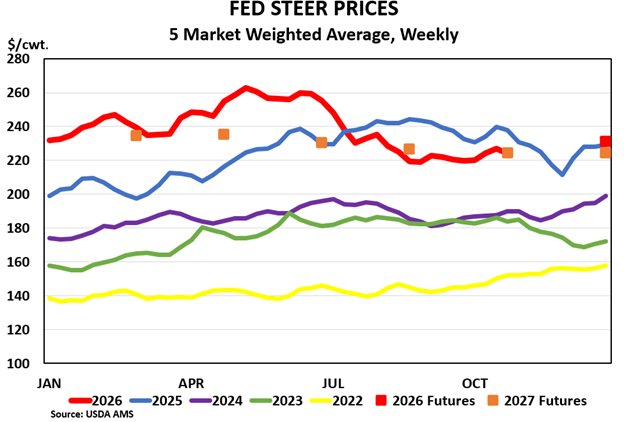
What do we know now? Fed cattle prices, at $224/cwt., are about $7/cwt. below last year’s $231/cwt., and the 2027 live cattle futures prices range from $230/cwt in February to $220 in December.
The 2026 U.S. calf crop is projected at 32.5 million head, down 1.5% from 2025, and the July 1 beef replacement heifer inventory at 3.8 million head was up 2.7%. So, there will be fewer calves to market this fall, which is supportive to prices.
The phased reopening of the Mexican border for importing Mexican cattle into the U.S. started on Aug. 24 at Douglas, Arizona; on Sep. 24 at Santa Teresa, New Mexico; on Oct. 26 at Columbus, New Mexico; and is scheduled to open on Nov. 30 at Nogales, Arizona. The number of Mexican calves entering the U.S. has been slow but is expected to ramp up. Historically, about 25,000 head per week are imported in the fall.
Good calf demand from Canada is expected again this year.
USDA is projecting a 2026 corn crop of just over 16 billion bushels, compared to just under 17 billion bushels in 2025. But it is still the second largest crop ever. USDA predicts an average farm price for this year’s crop at $4.70 per bushel (bu.) compared to $4.16/bu. last year. However, corn harvest is still progressing, and the final size of the crop is still in question.
Southern Great Plains winter wheat conditions have been poor due to drought, and seeding has been behind schedule. Recent rains and forecasts of continued precipitation are improving prospects, helping spark the calf market.
It is too late for price risk protection for fall calves, but backgrounding programs may consider it.
Many dynamic factors are causing enough uncertainty to make cattle futures and cash markets volatile.